Traditional A/B testing is a method used to compare two versions of a digital experience, such as a landing page, headline, or call-to-action, to find out which one performs better.
However, traditional A/B testing often struggles in fast-moving digital environments. It depends heavily on human intuition, manual setup, and slow feedback cycles, making it hard to keep up with rapidly shifting user expectations.
With the rise of AI-powered platforms, this process is undergoing significant evolution. Teams can now automate testing, personalize experiences in real time, and uncover deeper insights. Whether you’re applying AI for UX design, conducting AI for UX research, or streamlining feedback with AI for user testing, intelligent experimentation helps you move faster and make better decisions.
In this guide, we’ll unpack the concept of AI-driven A/B testing, explore its business benefits, and offer a step-by-step tutorial on how to integrate it into your workflow effectively. Whether you’re a product manager, marketer, or designer, this practical breakdown will help you unlock the full potential of intelligent experimentation.
AI-driven A/B testing is an enhanced version of traditional A/B testing that uses machine learning and automation to optimize digital experiences more quickly and accurately. Unlike manual methods, where you define two static versions (A and B) and wait for results, AI systems continuously analyze real-time user data to dynamically adjust variables, such as headlines, layouts, or CTAs, using techniques like multi-armed bandits and predictive analytics.
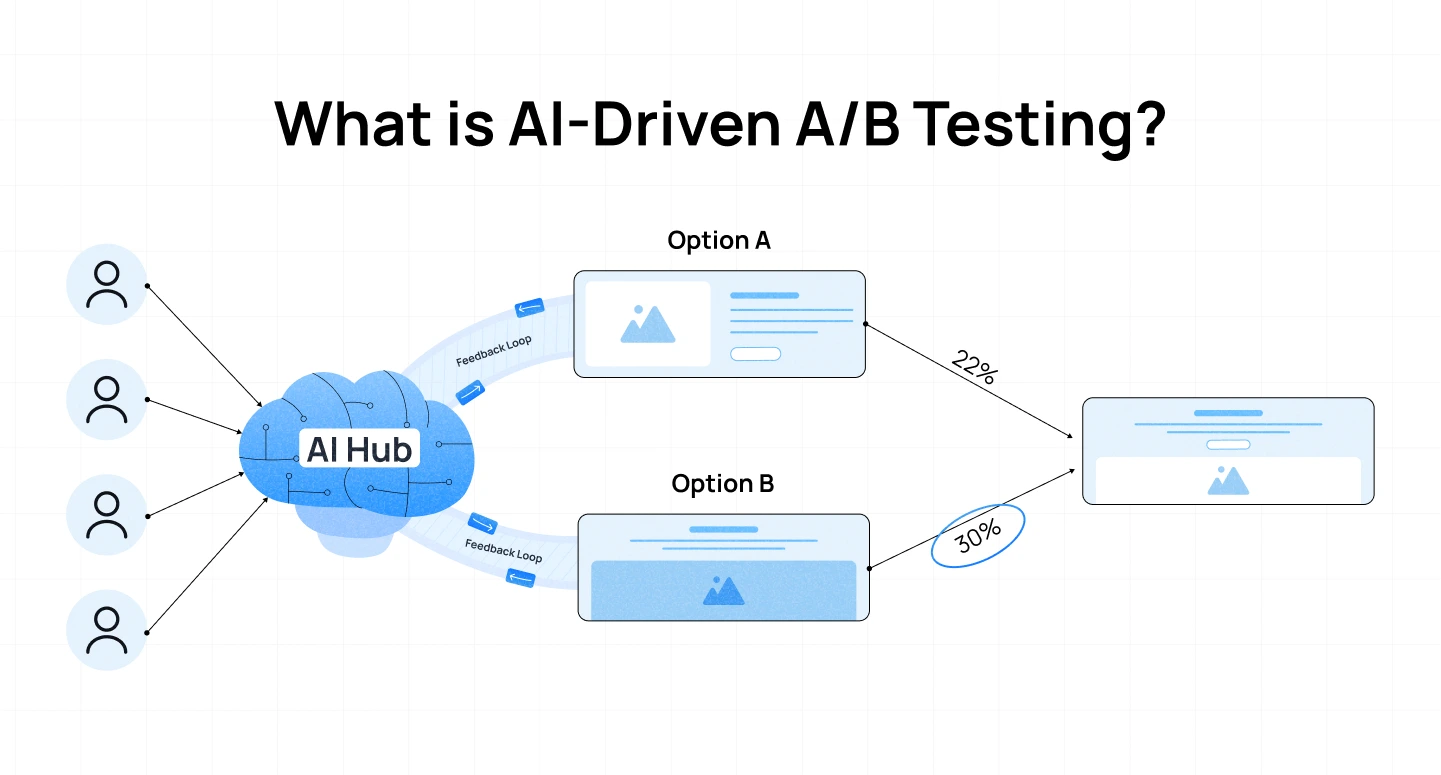
Once the test is live, it monitors performance in real time and shifts more traffic to the version that performs better, optimizing the results as the experiment runs. This is made possible by AI-powered systems built on large language models (LLMs), advanced technologies trained to understand and generate human-like content. With these capabilities, AI-driven A/B testing helps teams learn faster, act sooner, and deliver more relevant experiences.
Here’s how the two approaches compare:
AI brings a wide range of powerful advantages to experimentation, transforming it from a linear, manual task into a dynamic, intelligent engine for business growth. Here are 5 key ways this transformation delivers measurable value to your business.
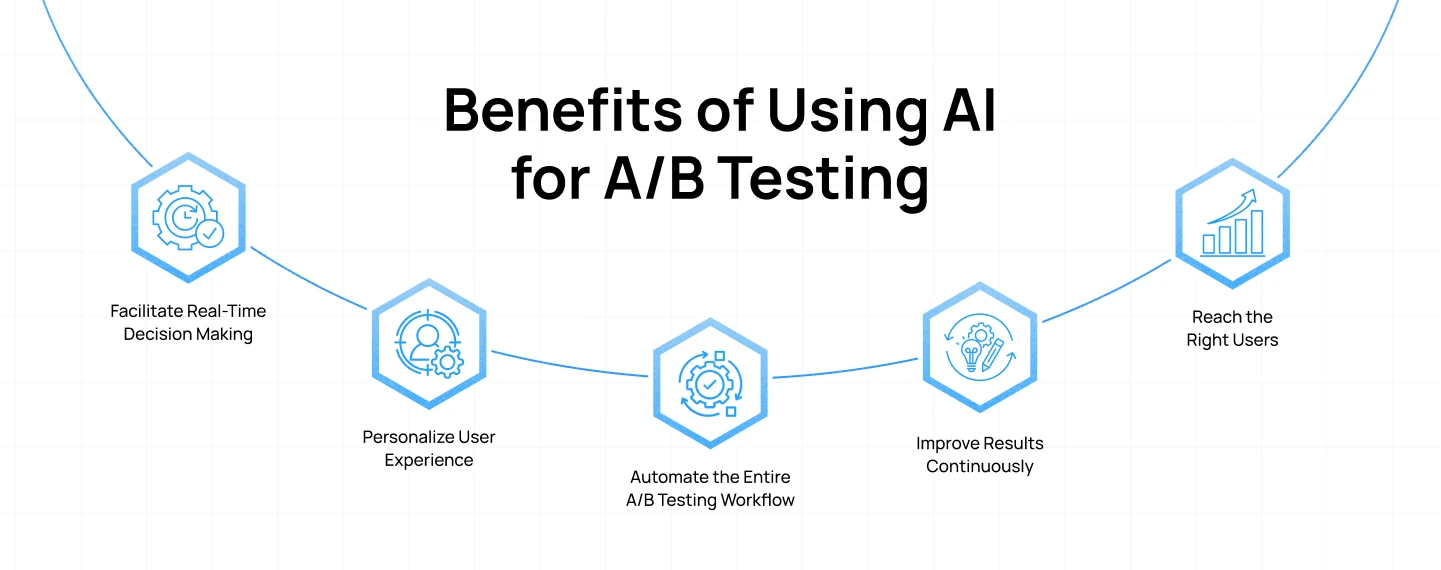
Traditional A/B testing can take weeks or even months to gather statistically significant results. In contrast, AI enables continuous data processing, allowing businesses to make changes and improvements on the fly. Algorithms analyze user interactions in real time and adapt experiences accordingly.
This speed empowers teams to respond to shifts in user behavior and market trends without delay, maximizing the impact of every experiment.
AI-driven A/B testing makes it possible to test and deliver personalized content at scale. Instead of showing all users the same version, AI personalization adapts each test variation to individual preferences and behavior.
In particular, machine learning analyzes device type, browsing history, location, and context in real time to tailor each experience. This transforms static tests into dynamic journeys, boosting relevance, satisfaction, and conversion rates.
AI A/B Testing tools handle everything from setting up experiments to evaluating results. Behind the scenes, intelligent agents continuously monitor performance, adjust traffic allocation, and suggest or even implement winning variants. This end-to-end automation reduces reliance on manual setup and ensures faster time-to-value for experiments.
Automation also lowers the barrier to entry for non-technical teams, making experimentation more accessible and efficient across the organization.
Note: In A/B testing, a variant refers to one of the different versions being tested, such as a new headline, layout, call-to-action (CTA), or any other element you want to compare.
Unlike static tests that end after a single cycle, AI models continually refine themselves. Using reinforcement learning techniques, they adapt to new patterns, external factors, and changing audience behavior over time. This creates a continuous loop of optimization, ensuring your experiments don’t just end with a winner but evolve into ongoing enhancements.
AI uses predictive models to forecast user behavior, such as the likelihood of clicking, converting, or churning, before it occurs. Behavioral segmentation then groups users based on real-time actions like scroll depth, time on site, or navigation paths.
Together, these tools allow AI to deliver the most relevant version of your test to each user segment. This targeted approach boosts engagement, improves conversion rates, and increases the overall return on investment.
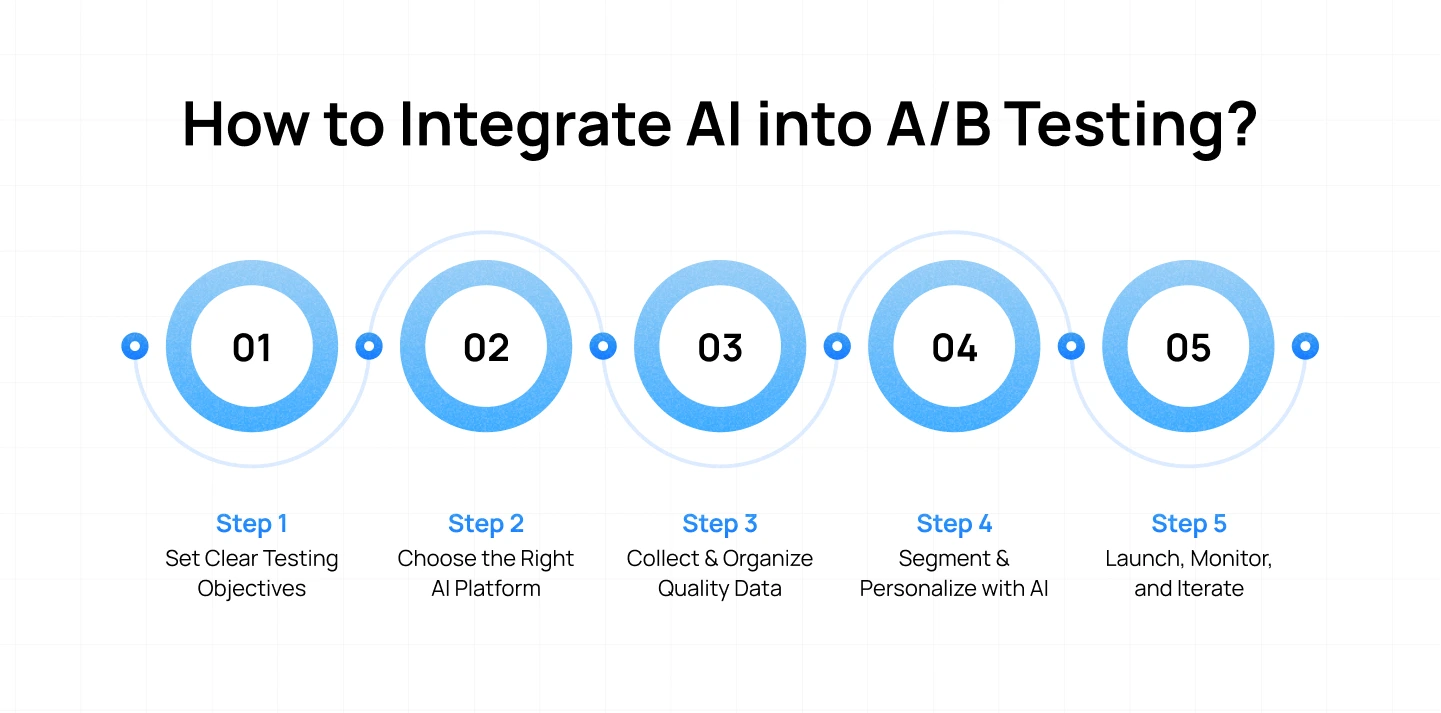
AI A/B testing can seem daunting, but breaking it into strategic, practical phases makes implementation more manageable and impactful. Below is a refined step-by-step approach to integrating AI into your experimentation process:
The first step in AI experimentation is defining exactly what you want to achieve through A/B testing.
How to conduct:
Defining the right goal sets the foundation for a meaningful and scalable AI-driven A/B test.
The next step in AI experimentation is selecting a platform that supports intelligent, scalable A/B testing.
How to conduct:
Choosing the right platform ensures your AI experimentation efforts are supported by the right technology, so you can focus on strategy, not setup.
Once you’ve selected a platform with the right AI capabilities, the next critical step is feeding it with the right data. Because even the most advanced tools rely on high-quality inputs to deliver accurate, personalized results. Data is what fuels AI-driven A/B testing, enabling models to learn from user behavior, make smarter decisions, and optimize experiences in real time.
How to conduct:
A well-managed dataset makes your experiments smarter, faster, and more scalable, leading to more confident decision-making.
Once your data is collected and organized, the next step is turning that data into actionable audience insights. This is where segmentation plays a critical role in AI-driven A/B testing.
How to conduct:
Segmentation and personalization powered by AI ensure your tests aren’t just split randomly but are tailored and relevant, boosting both insight quality and user experience.
Once segmentation is in place and personalized variants are ready, it’s time to launch your test. In AI-driven A/B testing, launching the experiment is just the start of a continuous learning cycle.
How to conduct:
This final step closes the loop, ensuring your tests not only measure results but also evolve your experience intelligently over time.
AI A/B testing is not just a theory; it’s actively transforming how brands approach user experience and performance optimization. These examples of using AI for A/B testing will help you understand how different industries unlock growth and improve performance through intelligent experimentation.
Bimago, an online art and decor store, used AI to personalize homepage banners for each visitor. Instead of showing everyone the same thing, the AI learned which product categories were most relevant based on each visitor’s past behavior and device type.
As the test ran, the AI automatically adjusted which banners appeared for different users; those on mobile saw simpler layouts, while repeat desktop users saw curated collections. This AI A/B testing approach helped them boost email signups by 44% and improve on-page engagement.
Plasto 2027, a SaaS collaboration tool, wanted to improve the performance of its promotional emails. Instead of sending the same message to everyone, they used AI data analytics to figure out who was most likely to engage, looking at login history, session length, and recent activity.
The system grouped users into high, medium, and low-intent segments and ran different A/B tests for each. By targeting only the most active users with the main promotion, they saw a 35% boost in click-throughs and a 21% increase in renewals.
Pluimen, a Dutch gift voucher company, used VWO’s AI-enhanced A/B testing tools to simplify their landing page and optimize call-to-action placement. VWO’s platform tracked user behavior, such as scroll depth, click patterns, and form submissions, and dynamically shifted more traffic to the cleaner design as it began to outperform the control version.
The result? A 19.7% increase in revenue shows how AI-driven layout testing can effectively identify, and amplify high-converting designs without requiring manual traffic redistribution.
VWO, an A/B testing and optimization platform, ran an AI-powered A/B test comparing chatbot scripts written by GPT-3 against human-created versions. The test evaluated how each flow influenced user engagement by tracking reply rates, session duration, and click behavior in real time. Both versions ran simultaneously, and the system dynamically shifted more users to the better-performing version as data rolled in.
The AI-generated flow ended up delivering 7.06% more clicks and higher completion rates, demonstrating how AI for A/B testing can optimize conversational UX faster and more effectively than manual testing.
Omniconvert, a conversion optimization platform, helped e-commerce brands test dynamic pricing strategies using AI. Instead of setting fixed price points, the system segmented users based on location, cart size, past purchases, and behavior patterns, then tested different pricing options for each group.
As the AI model analyzed how pricing affected conversions and cart abandonment in real time, it automatically adjusted the offers shown to each segment. This experimentation approach led to a 15% increase in average order value while maintaining strong conversion rates.
You may want to see more about AI in different industries:
Throughout this guide, we’ve explored how AI is reshaping A/B testing, making it faster, smarter, and more adaptive. Instead of waiting weeks for results, AI helps teams make decisions in real time. It continuously analyzes performance and shifts traffic to the better-performing version as the test runs.
Beyond faster results, AI also unlocks deeper personalization. By learning from user behavior, it delivers content that aligns with each person’s preferences, thereby improving user engagement and satisfaction. These advancements help teams learn faster, iterate more effectively, and build better digital products.
Looking for a partner to help integrate AI into your A/B testing or product design process? Lollypop Design Studio is here to help. As a global AI driven UI/UX design studio, we combine human-centered design with AI innovation to craft adaptive, future-ready experiences that truly connect with users.
Get in touch with us for a FREE consultation and discover how we can help you deliver seamless AI integration and create a more engaging product experience.
Platforms like Spot by Lollypop are helping businesses accelerate AI-driven experimentation and product optimization. Built by Lollypop Design Studio, Spot combines AI-powered UX insights, rapid prototyping, and intelligent testing workflows to help teams validate ideas faster, improve user experiences, and make smarter product decisions with confidence.

AI A/B testing is expected to evolve into fully autonomous systems that deeply integrate with customer data platforms, behavioral analytics, and predictive modeling. These enhancements will allow AI to automatically design, run, and optimize experiments with minimal human input, making testing faster, smarter, and more responsive to user needs in real-time. The future points toward fully self-optimizing digital products.
Leading platforms include Kameleoon, Optimizely, Adobe Target, and Dynamic Yield. While some, like Optimizely, focus on real-time personalization using machine learning, others, such as Kameleoon, combine predictive algorithms with adaptive targeting. Each platform offers a unique blend of features, so teams should evaluate based on their experimentation needs, technical maturity, and data integration capabilities.
AI A/B Testing challenges include data privacy concerns, reliance on high-quality training data, and the need for cross-functional collaboration. Also, adopting AI for experimentation requires teams to trust the system’s recommendations, often without fully understanding the underlying mechanics. There’s also a learning curve in balancing this trust with responsible human oversight, ensuring ethical use and clear accountability.