Artificial Intelligence (AI) is no longer just an idea for the future—it’s already changing how banks work and how people manage money. From getting personal financial advice to stopping fraud, AI helps banks work faster and serve customers better.
While AI does the heavy lifting behind the scenes, design defines how people actually experience it. Whether it’s a chatbot helping users check their balance or a dashboard alerting teams to potential fraud, the way people experience AI depends on how thoughtfully those tools are designed.
In banking, where every interaction can influence trust, confidence, and compliance—design helps ensure that AI-driven tools are not only functional, but also clear, trustworthy, and aligned with user and regulatory expectations.
This article explores 4 key types of AI in banking—generative, conversational, agentic, and predictive, and shows how each is reshaping the banking landscape. It also highlights the role of design in making these technologies work better for both customers and teams.
AI in banking combines multiple systems that detect fraud, assess risk, communicate with customers, and automate services. Their real value depends on thoughtful implementation and how clearly they present insights to users.
Below are 4 types of AI that are transforming banking today, with practical examples of AI in banking for each type.
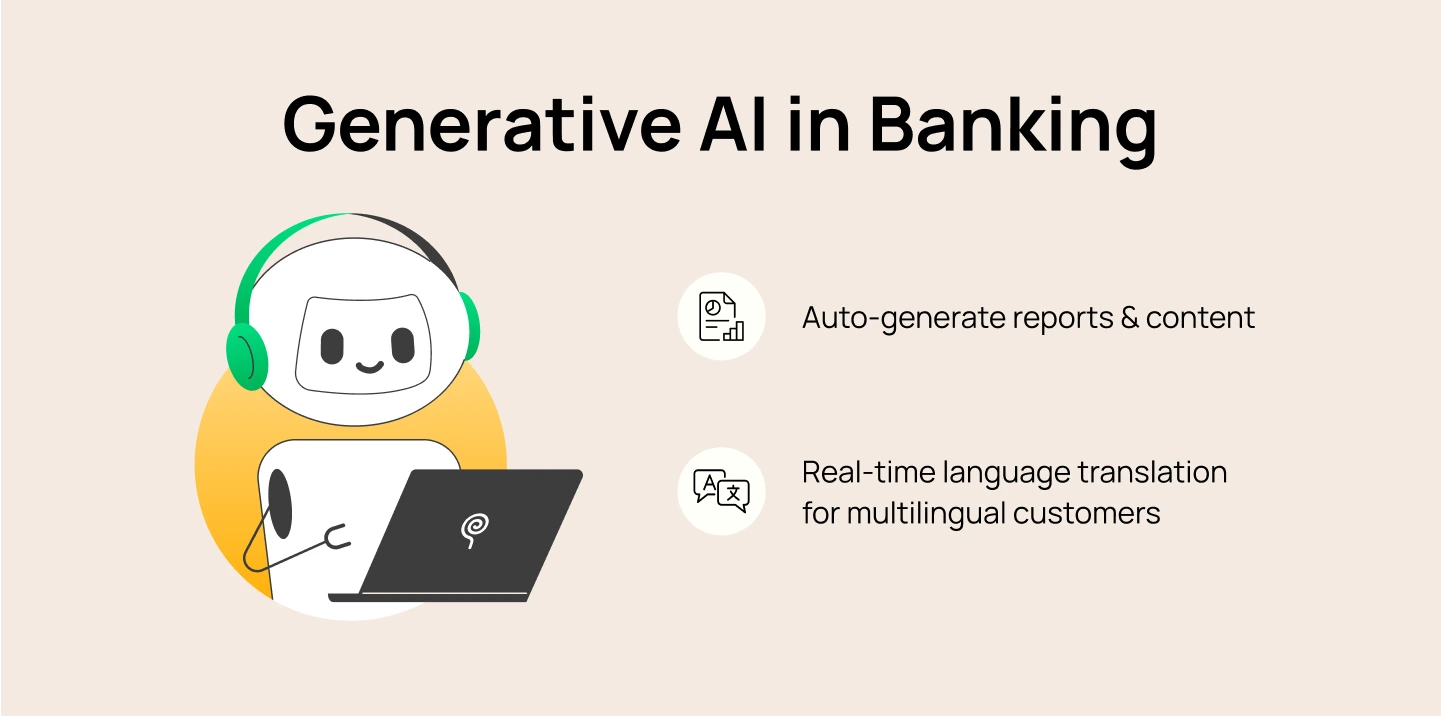
Generative AI refers to systems that can create original content, such as text, summaries, reports, or translations, by learning from existing data patterns. Gen AI in banking enables 2 key applications:
For example, Morgan Stanley uses generative AI to help financial advisors respond faster to client inquiries. The system pulls from a vast internal knowledge base and drafts high-quality responses in seconds. It allows advisors to spend more time supporting clients and less time searching for answers.
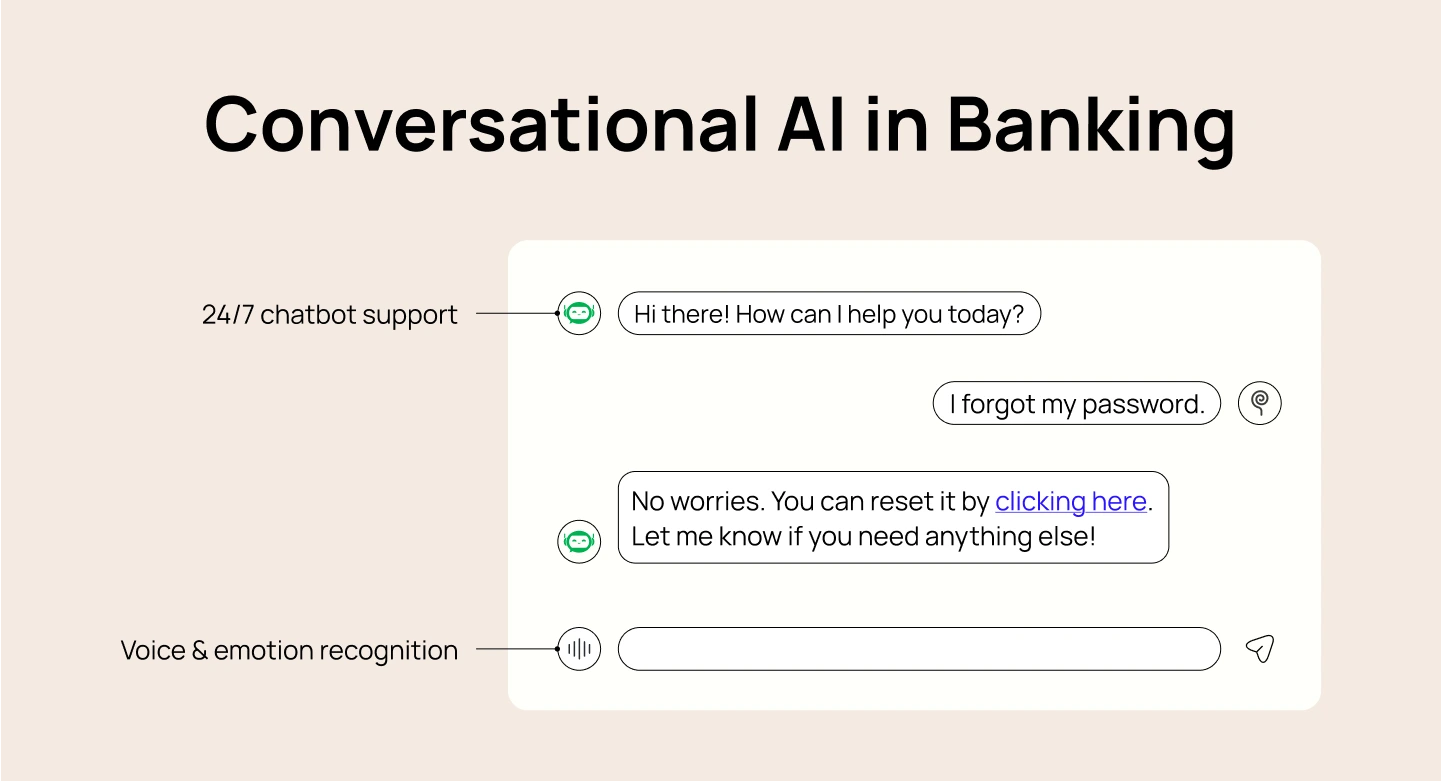
Conversational AI in banking enables banks to engage with customers using natural language, through text or voice. These systems power scalable, real-time interactions across channels, supporting everything from balance checks to complex queries. Conversational AI adoption in banking in 3 ways:
One example is DNB’s chatbot Aino, which handled over 50% of customer chats and helped improve customer satisfaction through automation and conversational design. Banks are also using conversational AI internally, where employee-facing bots help answer policy questions, find forms, or assist with IT tasks, reducing the workload on help desks and improving internal efficiency.
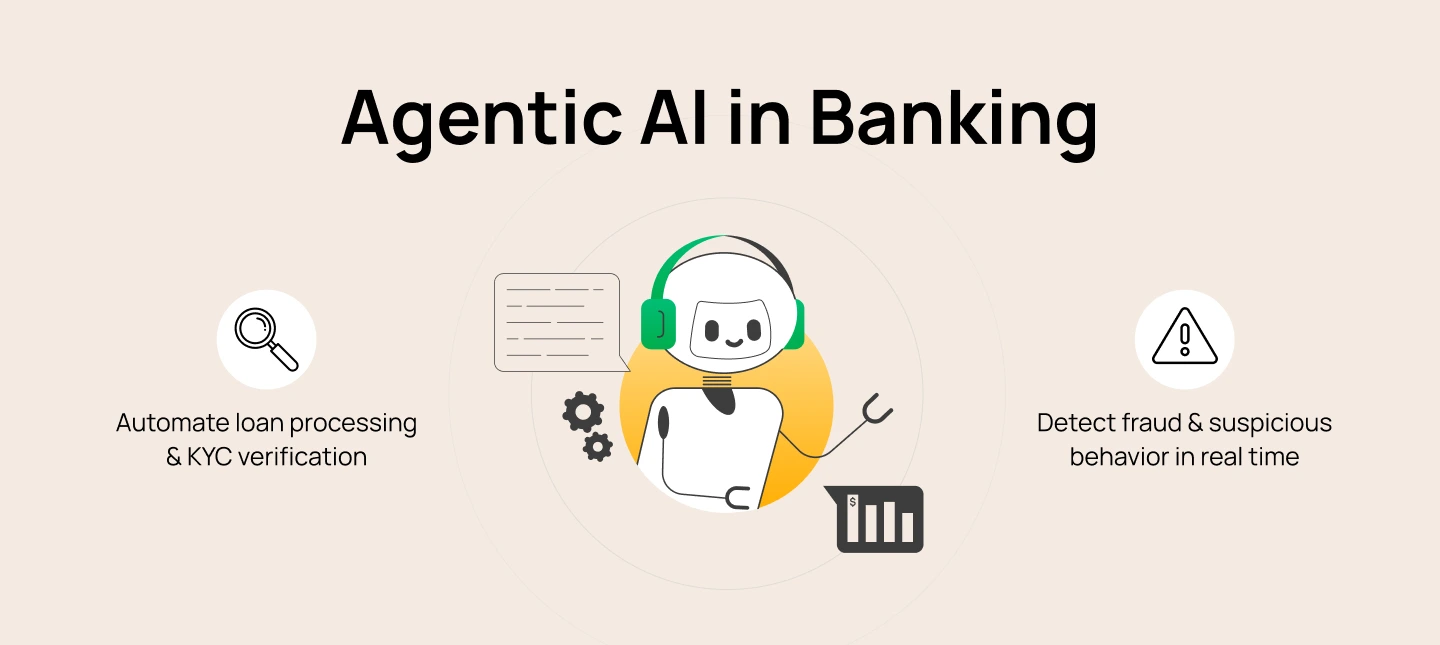
Agentic AI systems are capable of making decisions and taking actions on their own, based on predefined rules or learned behaviors. In banking, these systems deploy specialized AI agents that work autonomously in operations and compliance, where large volumes of decisions need to be made quickly. Below are 3 agentic AI in banking examples:
HSBC uses agentic AI to automate document processing and fraud alerts. The AI Agent can extract and verify data from thousands of trade finance documents, speeding up approvals and reducing manual effort. It can also flag anomalies in real time, allowing teams to focus only on what needs human review.
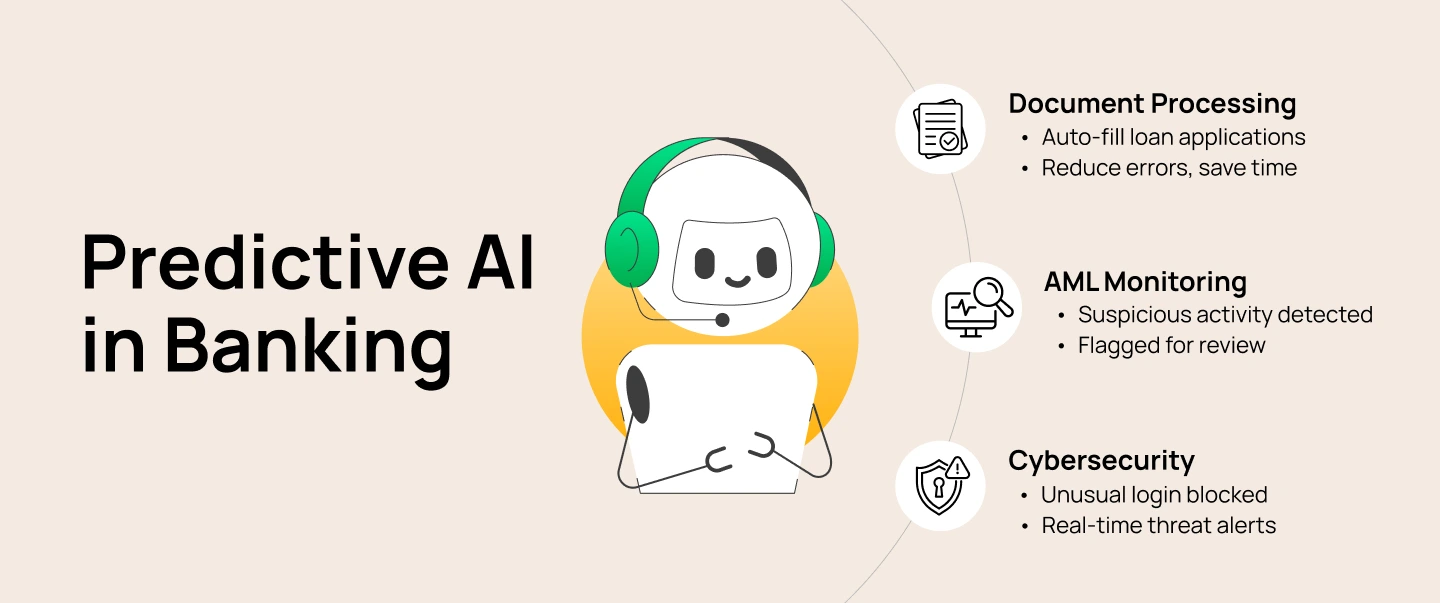
Predictive AI looks at past data to make forecasts, anticipating what might happen next. In banking, it supports decisions in credit, fraud, and customer engagement. There are 5 ways in which predictive AI transforms banking operations:
Take JPMorgan Chase, which uses predictive analytics to monitor credit card behavior. The system can block a suspicious transaction before the customer notices it, minimizing losses and reinforcing trust. Its effectiveness depends not only on model quality but also on how the risk is presented.
Using AI in banking thoughtfully offers both immediate and long-term advantages for banks and their customers. Each benefit ties back to a real outcome, from reduced cost and risk to more responsive, human-like services.
While AI is transforming banking operations, it also introduces complex challenges that require responsible AI practices to address thoughtfully. These issues often involve sensitive data, evolving regulations, systemic fairness, and user trust.
Below are key challenges and how design can help mitigate them.
AI systems rely heavily on personal data to function effectively. In banking, this includes transaction histories, identity verification documents, and behavioral patterns. This data dependence raises concerns around privacy, misuse, and user control, making ethical AI practices essential.
In many cases, users don’t fully understand what data is being collected, how it’s processed, or for what purpose. Without clarity, trust erodes. Users may feel uncomfortable with AI systems that access their financial information, leading to reduced adoption of AI-powered services and potential compliance issues for banks.
How design can improve: Design plays a key role in making consent clear and manageable. Interfaces should explain data usage simply, allow users to adjust preferences easily, and include visual confirmations for opt-ins. Good design helps users feel in control, building confidence in AI-driven services.
Banks operate under strict, evolving regulations. When AI systems make decisions—especially those involving loans, fraud alerts, or risk scores—they must comply with legal standards.
A major challenge is explainability. Many AI models operate as “black boxes,” making it hard for staff and customers to understand how a decision was made.
How design can improve: Design can visualize audit trails, flag key decision points, and explain outcomes using natural language. Clear summaries, risk indicators, and justifications help internal teams and users interpret results confidently and ensure that AI aligns with compliance expectations.
AI systems learn from historical data—which may reflect social or institutional bias. In banking, this can lead to unfair outcomes in credit assessments, fraud detection, or customer targeting.
For instance, if training data overrepresents one demographic, the system may unintentionally favor or disadvantage certain groups.
How design can improve: Inclusive design practices can help identify and mitigate bias. This includes testing with diverse user profiles, offering visual explanations for declined applications, and building interfaces that invite feedback or appeals. Transparency and empathy in UI design support fairness.
Many banks still rely on outdated systems that weren’t built for AI. Integrating modern AI tools with legacy infrastructure is complex and resource-intensive. This slows adoption and creates inconsistencies.
Disconnected systems can lead to poor user experiences—such as missing features, repeated inputs, or delays in real-time actions.
How design can improve: Modular, API-friendly design helps bridge systems gradually. A unified interface layer can abstract complexity from end-users, offering a consistent experience even when backend systems vary. Visual consistency reduces friction during transitions.
AI often feels opaque to customers, such as, when a loan is denied or a fraud alert is issued without explanation, users may become confused or frustrated.
In banking—where trust is paramount—lack of transparency undermines confidence in the system and the brand.
How design can improve: Design should prioritize transparency. Clear labels, visual indicators, and human-readable explanations help users understand what happened and why. Empowering users with “why” builds trust and allows for better-informed responses.
Thoughtful design is not a nice-to-have—it is essential for addressing the real, human-centered challenges of AI in banking. From clarity and fairness to system integration, design ensures that AI solutions remain understandable, compliant, and trustworthy.
AI in the banking industry is moving beyond automation into more adaptive, predictive, and human-aware systems. In banking, this means AI won’t just support operations—it will shape entire customer journeys, influence product design, and enable smarter financial ecosystems.
As AI continues to evolve, here are the key trends expected to define its role in banking:
The future of AI in banking isn’t just more automation—it’s deeper intelligence and transparency. Banks that invest in explainability, modular platforms, and thoughtful design will be better positioned to earn customer trust and unlock the full value of AI.
You may want to see more about AI in different industries:
AI in banking does more than save time. It empowers people to make smarter financial decisions and helps banks operate more efficiently. But for AI-Driven to truly deliver value, it needs to be transparent, fair, and easy to use—not just for customers, but for the teams behind the scenes.
At Lollypop Design Studio, we believe design is what transforms AI from a powerful tool into a meaningful experience. Whether it’s a chatbot, a dashboard, or a predictive model, thoughtful design builds clarity, trust, and connection.
Want to build AI tools that are simple, useful, and designed for real people? Let’s create them together.
At Spot by Lollypop, we help financial brands design AI-powered banking experiences that feel intuitive, transparent, and human-centered. From conversational AI to predictive finance tools, we transform complex technologies into seamless digital experiences that customers can easily understand and trust.