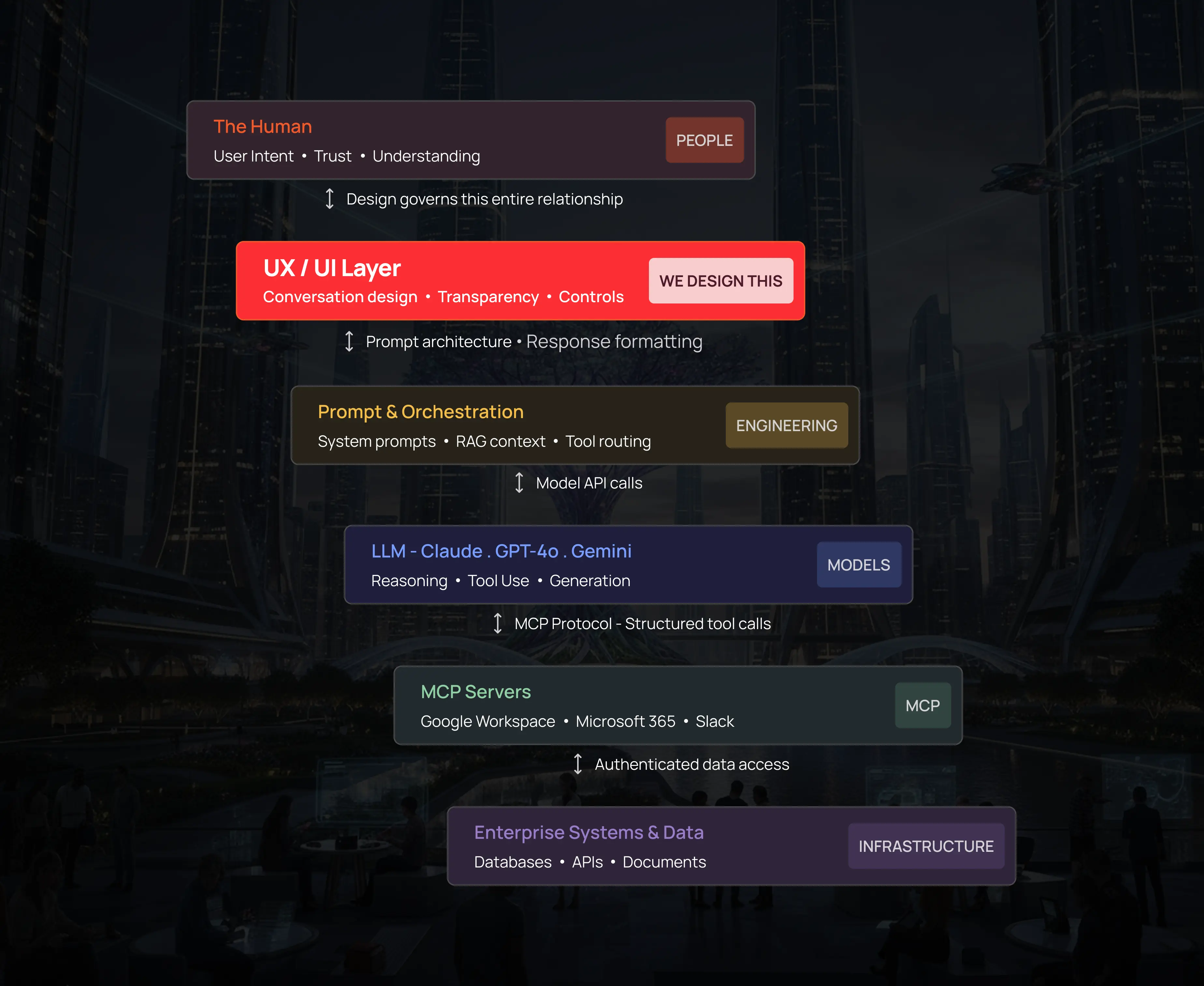
From the first conversational turn to the deepest enterprise workflow, we, as an AI design agency, design every layer of your AI product experience.
Chat architecture, stream-responsive design, multi-turn context visualization, source citation components, conversation memory indicators, tone calibration controls, and model-switching UX. We design the full conversational layer, not just the chat window.
When AI evolves from conversation to action, the interface must make every step clear. We design agent dashboards, progress flows, action-confirmation patterns, and failure-recovery UX for your complex and multi-step agents.
When AI connects to your enterprise systems via MCP, users need to see exactly what was accessed, what changed, and why. We design the permission layer, audit trail UX, and live data connection indicators for your MCP-powered products. This is AI-powered product design at the infrastructure level.
Enterprise AI platforms that route tasks across Claude, GPT-4o, and Gemini need interfaces that make model selection meaningful, not puzzling. We design unified dashboards for multi-LLM architectures, featuring real-time capability comparisons, model-switching controls, and per-model response quality indicators.
Retrieval-Augmented Generation gives AI access to your proprietary knowledge, but users need to see where answers come from. We design source citation UI, document preview drawers, knowledge base browsing UX, and confidence grading components that make RAG-powered answers trustworthy, not mysterious.
The first time a user encounters AI in your product determines whether they explore or disengage. Our human-centered AI design approach covers AI onboarding flows, capability introduction sequences, permission UX, and progressive trust-building patterns that turn first encounters into lasting adoption.
Model Context Protocol (MCP) gives AI agents the keys to your enterprise—from Salesforce to Slack. It’s an extraordinary capability and a profound AI UX design responsibility.
Lollypop has designed the user-facing layer for MCP-powered enterprise products that make AI agents trustworthy and under human command.
Our AI product design process is built on a single conviction: You cannot design a great AI interface without understanding the underlying logic. We don’t just design AI; we create a human experience around it.
Before wireframes, we map the AI system's actual behavior, what models are being used, what tools the agent calls, what data MCP provides it access to, where it can fail, and what the user's mental model of the AI needs to be.
We run user research specifically for AI trust: how users form expectations, where they over-rely, where they under-trust, and what triggers abandonment after an error. The research provides confidence signals, transparency components, and control mechanisms in our AI UX design services.
We design purpose-built AI component systems for every product, tailored for AI's unique interaction patterns, not repurposed from conventional UI libraries. This is the core of our AI-powered product design practice.
We test with real AI behavior, not static mockups. Our usability sessions employ live LLM integration to understand how users really react to actual AI responses, delays, mistakes, and actions.
We deliver complete design specifications, annotated components, interaction flows, and responsive breakpoints—plus developer handover sessions with AI-specific documentation that most design systems simply don't cover
We’ve worked with brands that trusted us to craft human-centered AI solutions for the future. Our modular AI design system adapts to each industry context while maintaining consistent design quality.




Hear it from Anush Mohandass, Founder of Asato.ai, on how we crafted a responsive and seamless design for their platform.

AI UX design delivers value across a variety of industries including healthcare AI platforms, financial technology tools, enterprise automation systems, retail AI solutions, logistics dashboards, and educational platforms powered by AI. With the rise of generative AI and machine learning interfaces, intuitive design is essential to build trust, usability, and engagement for both technical and non-technical users.
To begin your journey with us, simply reach out with your idea or AI product vision. We’ll initiate a discovery workshop to identify key user pain points, platform goals, and opportunities for AI UX optimization. From concept to execution, our team supports your AI UX/UI transformation with research-led, user-centric strategies tailored for scalable AI applications.
Our process revolves around thorough research, creating user personas, and designing intuitive interfaces that make AI processes transparent and easy to navigate. We ensure all designs are empathy-driven and focused on enhancing productivity and usability.
We create intuitive, empathy-driven designs tailored to generative AI’s unique requirements. Our designs simplify complex AI workflows while enabling users to fine-tune their experiences with ease.
Yes, we handle everything from research and prototyping to design and final implementation. We build scalable, pixel-perfect digital applications and integrate them with your existing systems.
Most AI interfaces are designed after the model is built—we design them alongside it. We specialize in AI-specific patterns: trust signals, confidence grading, agent action visibility, and failure-recovery UX. These aren’t things you’ll find in a standard design system, and they’re what separate AI products that users adopt from ones they abandon.
We’ve partnered with companies like PeakXV, Tattwa and Asato.ai, helping them create innovative, AI-driven solutions. Check out our case studies and testimonials for a deeper look at our work.
For generative AI, we design intuitive, customizable interfaces with prompt control and output visualization for personalized, human-AI interaction.
For predictive AI, we focus on explainable UX, using data visualization and confidence indicators to build trust and clarity.
Both approaches follow human-centered AI design principles to ensure usability and transparency.