Most design agencies will tell you that they are user-centered. We prefer to show it.
Over the last decade, we have worked across industries, including FMCG, telecom, healthcare, gaming, government, AI, and retail. What connects these different projects? Our obsession. Our approach: understanding the real humans using the product, not just what they do with it.
The result? 85% adoption rates, where competitors saw single digits. We modernized government digital services for millions without leaving anyone behind.
Our designs have garnered prestigious international accolades.
A’ Design Award
DNA Paris Design Award
International Design Awards
India’s Best Design Awards
Kyoorius Design Awards
Red Dot Award
Our work has been recognized by leading global and Indian design platforms, including Red Dot, A’ Design, DNA Paris, Kyoorius, and India’s Best Design Awards.
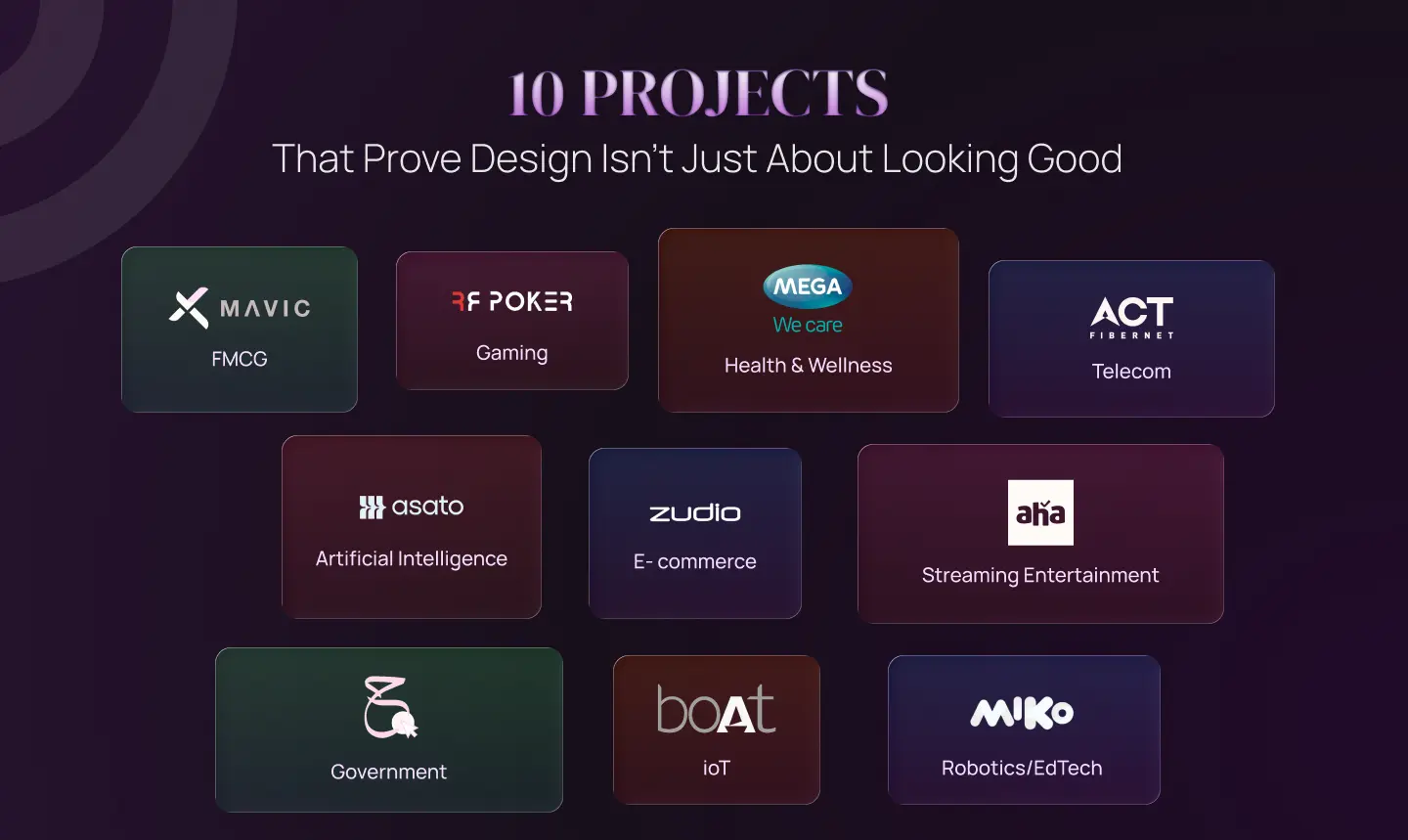
Below are ten Lollypop Design Studio projects (a Lollypop portfolio) that reflect what happens when design isn’t about making things pretty. It is about making them work.
If you want this kind of outcome for your own product, explore our UI/UX design services to see how we partner with teams across industries.
Mavic bridges the gap between on-ground sales and real-time decision-making. Built on field research and user insights, it tackles sales team challenges. Lollypop Design studio empowered Mavic by transforming a legacy sales force automation app with low adoption into an AI-powered platform via ethnographic research and human-centered design, streamlining workflows for thousands of field sales reps across India.
85% adoption rate within the first six months.
40% reduction in order-taking time.
22% monthly sales growth due to real-time insights and performance tracking.
Explore the full Tata Mavic FMCG Case Study & Research findings.
ACT Fibernet delivers high-speed broadband services to millions across India, but its app was a digital brochure. We transformed it into a self-service powerhouse through user research. The key aspect was what users actually want: quick bill payment, instant service upgrades, and real-time outage alerts. The redesign simplified everything users do. It enhanced engagement with seamless onboarding, plan management, and cross-selling features.
Simplified bill payments, service upgrades, and outage alerts.
Boosted retention with a dynamic homepage, a simplified status view, and an amplified user experience.
Elevated market position via a feature-rich yet performant app.
RF Poker revolutionizes poker with RFID-enabled live table analytics. We tackled the information overload and feature complexity through discovery workshops. Primary research across poker player cohorts and built an intuitive UI design that simplifies automated tracking, live streaming, and social interactions.
App adoption spiked by 3X-4X.
With AI and real-time data, we crafted a compelling user experience.
We enhanced retention via post-game insights, personalized leaderboards, and community forums for strategy sharing.
Designed a high-readability, minimalist layout that ensures intuitive navigation and seamless user flow.
Delivered a revamped dashboard providing clear, high-impact metrics and actionable gameplay insights.
Mega We Care delivers science-backed pharmaceuticals and nutraceuticals globally. Their challenge? To build trust in a pseudoscience market. They want to simplify the complex health information and make it accessible to all age groups.
We rearchitected their digital platform to prioritize educational content over product pushes. The design speaks of authority without intimidation. The color palettes, such as the Dark Seashore Night and Blue Marina, are used to build trust and expertise simultaneously. Then, robust e-commerce integration that feels helpful, not aggressive.
Dive into the Mega We Care E-commerce and healthcare architecture.
Asatoa provides enterprise CIOs with AI-driven IT asset management and spend optimization, powering technology that risked being unusable due to complexity.
We translated all raw data into actionable insights modified for executives, analysts, and admins who need operational control. The design emphasizes collaborative decision-making with customizable reports, personalized graphical dashboards, and LLM-powered chat interfaces (ChatGPT modules) that make AI feel conversational, not computational one.
Enabled collaborative decision-making with report builders, trackers, and personalized graphical dashboards.
Streamlined workflows from login to drill-down analysis, onboarding, and outcome visualization.
Delivered responsive web/mobile designs with minimalistic dashboards, light themes, and LLM-powered ChatGPT modules for intuitive AI interactions.
Check out how we crafted intuitive wireframes and AI co-pilot flows for Asatoa.
When Aha came to us, they had a clear vision: become the premier OTT platform for Telugu and Tamil content. The challenge? Creating an experience that works for both the tech-savvy binge-watcher in Hyderabad and the first-time smartphone user in rural Andhra Pradesh.
We redesigned the platform with a “glocal” approach: global premium aesthetics meet local simplicity. Conducted in-depth user research to create distinct user profiles (e.g., the binge-watcher vs. the rural mobile user), tailoring features like voice search and parental controls to specific behaviors.
Read about the ‘Glocal’ UX strategy we created for the Aha OTT platform.
Miko is an interactive AI-powered robot. The hardware was impressive, but the companion app is not keeping pace. We designed an app that balances both needs through adaptive learning modules, gamified controls, and parent dashboards displaying progress without intrusion.
Improved navigation with proper visual hierarchy throughout the app for parents.
Structured, simple layouts that are aesthetically pleasing and reduce the cognitive load for users.
Assigning goals for children was gamified by awarding badges and recognizing streaks on successful mission completion.
Explore the adaptive learning and gamification design for the Miko App.
Designing for a smartwatch isn’t the same as for a phone. You have to design for glances measured in seconds. The screen is in millimeters, and micro-interactions that happen while running, cooking, or driving.
CoverIoT by Boat wanted a unique blend of fashion and fitness tracking in India’s saturated wearables market. We started with persona mapping and spatial constraint solutions. Then crafted glanceable, dark-mode interfaces with micro-interactions that show information without demanding any extra attention.
Check out the spatial design and glanceable UX for CoveIoT wearables.
With Hukoomi, the challenge was democratizing government digital services. Hukoomi is Qatar’s national portal for essential public services, everything from licensing to healthcare access.
“Essential services shouldn’t require technical expertise to access.” With this motto in mind, we modernized the platform. It started with extensive accessibility research, built multilingual workflows that feel natural, and created WCAG-compliant designs ensuring screen readers, voice navigation, and keyboard controls work flawlessly.
Review the Hukoomi accessibility and multilingual service transformation.
Zudio is a gateway for affordable, trendy fashion to India’s young shoppers. The challenge was simple: higher bounce rates due to slow page load time and checkout friction.
So, we restructured information architecture around Zudio’s strength. Then we optimized for speed because every second counts and personalization for higher conversion.
Transformed Zudio’s online presence into a high-fashion, premium shopping experience.
Surged sales through lightning-fast browsing and visual search features.
Minimized cart abandonment via one-tap payments and AR try-ons.
See how we optimized Zudio’s e-commerce flow for higher conversions.
These are Lollypop Design Studio’s top 10 transformative projects. Lollypop Design Studio has consistently demonstrated that thoughtful, research-driven design creates measurable impact for businesses and consumers. We work in a variety of industries, and when human-centered design principles are applied with skill and understanding, they have a powerful global impact.
At Lollypop, we create stunning user interfaces, modernize legacy systems, and design experiences that eventually change how people engage with technology. If you are looking for one such experience, explore our portfolio, talk to our experts, and see how design can change your organization.
Lollypop’s top projects include Tata Mavic, Aha, RF Poker, Hukoomi, and Zudio. Each project demonstrates our human-centered design approach and the impact it had across telecom, healthcare, AI, robotics, and IoT sectors.
Visit Lollypop’s project page for the best UI UX case studies. Tata Mavic’s 40% reduction in order-taking time, ACT Fibernet’s self-service redesign boosting retention, Miko’s adaptive learning interface for AI robots, and CoveIoT’s smartwatch design are some of the best UI UX case studies to look out for.
The real difference between us and other agencies is ethnographic research and user immersion before any design work begins. Unlike other agencies that start designing solutions, we spend time understanding actual user struggles and user pain points.
We define success through measurable business impact and user performance metrics. For projects like Tata Mavic, we tracked specific KPIs such as adoption rates (85%) and reduction in task completion time (40%), ensuring that design translates directly into operational efficiency and sales growth.
Yes, Lollypop specializes in simplifying complex emerging technologies. Our portfolio includes AI co-pilot platforms like Asatoa, where we utilized LLM-powered interfaces, and wearable IoT solutions for CoveIoT-Boat, focusing on glanceable interfaces and battery efficiency.
Modernizing legacy systems is one of our core strengths. We transformed Tata Mavic’s low-adoption legacy sales app into a high-performance AI platform by conducting ethnographic research to understand existing workflows and implementing a human-centered design that feels intuitive for long-term users.
Accessibility is a non-negotiable part of our process, especially for large-scale public platforms. For Hukoomi (Govt. of Qatar), we conducted extensive research to deliver WCAG-compliant designs, ensuring the platform is fully usable for individuals with visual impairments and varying levels of digital literacy.
While we are industry-agnostic, we have deep expertise across FMCG, Telecom, Healthcare, Gaming, Government, Artificial Intelligence, Robotics/EdTech, and E-commerce. Our approach remains consistent across all sectors: we immerse ourselves in the user’s environment to solve industry-specific challenges through research-driven design.