A website development company plans, designs, builds, and often maintains websites for businesses. But not every development partner approaches the problem in the same way.
Some start with a technical specification. Others start with a template. A design-led website development company starts by understanding what users need to do, what the business needs to achieve, and how the two can work together—then uses research, UX, visual design, and engineering to build the experience.
That distinction matters most for B2B, SaaS, and enterprise websites, where a website is rarely just a digital brochure. It may be responsible for explaining complex products, supporting sales conversations, generating qualified leads, strengthening brand credibility, and helping prospects find the right information without speaking to someone first.
So, when should you choose a design-led partner? What should the process include? How much should you expect to invest? And how can you tell whether an agency actually works this way?
This guide breaks it down.
A design-led website development company brings research, UX, UI design, content structure, and engineering into one connected process.
The important word is connected.
Design-led does not simply mean “an agency that has good designers.” It means decisions about the website’s structure and experience are made before—and during—the development process, rather than treating design as a visual layer applied to an already-defined technical build.
A typical design-led engagement may move through:
Research → UX strategy → Information architecture → Wireframes → UI design → Prototyping → Development → Testing → Launch → Iteration
The exact sequence varies by project, but the principle remains the same: the team defines the right experience before investing heavily in building it.
For example, Lollypop describes its work across Research, Design, and Build, with UX research covering methods such as user interviews, usability testing, and concept validation, followed by design and development capabilities.
That is different from a development-only partner, where the client may arrive with completed designs, specifications, and content and the development team primarily focuses on implementation.
It is also different from a template-focused provider, where the starting point is often an existing theme or predefined component system.
None of these models is automatically wrong. The question is whether the model matches the problem you are trying to solve.
Orbit Media makes a similar distinction in its approach to web development, connecting strategy, UX, content, design, development, measurement, and post-launch optimization rather than treating development as an isolated technical task.
A development company builds the website. A design-led development team first works out what the website needs to accomplish—and then builds around that answer.
For organizations with complex audiences, multiple stakeholders, large content ecosystems, or significant conversion goals, that difference can affect the entire project.
Not every business needs the same level of website design and development support.
If you already have a strong in-house design team, you may only need a development partner to turn approved designs into a working website. If you need to rethink your user experience, information architecture, and visual system as part of the project, a design-led team may be a better fit. And if you need a simple website quickly, a template-based solution may be enough.
The key is to match the approach to the complexity of your website and the problem you are trying to solve.
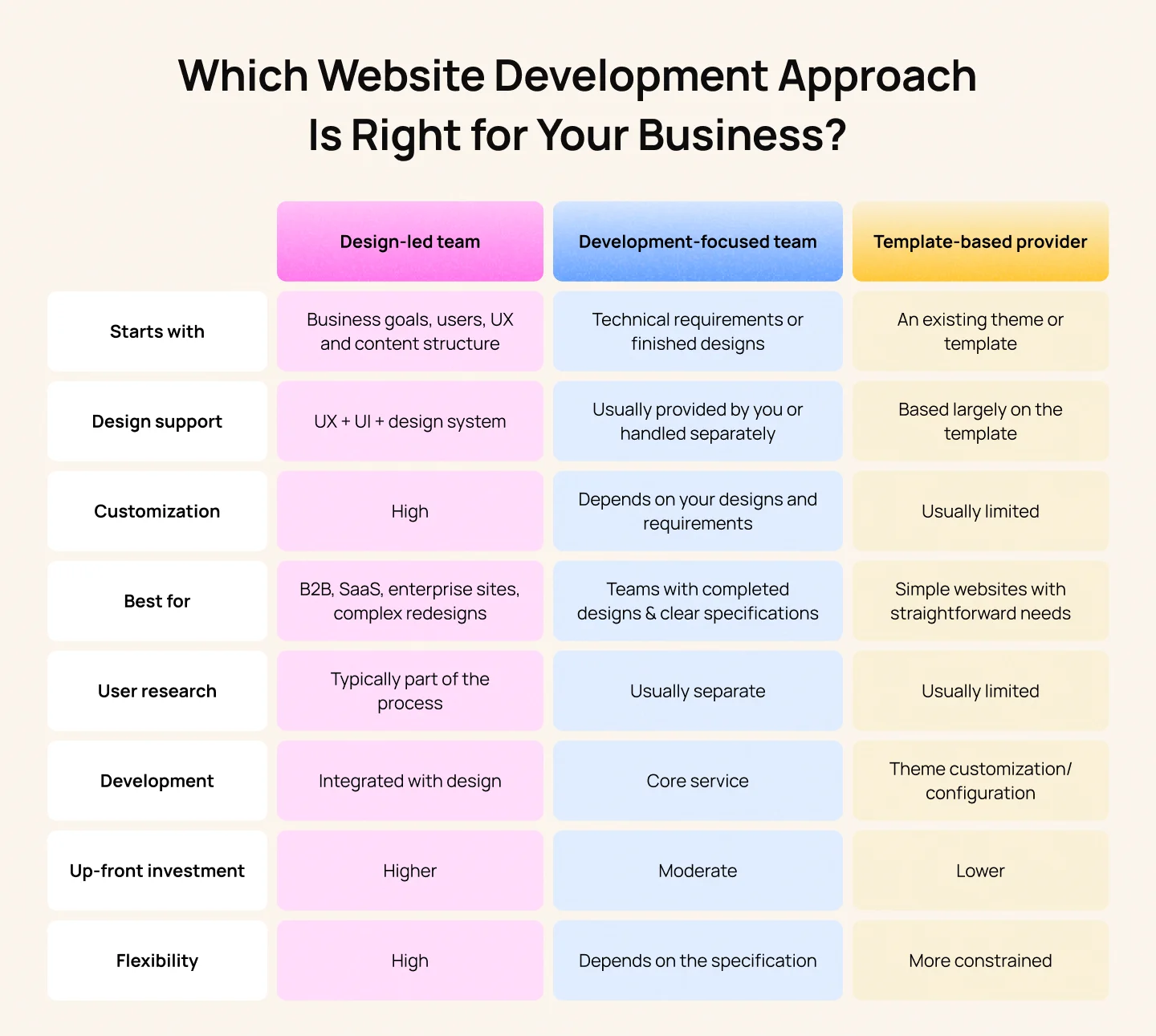
There is no universally “better” option. The right choice depends on what you already have, what still needs to be solved, and how important the website is to your business.
The strongest argument for design-led development is not that “good design looks better.”
It is that decisions are tested earlier, when they are cheaper to change.
Imagine discovering after development that:
These are not purely visual problems. They can require structural or technical changes.
Prototypes, wireframes, information architecture, and usability testing create opportunities to identify those problems before they become production problems.
Lollypop, for example, describes usability testing as something that can happen throughout the design process—from low-fidelity prototypes to final products—to identify issues before significant design and development time has been invested.
There is also broader evidence that design capability can correlate with business performance. McKinsey’s research across 300 companies found that organizations in the top quartile of its McKinsey Design Index had 32 percentage points higher revenue growth and 56 percentage points higher total returns to shareholders over a five-year period than industry counterparts. The study covered medical technology, consumer goods, and retail banking.
However, that statistic needs context.
It does not mean that redesigning a website will automatically increase revenue by 32 percentage points. McKinsey studied overall design performance across organizations and found a correlation with financial performance.
The useful lesson for a website project is narrower: design can be treated as a business capability, not only as visual decoration.
For a design-led website team, that means asking: What should users understand, find, compare, trust, and do—and how should the website make those actions easier?
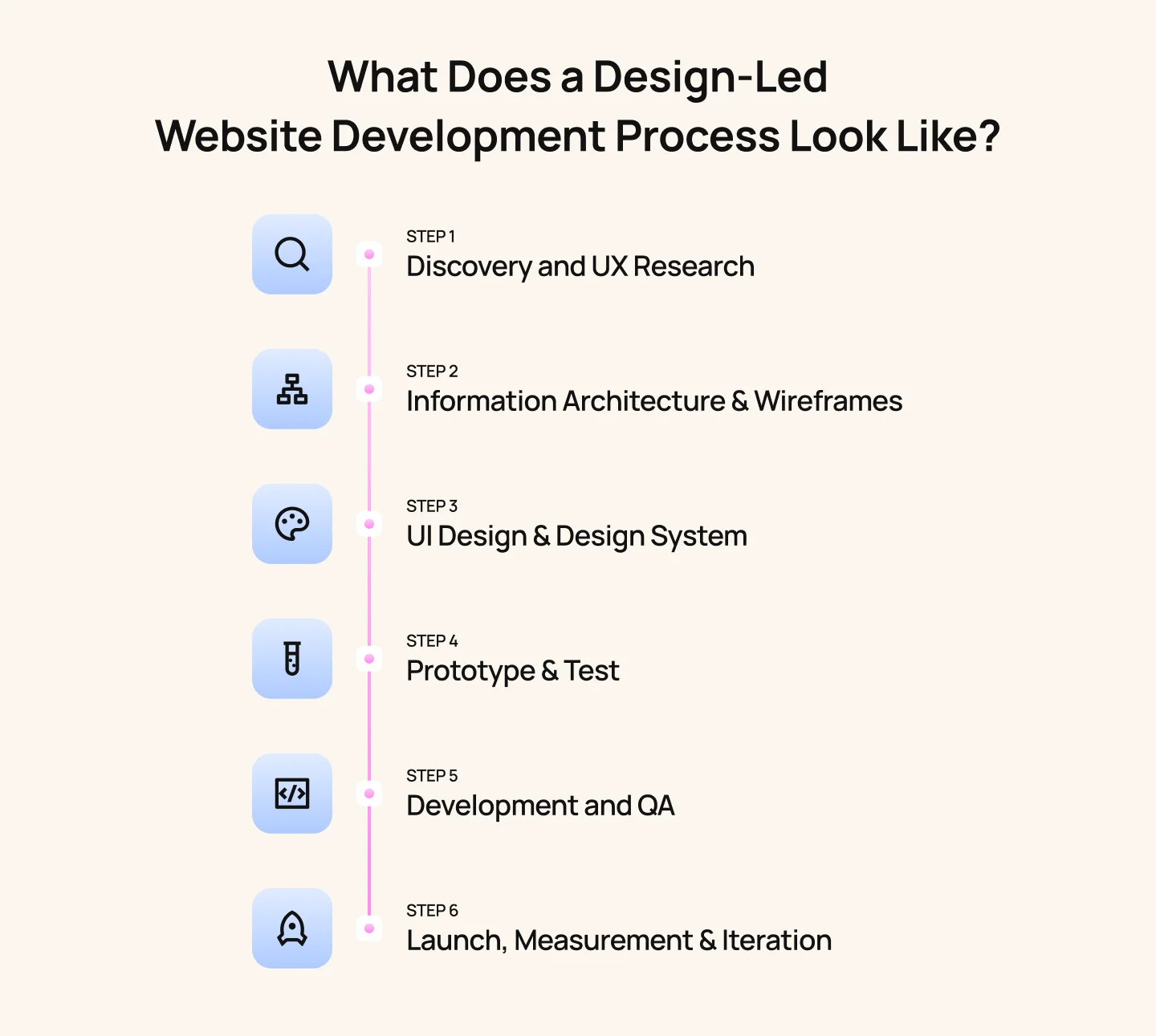
A strong process should reduce uncertainty progressively.
A practical six-stage model looks like this:
Start by understanding the business, users, market, existing website, and constraints.
Depending on the project, this may include:
The objective is not to produce a large research report. It is to identify the insights that should change what gets built.
Lollypop’s process, for example, begins with discovery around business goals, user requirements, and market research before moving into design.
Next, determine how information should be organized.
For a B2B website, this can be particularly important. A visitor may arrive looking for a product, a capability, an industry solution, a case study, technical documentation, pricing information, or proof of expertise.
The information architecture determines how those needs map to navigation, page hierarchy, and content relationships.
Wireframes then establish the structure of key pages before visual styling becomes the focus.
Once the structure is validated, the team develops the visual experience.
This includes:
A design system matters particularly for enterprise websites because the site may contain dozens or hundreds of pages. Without reusable patterns, consistency becomes increasingly difficult as the site grows.
Before development is complete—or before development begins for critical journeys—test important assumptions.
Usability testing can expose problems that internal reviews miss because the team already understands the interface.
Lollypop’s usability-testing practice includes testing prototypes as well as live websites and applications, with both moderated and unmoderated approaches.
The approved experience is translated into a working website.
Depending on the project, this may include:
At this stage, designers and developers should continue communicating. A design decision that creates unnecessary technical complexity should be discussed rather than implemented blindly—and a technical constraint that affects usability should be surfaced early.
Launch is not the end of the website project.
Post-launch teams should monitor relevant business and experience signals, identify issues, and improve the site based on real-world behavior.
The exact metrics depend on the business, but may include qualified leads, conversion rates, organic visibility, engagement with key pages, form completion, search behavior, and Core Web Vitals.
A website development proposal should describe more than “a responsive website.”
For a substantial B2B or enterprise project, ask whether the scope covers the following:
The technical bar should also be explicit.
Google’s current Core Web Vitals guidance defines three key metrics: LCP for loading, INP for interactivity, and CLS for visual stability. At the 75th percentile, the recommended “good” thresholds are LCP of 2.5 seconds or less, INP of 200 milliseconds or less, and CLS of 0.1 or less.
These are useful benchmarks—not a promise that every page will always achieve those numbers under every condition. Google specifically recommends evaluating field data at the 75th percentile across mobile and desktop users.
Accessibility should be treated similarly. WCAG 2.2 is the current W3C Recommendation, with testable success criteria designed to make web content more accessible across devices and to people with different disabilities.
If your organization requires WCAG 2.2 Level AA conformance, make that an explicit project requirement rather than assuming that any “accessible” website automatically meets it.
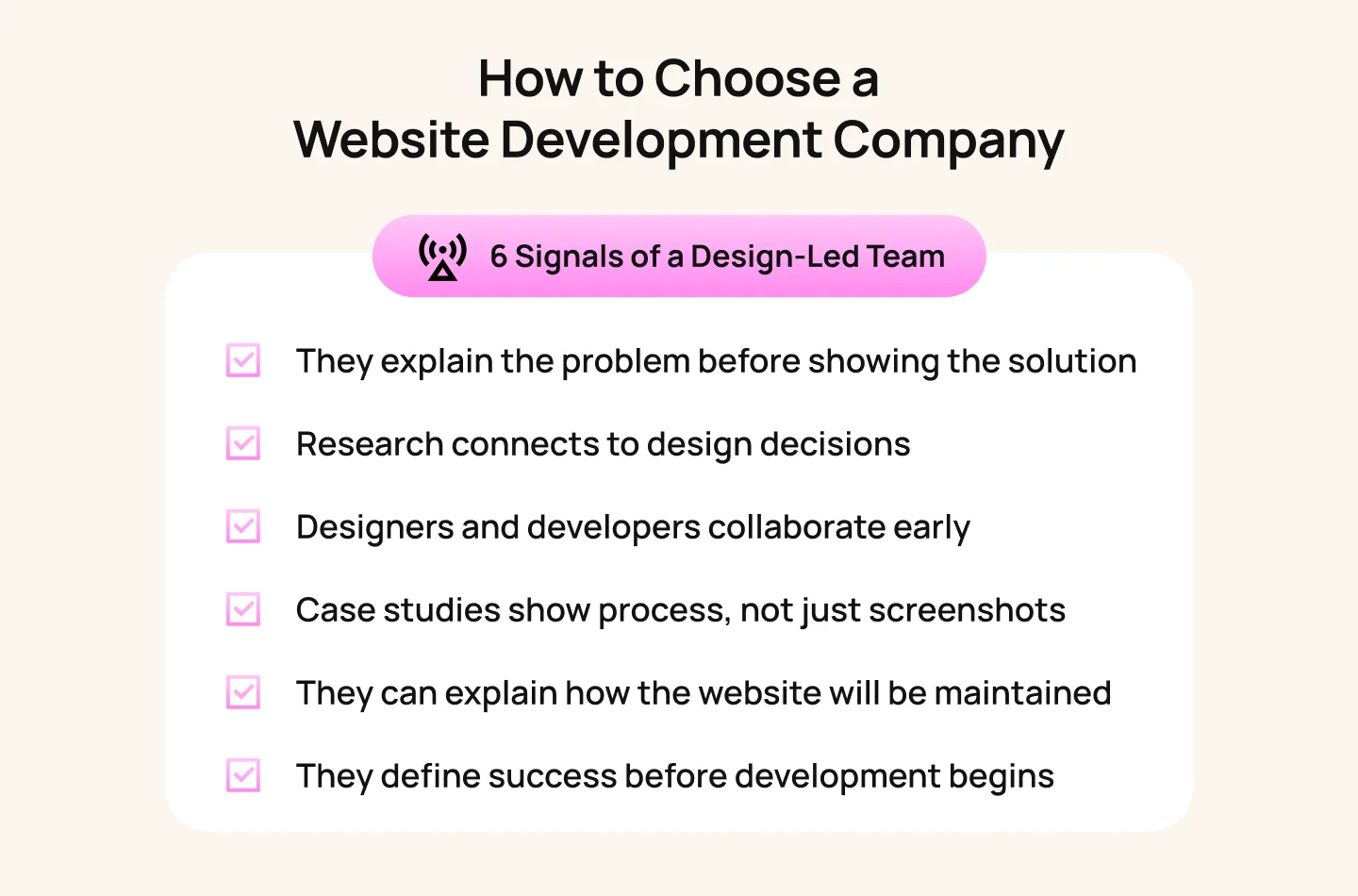
A polished portfolio does not necessarily reveal how an agency works.
Look for evidence behind the visuals.
Ask why a particular navigation system, page structure, or interaction was chosen.
A design-led team should be able to explain the reasoning—not just show the final mockup.
Ask: “What changed because of your research?”
A strong answer should connect findings to actual decisions.
For example: research revealed a terminology problem → navigation was restructured → prototype was tested → the final architecture reflected the findings.
You do not necessarily need every discipline employed under the same legal entity. What matters is whether design and engineering collaborate early enough to identify constraints and opportunities.
Ask who attends design reviews, who validates feasibility, and when developers become involved.
Look for evidence of:
Lollypop’s WWF-India case study, for example, documents the site’s fragmented navigation and discoverability problems before describing the discovery, information architecture, wireframing, design system, and responsive implementation used in the redesign.
Ask what happens after launch.
Who manages the CMS? Who owns the code? How are new components added? Who handles bugs? What happens when your marketing team needs 20 new pages?
A website that cannot evolve with the organization is an expensive short-term solution.
A design-led partner should not wait until launch to ask whether the project worked.
Agree on relevant measures upfront.
For a B2B site, that could mean: qualified leads + conversion rate + organic visibility + key journey completion + content engagement
rather than simply: number of pages launched + traffic + “looks good.”
Clutch’s current guidance similarly recommends evaluating a potential partner’s services, technology expertise, portfolio, pricing, communication, UX process, accessibility approach, and post-launch support.
Instead of asking only, “How much will the website cost?”, use the conversation to understand how the team thinks.
Here are eight useful questions:
One particularly revealing question is:
“Can you walk us through a website project where research changed the final solution?”
If the answer is vague, research may be more of a sales line than an actual part of the process.
Orbit Media similarly recommends using the interview to understand how a prospective partner thinks, including asking how they learn about a client’s business and how they approach UX and design.
A development-focused partner can be the right choice.
You may not need a full design-led engagement when:
In those situations, bringing in a specialist development team can be efficient.
But if the brief sounds more like: “Our website isn’t converting, nobody can find the right information, our product story is complicated, and we’re not sure what needs to change.”
then the problem is probably not development alone.
Start with discovery, UX research, or a design audit before committing to a large build.
A design audit can provide an independent assessment of usability, hierarchy, interaction, and other experience issues before development begins. Lollypop positions its audit service as a way to identify website or product gaps and establish actionable design direction, including before development or before a major redesign.
Choosing a website development company is not simply about finding a team that can build your website. It is about finding the right team for the problem you need to solve.
If you already have validated UX, finished designs, and clear technical requirements, a development-focused partner may be all you need. But if your website needs to clarify a complex offering, improve user journeys, support multiple audiences, or rethink how the experience works from the ground up, a design-led approach can bring strategy, design, and development together from the start.
The right partner should be able to show you more than polished screens. Look for the thinking behind them: how they research, how they make decisions, how they test ideas, how designers and developers collaborate, and how they measure success after launch.
At Lollypop, we bring research, design, and development together to create digital experiences around real user needs and business goals.
If you’re planning a new website or considering a redesign, explore our website design and development services or start with a design audit to understand where your current experience can improve.
A website development company plans, designs, develops, tests, launches, and may maintain websites or web applications. Depending on the provider, its services may include UX research, information architecture, UI design, front-end and back-end development, CMS implementation, integrations, QA, analytics, and post-launch support.
Web design focuses on how a website works and appears for its users, including information architecture, UX, visual design, interaction, and responsive layouts. Web development turns those designs and requirements into a functioning website through front-end, back-end, CMS, integrations, and other technical implementation.
In a design-led process, the two disciplines are closely connected rather than treated as completely separate stages.
The timeline depends on the scope and decision-making process. A simple marketing site may require considerably less time than a large B2B or enterprise website involving research, complex information architecture, multiple page types, content migration, integrations, and extensive QA.
Rather than choosing an arbitrary timeline, ask the development company to map the project into discovery, design, development, testing, launch, and post-launch phases—and identify what decisions or client inputs each phase requires.
Choose based on complexity and the amount of customization you actually need.
A template can be appropriate when your website has straightforward requirements and speed or budget is the priority. Custom development becomes more relevant when you need distinctive user journeys, complex integrations, unusual functionality, a scalable design system, or greater control over the experience.
The important question is not whether “custom” sounds more premium. It is whether the additional flexibility solves a real business or user problem.