
You’ve shortlisted a few UX design agencies, shared your project requirements and received proposals. But one agency recommends starting with user research, another jumps straight into interface design, and a third proposes an entirely different scope. How do you know which approach is right for your product?
The problem often starts before the proposals arrive. When project expectations, user needs and deliverables aren’t clearly defined, agencies make different assumptions about the work.
A well-written UX design RFP gives every agency the context it needs to propose a relevant solution. It also gives your team a consistent way to compare expertise, methodology, timelines and costs.
Quick Answer: What Is a UX Design RFP?A UX design RFP (Request for Proposal) is a document businesses use to invite design agencies or independent consultants to propose solutions for a digital product project. It outlines business goals, target users, project scope, expected deliverables, timelines, budget, and selection criteria, allowing buyers to compare proposals consistently. |
A UX design RFP and a project brief both communicate what a business needs from a design partner, but they serve different purposes. Understanding that difference helps you decide which document your project requires and how much detail to include.
A project brief communicates the basic context and expectations of an engagement. An RFP goes further by requesting structured proposals from potential providers.
| Project brief | UX design RFP |
| Explains the project at a high level | Defines requirements for a formal proposal |
| Usually shorter and less formal | Includes scope, methodology and evaluation criteria |
| Useful for a clearly defined engagement | Useful when comparing multiple agencies |
| Focuses on context and expectations | Covers team, deliverables, timelines and commercials |
Not every project requires a formal RFP. A short brief may be enough for a small, well-defined design task. An RFP is more useful when the engagement involves multiple phases, stakeholders, platforms, or significant investment.
Consider preparing one when you are:
When several agencies are being considered, a formal RFP gives each one the same project context and requirements. This creates a consistent basis for comparing proposals while allowing agencies to recommend their own discovery process, design approach and delivery plan.
As a result, differences between proposals are more likely to reflect how each agency would approach the project, rather than different assumptions about what the work involves.
Before approaching agencies, align your internal team on the problem, users, and expected outcomes. A detailed document cannot compensate for unclear project decisions.
Explain why the project is necessary and what needs to improve. For example, a business may want to simplify onboarding because new users struggle to complete registration.
Also distinguish between requirements that are fixed and areas where you are open to the agency’s recommendations. For example, your business objective and technical constraints may be non-negotiable, while the user flows and interface approach can be explored during discovery.
Separate the desired outcome from the design deliverable:
Avoid inventing performance targets when you do not have baseline data.
Identify the primary and secondary user groups, their needs, current pain points, and the platforms they use. Share relevant website or app links, existing user research, product analytics, and customer feedback.
Agencies need this context to understand the product beyond its visual interface.
Decide which features, platforms, and user journeys are included. Identify exclusions, internal stakeholders, approval responsibilities, and dependencies.
Set a realistic budget range and expected timeline. You do not need every design decision finalized, but you should know what the project needs to achieve.
Identify the person responsible for consolidating feedback and providing final approvals. Multiple stakeholders giving conflicting feedback can delay design decisions and affect project milestones.
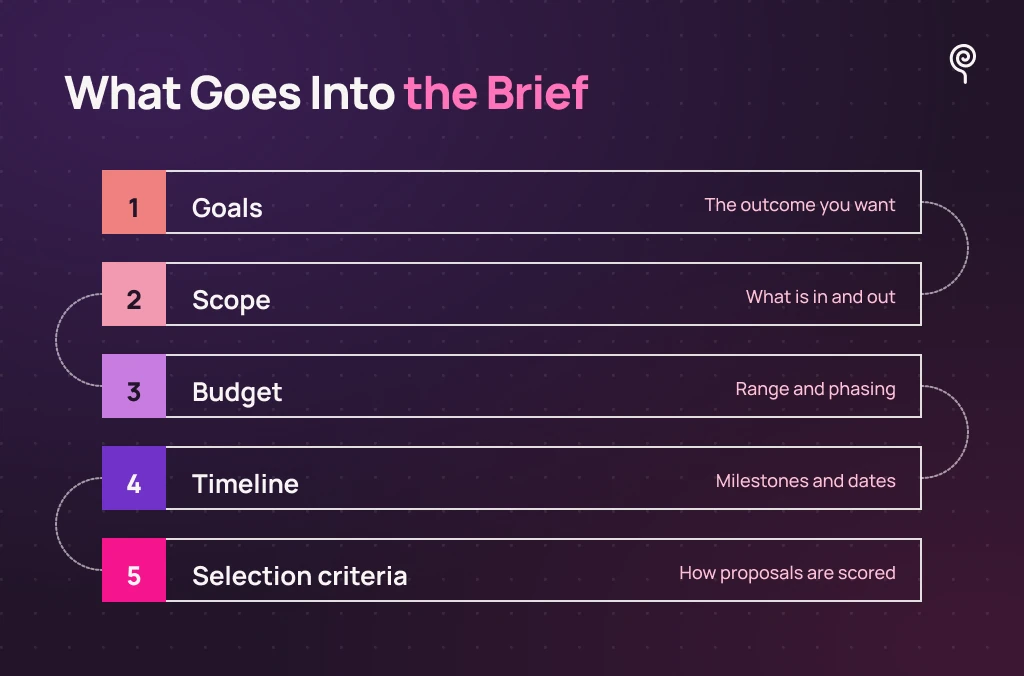
A useful UX design RFP template should give agencies enough information to estimate the work, propose a methodology, and explain the resources required. You can adapt the following structure to your project.
Company background: Provide a short overview of your business, products, target audience, and market.
Project objectives: State the outcomes expected from the engagement, such as simplifying navigation, improving onboarding, or making complex workflows easier to complete.
Describe the primary and secondary user groups, their needs, important tasks and known pain points. Include relevant user roles, permissions and differences between platforms.
Where baseline data is available, identify the metrics that will help evaluate the project, such as task completion rate, onboarding completion, conversion, retention or support requests related to usability.
For each metric, provide the current baseline, available data source and intended direction of improvement. If these figures are unavailable, state that they need to be established during discovery rather than inventing targets.
Identify the phases required for the engagement.
| Project phase | Possible activities and deliverables |
| Research and Discovery | Stakeholder interviews, user research, competitor analysis, research synthesis and identified usability gaps |
| UX Strategy and Information Architecture | User flows, navigation structure, sitemaps, task journeys and low-fidelity wireframes |
| UI Design and Design Systems | Visual direction, responsive screen designs, reusable components and design-system documentation |
| Prototyping and Validation | Interactive prototypes, usability testing, findings and design iterations |
| Engineering Handoff | Organized design files, component specifications, assets, interaction documentation and developer walkthroughs |
Note: Specify which deliverables are mandatory, which are optional and which require separate approval. Also clarify whether revisions, additional design rounds, content production and implementation support are included.
| Milestone | Target completion |
| Vendor selection and kickoff | [Date] |
| Research and discovery | [Date] |
| Information architecture and wireframes | [Date] |
| High-fidelity design and prototypes | [Date] |
| Validation and final handoff | [Date] |
Include stakeholder review periods, feedback deadlines and approval dependencies in the schedule. Agency delivery dates often depend on how quickly the client provides consolidated feedback.
Ask agencies to explain their pricing assumptions and itemise costs by major project phase. They should also distinguish mandatory deliverables from optional services in their quotations, making it easier to compare proposals even when agencies recommend different approaches.
Request that each agency provide:
Specify how agencies should submit questions, who they should contact and when responses will be shared. If the same clarification affects all bidders, distribute the answer consistently so agencies are working with the same information.
Consider a fictional B2B SaaS company whose users struggle to locate reports and complete recurring analytics tasks.
Its RFP might define the project like this:
| Field | Example response |
| Project | Analytics dashboard redesign |
| Primary users | Account administrators and business analysts |
| Core problem | Users struggle to find reports and navigate recurring workflows |
| Objectives | Simplify navigation and improve core task usability |
| Scope | Discovery, information architecture, key flows, wireframes and UI design |
| Existing evidence | Analytics, customer support tickets and stakeholder interviews |
| Expected outputs | Research summary, prioritized findings, high-fidelity designs and interactive prototype |
| Timeline | 10–12 weeks, including discovery, design and validation |
| Out of scope | Front-end development, backend engineering and content production |
| Internal stakeholders | Product manager, engineering lead and business representative |
| Approval process | Consolidated feedback from the product manager at each milestone |
| Handoff requirements | Organized Figma files, component documentation and developer walkthrough |
The agency should be free to recommend changes to the proposed methodology, provided it explains how those changes support the project’s objectives and affect the timeline or budget.
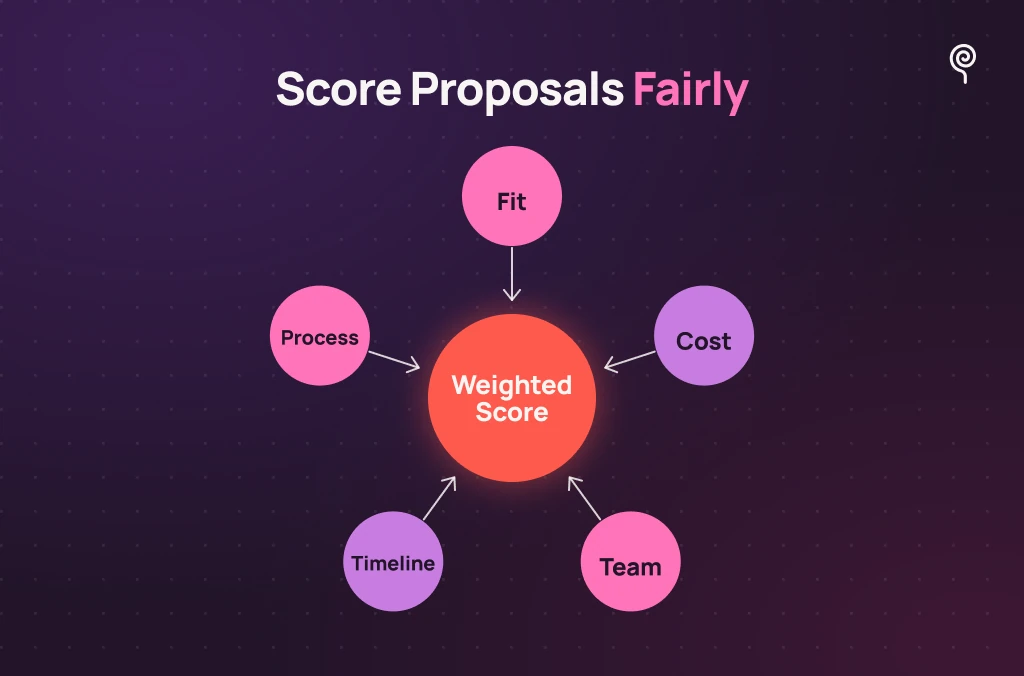
A good-looking portfolio is not enough to establish whether an agency can solve your product’s problems. Effective UX agency proposal evaluation should consider the team’s approach, relevant experience, research capabilities, delivery plan, and commercial clarity.
Before assigning scores, establish any mandatory requirements that agencies must meet. These could include relevant industry experience, availability within the required timeline, acceptance of essential project constraints or the ability to meet specific technical requirements. Proposals that fail mandatory requirements can be excluded before the comparative scoring begins.
| Evaluation criterion | Points | What to assess |
| Strategic alignment and discovery | 50 | Understanding of business goals, users, and project challenges |
| Technical and design competency | 40 | UX methodology, design systems and accessibility awareness |
| Team composition and seniority | 40 | Experience and involvement of assigned practitioners |
| Relevant case studies and evidence | 40 | Relevant projects and documented outcomes, where available |
| Commercial terms and pricing | 30 | Scope clarity, milestones, exclusions and transparent fees |
| Total | 200 |
Adjust the weights to reflect what matters most to your project. These are suggested evaluation weights, not a universal procurement standard.
| Evaluation area | Red flag | Green flag |
| Methodology | Jumps straight into high-fidelity visuals | Includes discovery and user validation |
| Scope | Vague feature or page lists | Defines inclusions and exclusions |
| Case studies | Screenshots without project context | Explains challenges, decisions and outcomes |
| Team | Unnamed delivery team | Identifies assigned practitioners |
| Communication | Generic responses | Asks relevant business and technical questions |
| Commercials | Unclear fees and assumptions | Itemized pricing and milestone clarity |
| Project assumptions | Does not explain dependencies or exclusions | Identifies assumptions, dependencies and risks upfront |
During UX agency proposal evaluation, look beyond polished presentation decks. Ask how the agency arrived at its recommendations, what evidence supports its approach, and who will actually deliver the work.
Once the RFP is ready, share it with a shortlist of agencies whose experience and capabilities match your project. Three to five pre-vetted agencies can be a practical starting point, although the right number depends on your procurement requirements.
A consistent process helps make their responses easier to compare:
Keep the process structured, but allow agencies to ask questions and challenge assumptions. Their questions can reveal how deeply they have understood the project.
Even a detailed UI UX design RFP can produce unsuitable responses when essential information is missing or contradictory.
Requesting a fixed number of screens or prototypes does not tell an agency what problem needs solving. Define the user and business objectives before listing design outputs.
Specify who provides product data, arranges user access, approves deliverables, and makes decisions. Clarify ownership of design files, reusable assets, and third-party licences in the commercial agreement.
Explain what is included, what is excluded, and what would trigger additional charges. Define acceptance criteria, revision rounds, documentation, and engineering handoff expectations.
An RFP should communicate the problem and the constraints, but it should not necessarily prescribe every design decision. Asking agencies to reproduce a predetermined layout or follow a fixed set of screens can limit their ability to identify better solutions.
Define the required outcomes and essential requirements, then allow agencies to explain how they would approach the work.
These questions help reveal whether an agency understands the problem or is simply responding to a list of requested screens.
A strong UX design RFP gives agencies clarity without restricting their thinking. It explains what the business needs to achieve, who the product serves and what the engagement must deliver, while leaving room for the agency to recommend the right design approach.
Define your goals, users, scope, budget, and expected outcomes before approaching potential partners. The clearer the requirements, the easier it becomes to compare proposals and establish a productive working relationship.
Have a UX project brief or RFP? Discuss your project with Lollypop.
A project brief communicates the basic context and expectations of a design engagement. An RFP formally invites agencies to submit proposals against defined requirements, including scope, methodology, team, timeline, and commercial terms.
Yes, when possible. A realistic budget range helps agencies recommend an appropriate scope and prevents proposals that are far beyond available resources. Explain whether the budget is fixed or has some flexibility.
Start with a small, pre-vetted shortlist of agencies with relevant experience. Three to five agencies can be a practical starting point, although the appropriate number depends on project complexity and procurement requirements.
Yes, when engineering handoff is part of the engagement. Specify whether agencies must provide organized design files, reusable components, assets, interaction specifications, documentation, and developer walkthroughs.