A B2B website needs to do more than look professional. It must help potential buyers understand what your business offers, why your solution is worth considering, and what to do next. When prospects still struggle to understand your value or sales teams have to explain information that should already be clear on your website, the problem may go beyond the design itself.
A B2B website design agency helps businesses address these issues through strategy, UX/UI design, content structure, and development. But choosing the right partner is not always straightforward. A polished portfolio can show what an agency has designed, but not necessarily how it identifies business problems, understands complex B2B buying journeys, or determines what a website needs to achieve. Without that understanding, a redesign can consume significant time and budget without addressing the issues that prompted it in the first place.
So, how can you tell whether an agency is equipped to solve the right problems before committing to a project? This guide covers the capabilities to look for, the questions to ask when evaluating potential partners, and the factors that shape project costs.
The work usually covers five areas, though not every agency offers all of them. Knowing what each one involves makes it easier to compare agencies.
B2B and B2C websites serve different buying needs. B2C websites often help consumers find products and purchase them directly, while B2B websites support the evaluation of services, software, and business solutions that may require discussions and approvals before a purchase decision is made.
These differences influence how a B2B website should be designed.
A B2B website is more than an online presence. It helps potential clients understand a business’s expertise, assess whether its services meet their needs, and prepare for a conversation with the sales team. When choosing a B2B website design agency, look for a partner that understands your sales process and can translate your business goals and buyers’ needs into an effective website experience.
B2B website design agencies differ in the capabilities they offer and the problems they help solve. Some focus on user experience, while others handle website development, B2B messaging, or broader digital marketing. Understanding these differences can help you identify the expertise your project needs before comparing potential partners.

These categories can overlap. A B2B-focused agency may also offer UX/UI design and development, while a full-service agency may have a dedicated B2B team. The important difference is not the agency label, but whether its capabilities match your project requirements.
Before choosing, identify what your team needs most. If usability is the main issue and development is already covered internally, a UX/UI design agency may be sufficient. If you need a complete website built, look for a partner that can manage both design and development. If buyers struggle to understand your offering or find the information they need to evaluate it, prioritize an agency with experience in B2B buyer research, messaging, and conversion paths.
This gives you a clearer starting point for evaluating agencies based on the problems they can solve, rather than choosing solely by portfolio or service list.
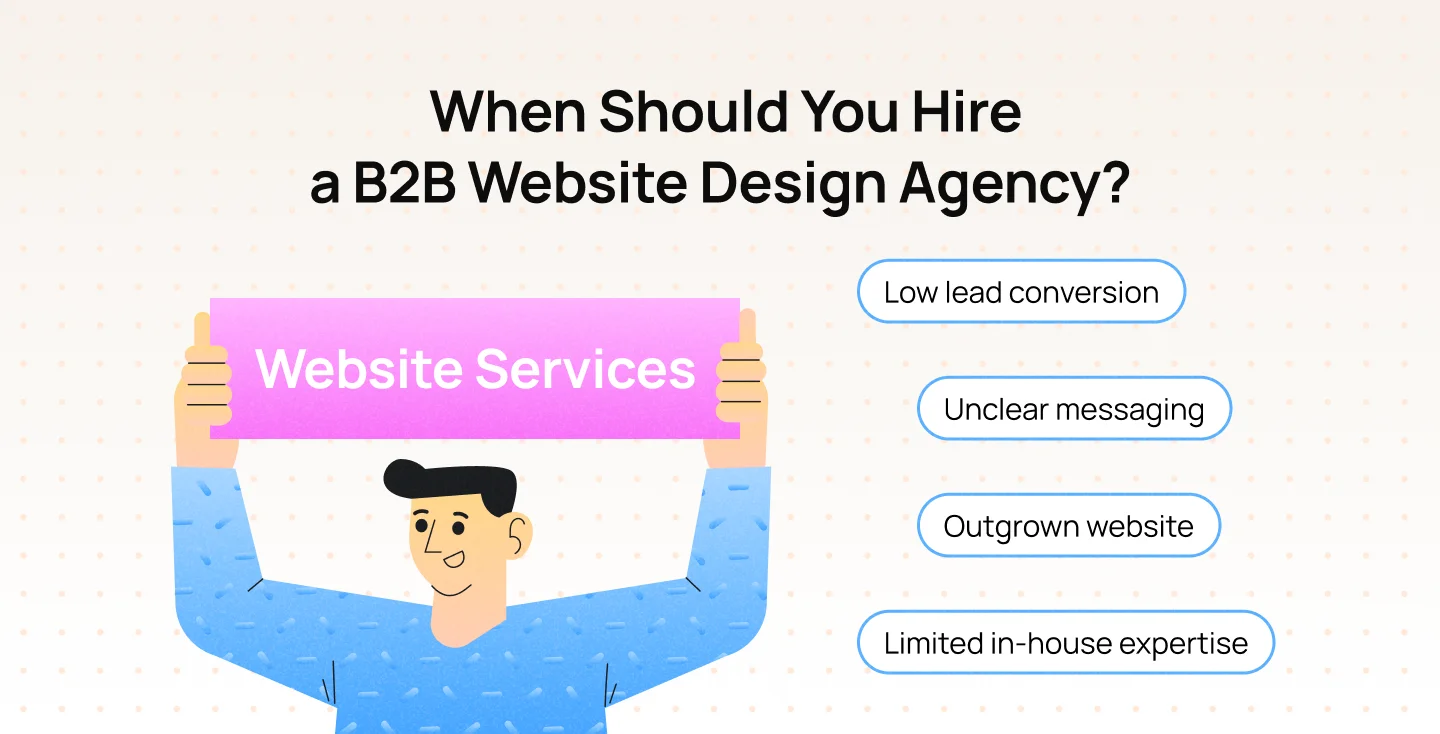
Hiring a B2B website design agency makes sense when your website no longer supports your business goals and your internal team lacks the time or expertise to address the problem. Before committing to a redesign, look for signs that your website needs more than a visual update.
Not every website issue requires an agency. Your internal team may be able to handle small content updates or straightforward usability problems. External support becomes more valuable when challenges require multiple areas of expertise, substantial research, or changes that affect how buyers evaluate your business.
Before reaching out to agencies, identify the main problem you need to solve and define what success would look like. You may want to help buyers understand your offering more quickly, make key information easier to find, or create a clearer path from a service page to a sales conversation. These priorities will help you evaluate potential partners based on your actual business needs.
The cost of hiring a B2B website design agency depends on the scope of work, the complexity of the website, and the level of support your project requires. Two agencies may quote different prices for what appears to be the same project because one includes research, content support, integrations, and post-launch improvements while the other covers only design and development.
Rather than comparing the final price alone, review what each proposal includes and whether it addresses your website’s actual needs.
Several factors can affect the cost of a B2B website project.
Consider two hypothetical quotations for a B2B SaaS website redesign. Both agencies may appear to offer the same outcome, but their scopes can differ significantly.
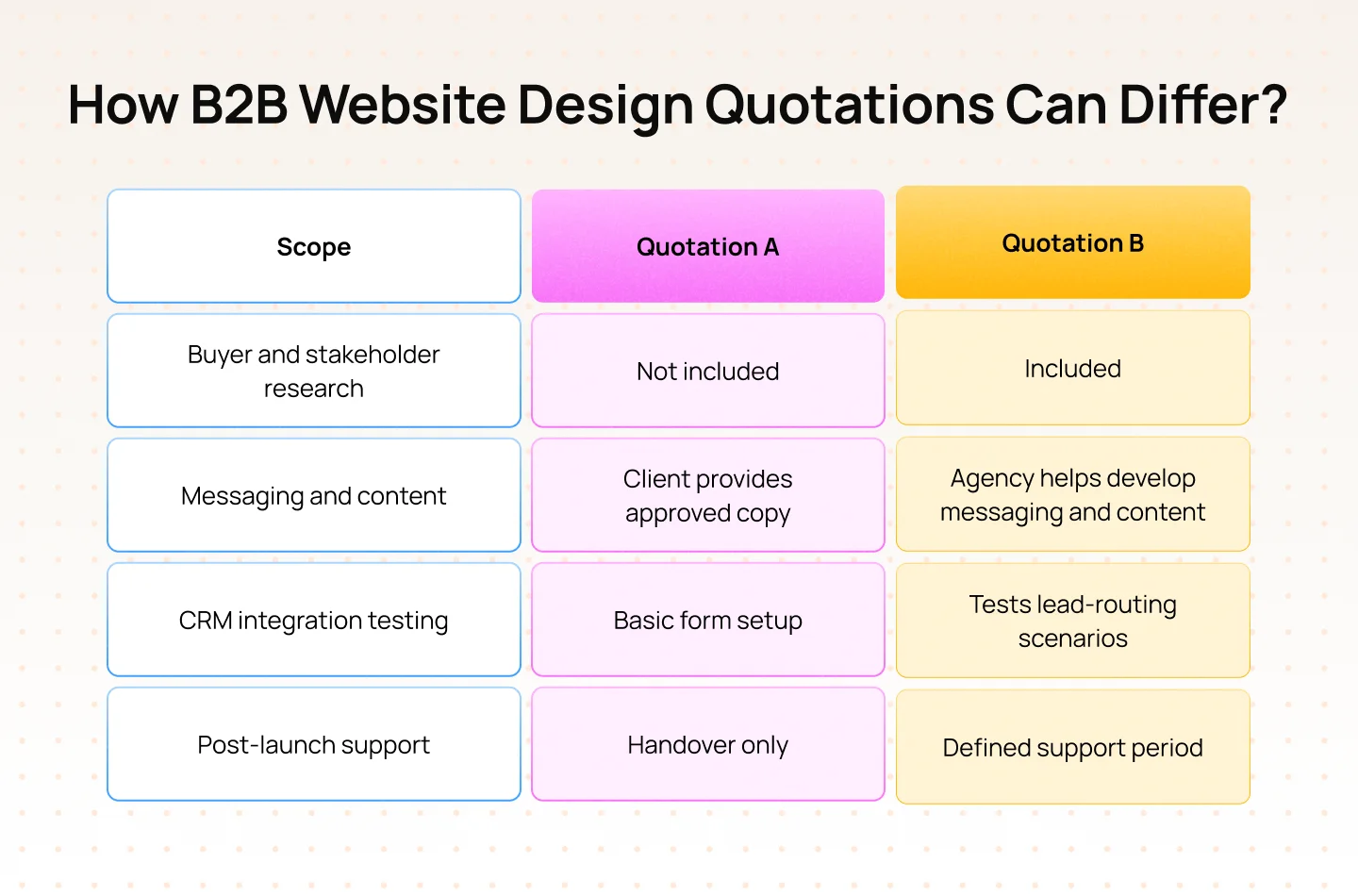
Quote A may cost less because your team is responsible for more of the work. This can be a reasonable option if you already understand your buyers, have approved messaging, and can manage the website internally.
Quote B covers additional activities that may be important if your team lacks the necessary research, content, or technical resources. However, a broader scope is not automatically better. The right proposal is the one that covers the work your business needs without paying for services you do not require.
Some expenses become apparent only after a project begins or the website goes live.
Before signing, ask each agency to identify exclusions, explain how changes will be priced, and confirm who is responsible for providing content, approvals, and access to internal systems.
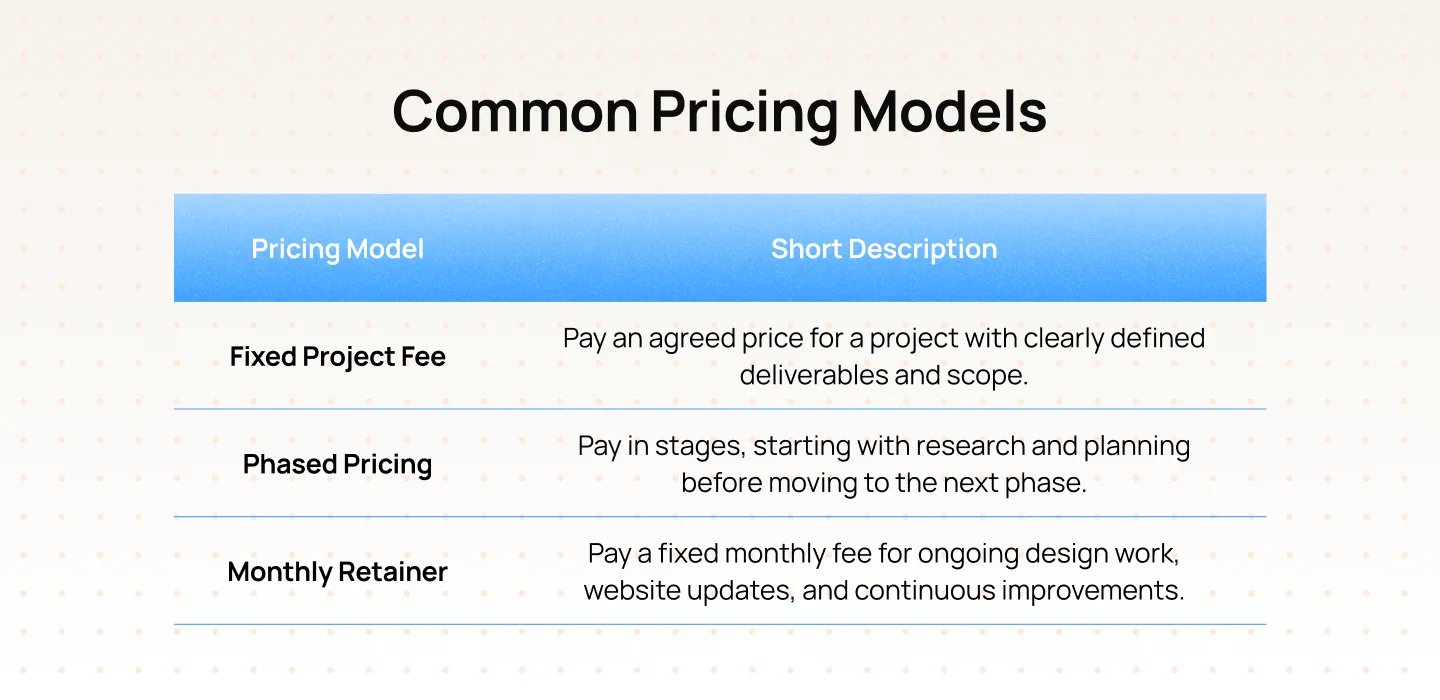
B2B website agencies may structure their fees in different ways, depending on how clearly the work can be defined and how much ongoing support is needed.
Whichever model you choose, compare proposals using the same scope and deliverables. Ask what is included, what costs extra, how changes are handled, and what support is available after launch. A clear agreement helps you understand the investment and reduces the risk of unexpected costs.
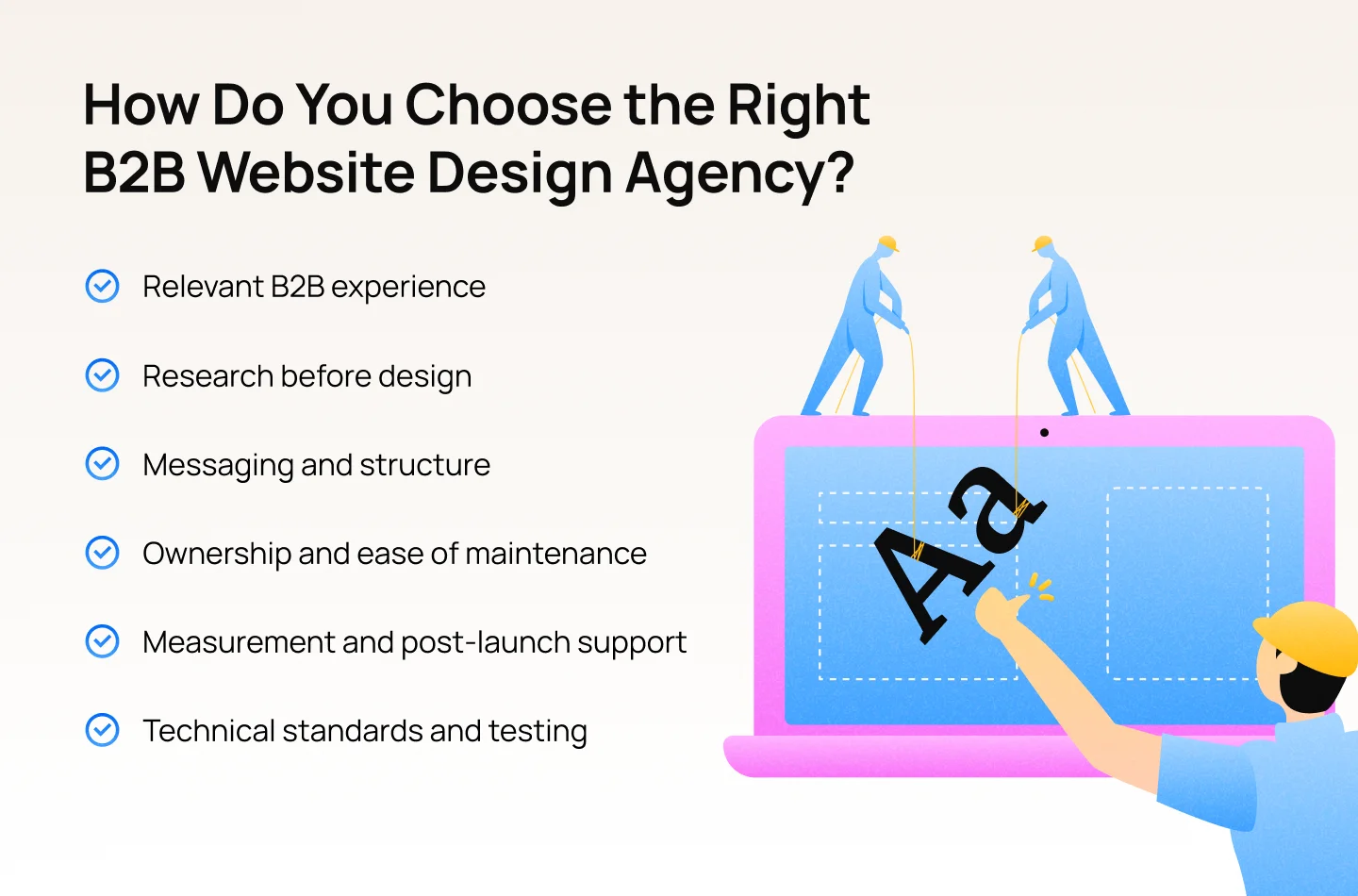
Choosing a B2B website design agency requires more than reviewing portfolios. You need a partner that understands your buyers, can translate business requirements into a clear website experience, and has the capabilities to deliver and support the project. These six criteria can help you evaluate agencies based on what your business actually needs.
Look for projects involving challenges similar to yours, such as complex products, multiple buyer roles, or long sales cycles. A useful case study explains the original problem, the decisions the team made, and the results—not just what the finished website looks like. Ask the agency which projects are most relevant to your business and why.
An agency should understand your buyers before deciding how the website should work. Ask whether it gathers insights from buyers, sales teams, and customer success teams, and how those findings influence the site structure, messaging, and user journey. This is especially important when your offering is complex or different stakeholders need different information.
Your website needs to explain what you offer, why it matters, and how it differs from other options. Ask who will shape the messaging, organize the content, and determine which information belongs on each page. Clarify whether these activities are included in the proposed scope or whether your team must provide the strategy and copy.
Your team should be able to manage routine website updates without relying on the agency for every change. Ask how the agency plans to structure the CMS, document the website, and hand over the necessary access and assets after launch. Clarify which updates your team can handle independently and which may require developer support. This helps you assess whether the website will remain practical to maintain as your business evolves.
Launching the website is not the same as knowing whether it works. Ask how the agency plans to measure performance, which analytics tools and metrics it will use, and what support is available after launch. The measures should reflect your goals, such as helping buyers reach relevant pages or making it easier for qualified prospects to contact your sales team. Clarify which services are included in the project fee and which cost extra.
Website performance, accessibility, security, and integrations all affect the experience buyers have and the way your team receives and manages leads. Ask what the agency tests before launch, who is responsible for each check, and whether you will receive documentation of the results. If your website connects to a CRM or other business systems, make sure those integrations are included in the agreed scope.
Once you have shortlisted potential agencies, clarify how the partnership will work in practice. The following questions can help you identify risks before the project begins.
Who will work on our project?
Ask who will be responsible for the day-to-day work, what experience they bring, and who will make key decisions. You should also know whom to contact when questions or delays arise.
What happens if a key team member becomes unavailable?
Projects can run for months, and staffing changes happen. Ask how the agency handles absences or departures, who can take over, and how project knowledge and progress will be maintained.
Who owns the work when the project ends?
Clarify ownership and handover arrangements for design files, code, content, and other project assets. Confirm what your team will receive at the end of the engagement and document the agreement in the contract.
Before making your final decision, compare agencies against the same criteria and confirm what each proposal includes. The strongest choice is not necessarily the agency with the most impressive portfolio, but the one whose experience, working process, and scope best match your business needs.
If you are looking for the right B2B website design partner, explore Lollypop’s projects to see how the team approaches website design, or explore an approach that aligns with your business goals and buyers’ needs.
Choosing a B2B website design agency is not just about finding a team that can build an attractive website. It is about finding a partner that understands your buyers, addresses your website’s current challenges, and can deliver a solution that fits your business goals and internal capabilities.
Before making a decision, identify what your website needs to achieve, which capabilities your team lacks, and what each agency will deliver. Compare proposals based on their scope, working process, technical capabilities, and post-launch support—not just their portfolios or quoted prices.
Ready to make your B2B website work harder for your business? Talk to Lollypop to discuss your goals and explore how a well-designed website can build buyer trust and support your sales process.
A B2B website design agency helps businesses plan, design, and build websites that communicate their value to business buyers and support their sales goals. Depending on the project scope, services may include buyer research, content structure, UX/UI design, development, CMS setup, and post-launch support.
The cost depends on the website’s complexity, the services included, and the level of support required. Research, content development, integrations, and post-launch improvements can increase the project scope. Before comparing quotes, review each proposal’s deliverables, exclusions, and additional fees to understand what you are paying for.
A redesign may be worth considering if your website attracts traffic but generates few qualified leads, buyers struggle to understand your offering, or your existing structure no longer supports your business goals. Before committing, identify the underlying problem to determine whether you need a full redesign or targeted improvements.
The timeline depends on the project scope, website complexity, technical requirements, and how quickly your team provides content and feedback. Ask the agency to outline key milestones, responsibilities, and approval timelines before work begins so you can plan resources and set realistic expectations.