Launching a SaaS product, or even just a new feature, without validating user needs can lead to costly failures. Many startups struggle with building too much, too soon, only to face low adoption rates or run out of funding.
In a highly competitive SaaS landscape, continuous product development is essential — but it must be balanced with thoughtful planning and financial discipline. That’s why the Minimum Viable Product (MVP) approach has become a popular strategy. It allows companies to test ideas quickly, minimize waste, and refine products based on real user feedback.
In this article, Lollypop explores the minimum viable product definition, its benefits, the main MVP types, and how to build a minimum viable product using the Lean UX approach.
Let’s dive in.
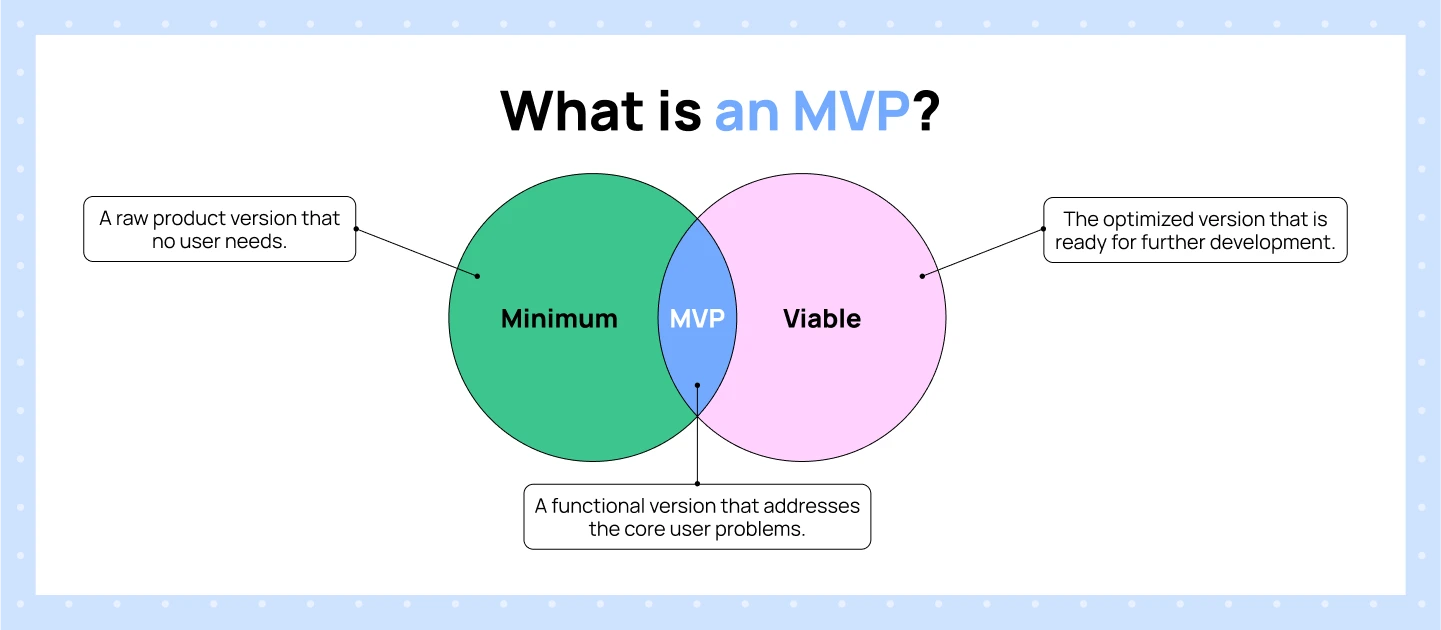
A Minimum Viable Product (MVP) is the most simplified version of a product that can still deliver meaningful value to users. It includes only the essential features needed to solve the core problem the product is intended to address. The main goal of an MVP is to launch quickly, test the idea in the real world, and learn from actual user interactions with minimal resources.
The term “Minimum Viable Product” breaks down into 2 parts:
Instead of building a fully-featured product from the start, the MVP approach focuses on building just enough to collect user feedback and validate assumptions. This helps product teams avoid wasting time and money on features that users might not want or need.
Launching a new SaaS product can be a complex and resource-intensive process. Building a Minimum Viable Product (MVP) helps you start small, validate ideas early, and scale with confidence.
Here are the benefits of minimum viable product to your SaaS development journey:
When building an MVP, it’s important to recognize that not all MVPs serve the same purpose. They can vary in complexity based on your goals, timeline, and available resources.
Broadly, MVPs fall into two main types:
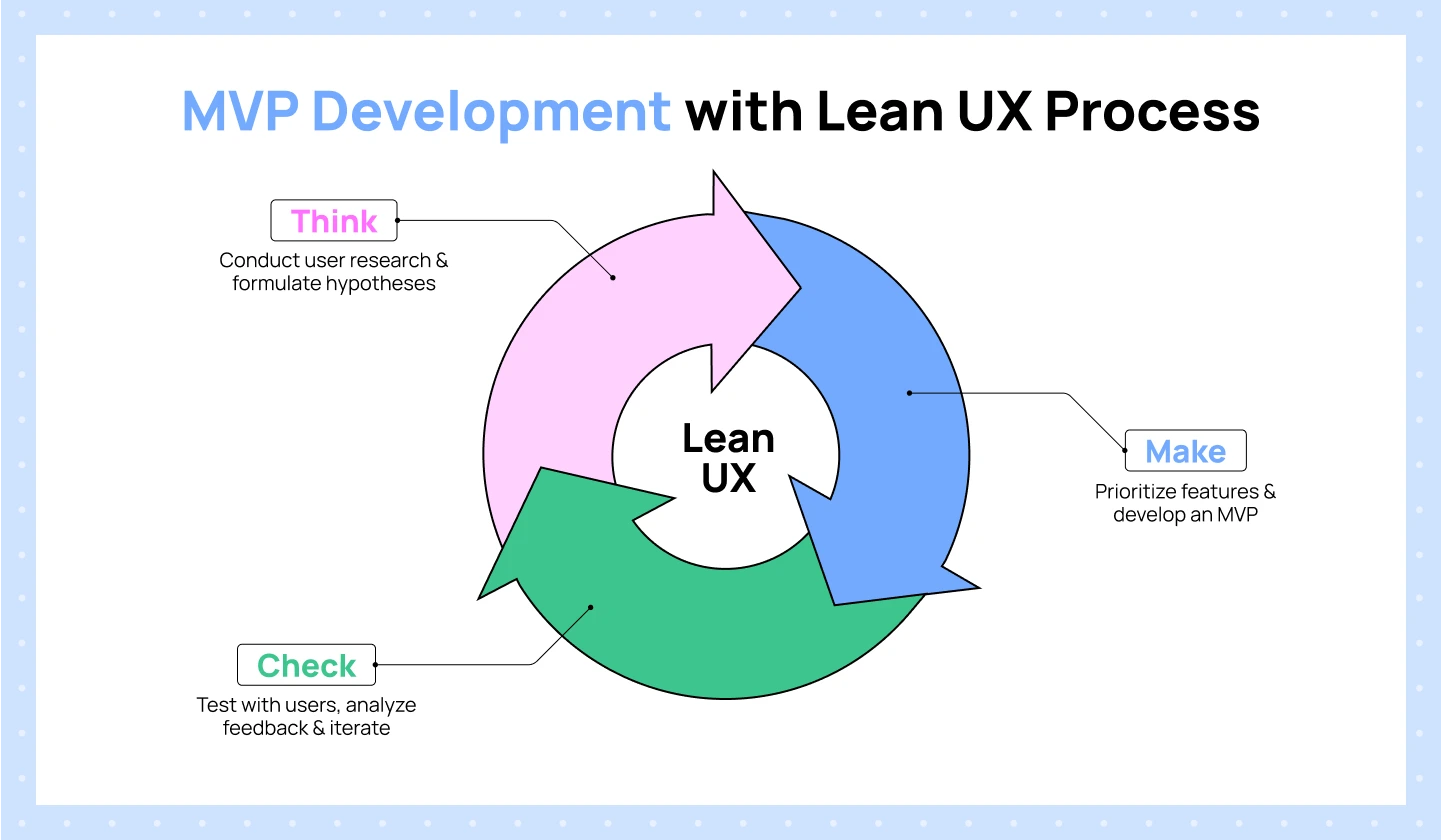
Lean UX is a design approach that emphasizes minimizing unnecessary tasks and quickly building a minimum viable product to gather rapid user feedback. This transforms design into a hypothesis-driven process, where each decision is informed by user insights before scaling further.
Let explore the lean UX process to creating a minimum viable product as below!
In the “Think” phase of the Lean UX approach, the focus is on deeply understanding the user, the business context, and the problem space — all essential to shaping a meaningful and focused MVP.
Rather than jumping into features, this phase helps teams validate whether there’s a real user need worth solving. Through user research (interviews, surveys, analytics), competitive analysis, and stakeholder alignment, teams gather the insights needed to define a strategic foundation for the MVP.
Deliverables:
In the “Make” phase, your MVP starts to take shape. Leveraging insights and hypotheses formed in the “Think” phase, the team begins to ideate, sketch, prototype, and build a functional version of the product — just enough to validate with users.
This step is not about building a complete product. It’s about designing a lean, focused MVP that tests core assumptions, delivers value to users, and helps you gather meaningful feedback quickly.
During this stage, you should:
Deliverables:
In the “Check” phase, the goal is to validate whether the MVP effectively meets user needs and solves the intended problem. This is achieved by testing the product with real users, gathering both qualitative insights (through interviews or observations) and quantitative data (through usage metrics, surveys, or A/B testing).
The team analyzes the feedback to identify what resonates, what causes friction, and what needs improvement. This phase is critical for learning — not just about the product, but about user behavior and expectations.
If the core assumptions are validated, the team can move forward with confidence. If not, findings are used to iterate, refine the MVP, or pivot as needed. This feedback loop ensures smarter product decisions before significant time or resources are invested in full-scale development.
Deliverables:
Building a minimum viable product agile is a strategic move for any SaaS business, especially in a fast-paced, resource-sensitive environment. It allows you to validate ideas, reduce financial risk, and build products that truly align with user needs before committing to full-scale development. By focusing on learning and iteration, MVPs help you move faster, smarter, and with more confidence.
If you’re planning to bring an innovative SaaS product to market and are looking for those offering minimum viable product development services, Lollypop is here to help. As a global SaaS design agency specializing in UI/UX, we don’t just create beautiful interfaces — we build complete, scalable product experiences powered by strategy, SaaS metrics, and emerging AI SaaS technologies.
From early-stage discovery to MVP SaaS development and product scaling, we offer end-to-end design and development services tailored to your business goals.
Get in touch for a FREE consultation and let’s explore how we can help future-proof your SaaS UX product design, together.
The development of a Minimum Viable Product (MVP) typically takes between 2 to 6 months, depending on the complexity of the idea, the size of the development team, and the resources available.
While POC, MVP, and Prototype are all early-stage development tools, they serve different purposes. A POC (Proof of Concept) is designed to demonstrate whether a particular idea, technology, or feature is feasible. A prototype, on the other hand, is a preliminary model or mock-up that showcases how a product might look and function, often used to visualize the user experience without full functionality. An MVP (Minimum Viable Product) is a functional version of the product that includes only the essential features needed to meet initial user needs and gather feedback.
Many successful SaaS companies started with simple MVPs focused on solving a clear user problem. For example, Dropbox initially created a basic explainer video demonstrating how their file-sharing technology would work, gauging user interest before building a full platform. Airbnb’s first MVP was a simple website that allowed the founders to rent out their own apartment to test the idea. Buffer, a social media scheduling tool, began with just a landing page explaining the concept and a signup form to measure interest.