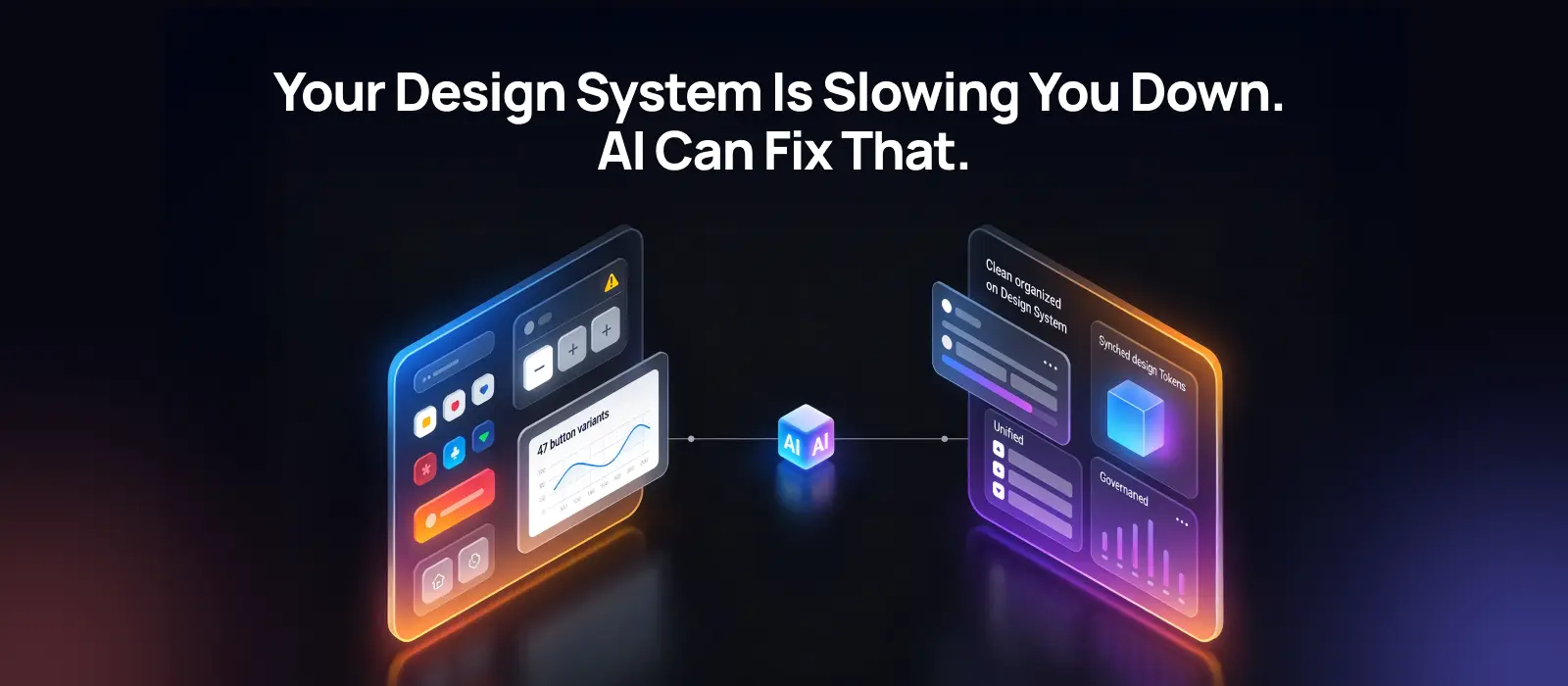
This might have happened with your organization. Your product team is scaling fast. You’ve got twelve squads shipping concurrently and a design system that’s been carefully built over three years. A dedicated team is doing everything to keep up. But can’t help it. All due to a few new components that appeared in the codebase that were never reviewed. Token values drift subtly between platforms. A rebrand that should take a week takes a quarter because nobody knows which of the forty-seven button variants is the official one.
It looks like a human failure. But it’s a failure of the model. It happened because manual design governance was never built at the same pace as models. What is the solution? The enterprises moving fastest in 2026 have figured out a different approach: they’ve turned to agentic AI design systems that govern themselves, requiring little to no human intervention.
The question for enterprise leaders isn’t whether to automate their design systems. It’s whether they can afford not to.
For enterprise leaders evaluating scalable digital infrastructure, traditional human reviews introduce structural friction. Automated design governance solves this by embedding autonomous AI agents directly into the design-to-code pipeline. By shifting from reactive audits to proactive, self-running system cross-checks, organizations eliminate visual debt, maintain a cross-platform source of truth, and prevent token drift across large-scale software engineering teams.
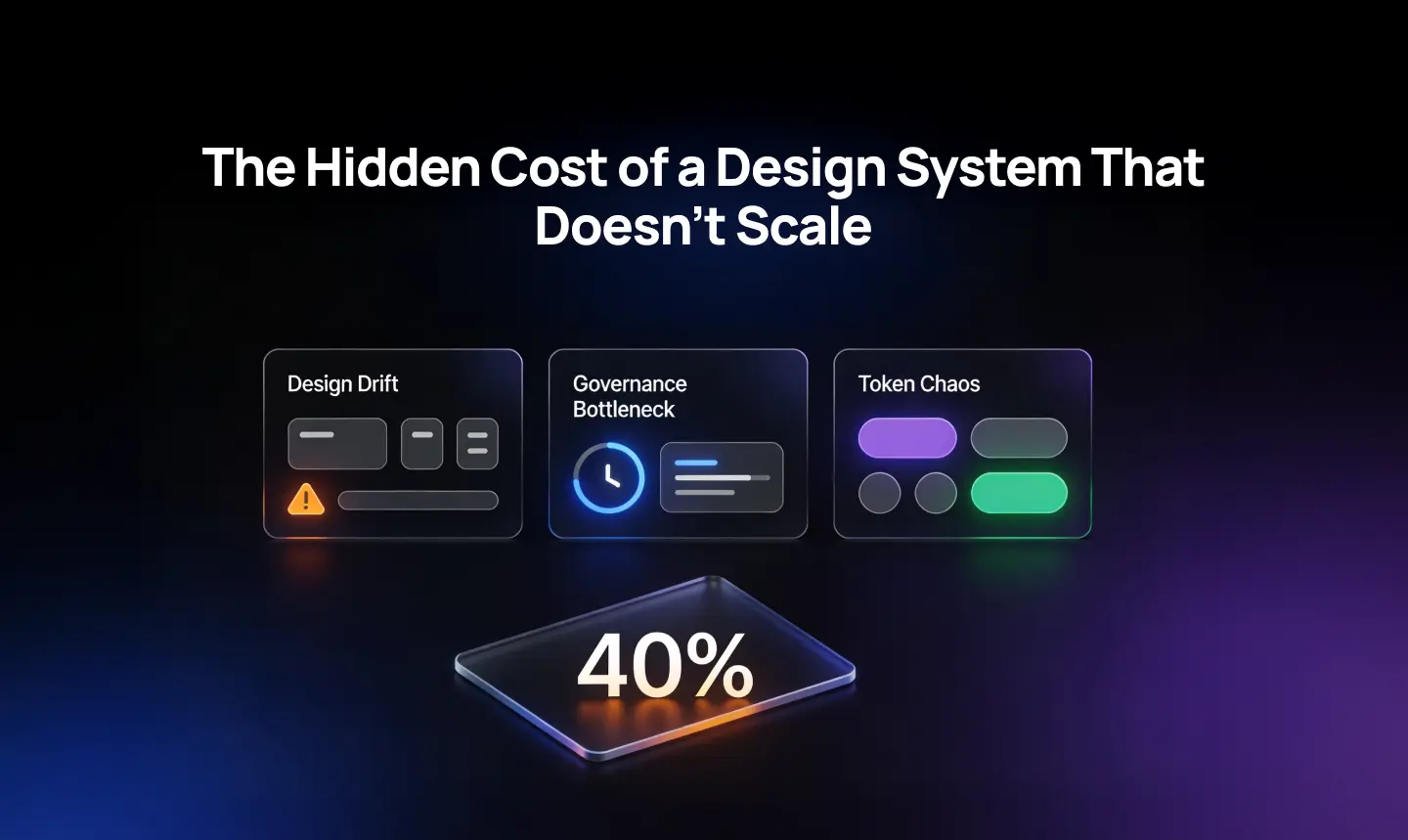
Most design system problems don’t announce themselves. They compound quietly. A developer builds a new card component because they couldn’t find it in the library. Similarly, another team ships a different shade of your brand, and nobody caught it. A third team skips the design review in a hurry. By the time leadership notices—usually during a brand audit or a major product launch—the visual debt is enormous. And the cost of cleaning it up is measured not in hours but in sprints.
What breaks when enterprise design systems grow without AI governance:
Components diverge silently across codebases with no one catching the changes.
Human reviewers can’t keep pace with the volume of changes teams ship daily.
Tokens drift between Figma, the codebase, and production with no automated sync.
Manual governance breaks under this weight — the solution isn’t more people, it’s a smarter system.
40%
of enterprise applications will embed AI agents by the end of 2026—up from less than 5% in 2025. Design systems are at the center of that shift. (Gartner, 2026)
The deeper problem is structural. As your organization grows, the complexity of your design system grows exponentially—but the team managing it grows linearly, if at all. That gap is where consistency goes to die. What enterprises need isn’t a bigger design system team. They need a smarter system.
Stop losing engineering capacity to manual UI tracking and token chaos. Book an enterprise-scale evaluation with our strategy team.
The term “agentic AI” gets thrown around a lot. In the context of design systems, it means something specific and practical: AI agents that take over the routine, rules-based work of maintaining your design system so your team can focus on the work that actually requires human judgment. Think of it less like deploying a tool and more like hiring a team of tireless specialists who work around the clock.
None of this requires replacing your design team. It requires giving them better infrastructure. An agentic design system doesn’t replace designers. It removes the work that was never a good use of their time in the first place.
At Lollypop, we’ve developed a clear, phased approach to taking enterprises from where they are today to a fully autonomous design system. It’s not a rip-and-replace. It’s a deliberate progression — each phase delivering measurable value before the next begins.
No big-bang transformation — each phase stands on its own and compounds the next.
Phase 1: Clarity First
Before any automation is useful, you need an honest picture of what you’re working with. Our audit goes deeper than reviewing Figma files. We map the full health of your design system: how many components exist versus how many are actually used; where your tokens are out of sync; which teams have stopped trusting the system and why; and what’s technically preventing automation from being deployed today.
The output isn’t a report that lives in Confluence. It’s a prioritized action plan that tells you exactly what to fix first to get the highest return from everything that follows. Enterprises consistently tell us this phase alone saves months of misdirected effort.
Phase 2: Right Foundation
Most legacy component libraries weren’t built to be understood by machines. They were built for designers and developers to browse. An AI-ready component library is different; every component has a clear contract, defined behaviors, and structured metadata that both humans and AI agents can evaluate and act on. We rebuild or refactor your library with this in mind.
The result is a component library that doesn’t just look good in Storybook — it actively powers the governance and generation agents that come later. This is the foundation that makes everything else possible through structured UI UX Design Services.
Phase 3: No More Token Chaos
Token management is where most design systems break down at scale. A color change in Figma shouldn’t require a developer to manually update four different files across three platforms. It should propagate automatically, be validated for accessibility compliance, and reach production without anyone needing to think about it.
We implement the full token automation pipeline — from your Figma design files through to every platform your product runs on. Token changes are validated against industry standards before they ship, and every change is logged with full rollback capability. What used to take a sprint now takes minutes.
Phase 4: Full Automation
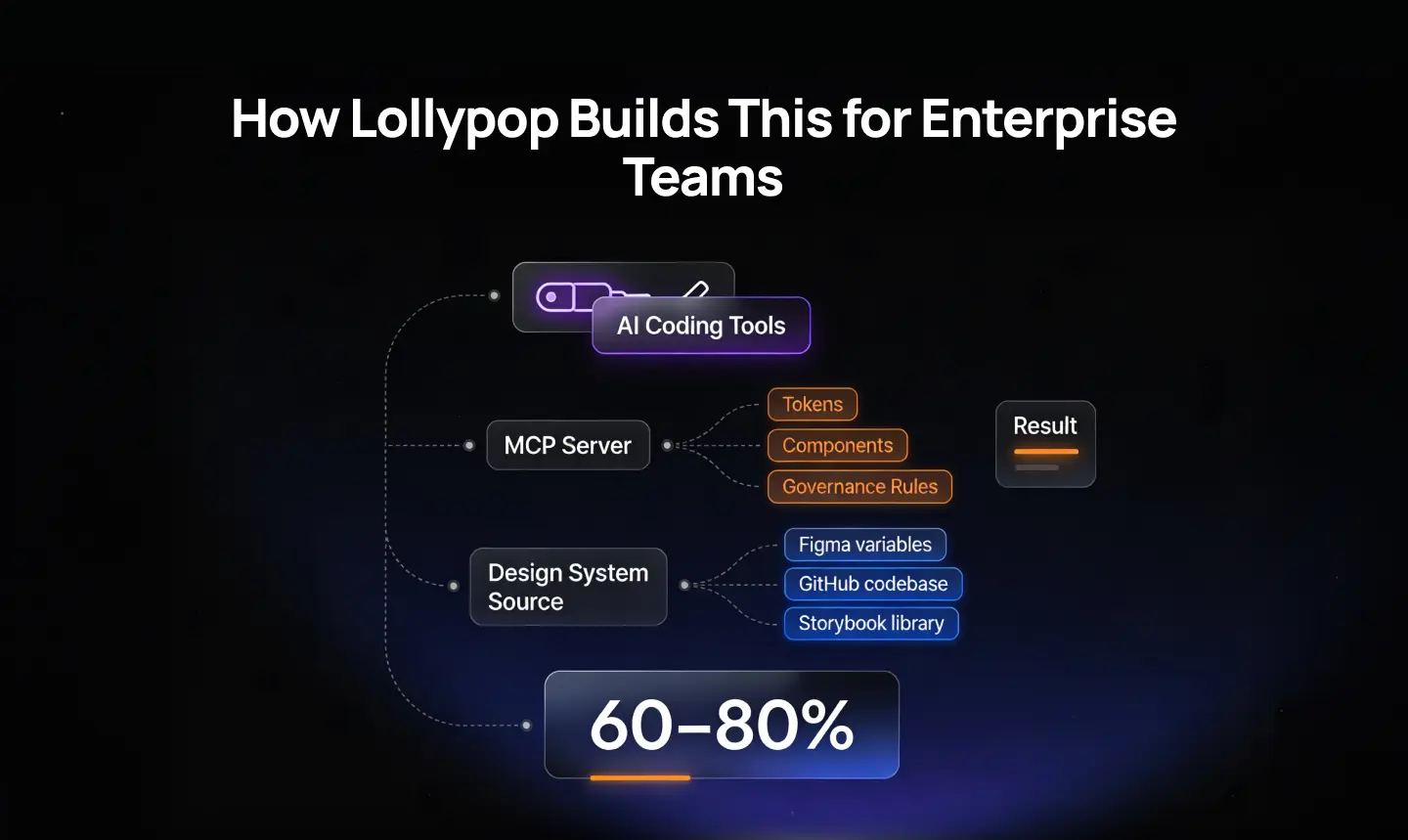
This is the piece that ties everything together, and it’s where the real leverage lives. Your engineers are already using AI coding tools — Cursor, Claude Code, and GitHub Copilot. Without a design system integration, those tools generate components that look plausible but don’t match your system. Token values are slightly wrong. Component names are close but not right. And every deviation adds to your visual debt. Discover the shift in developer environments in our analytical breakdown on AI Wireframing and Autonomous Tech Stacks.
We deploy a custom Model Context Protocol (MCP) server that makes your design system queryable by any AI tool your team uses. When an engineer asks an AI to build a feature, the AI consults your actual design system — your real tokens, your real components, your real rules — and generates code that conforms.
*MCP connects AI coding tools directly to your design system — so AI generates the right code, not an approximation of it.*
60–80% reduction in design review cycle time reported by enterprises after deploying AI governance agents — from days to minutes.
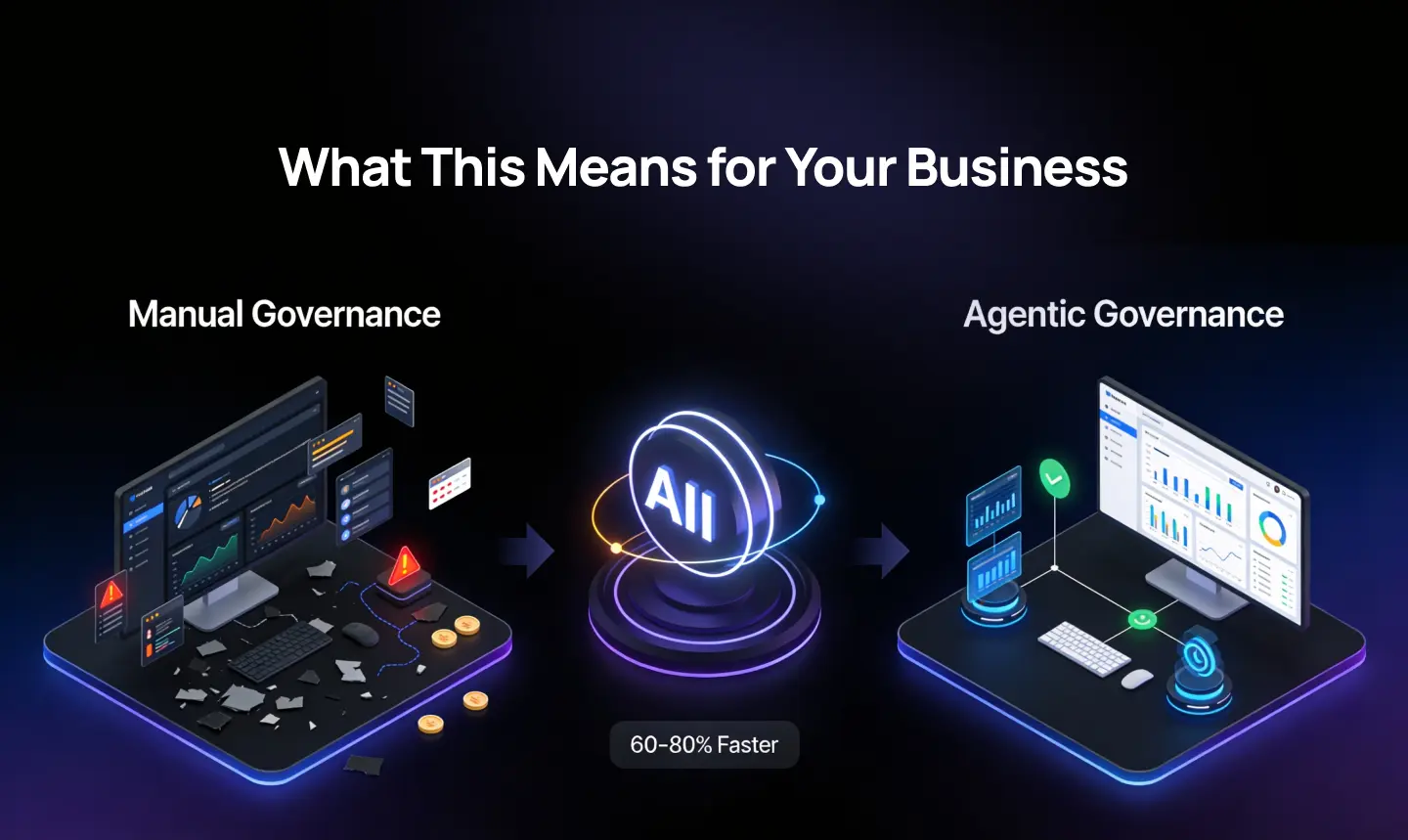
The business case for agentic AI design systems isn’t theoretical. The value shows up in places that matter to leadership.
| Operational Metric | ✗ Manual Governance | ✓ Agentic Governance |
|---|---|---|
| PR review cycle | Days to weeks | Seconds—automated agents |
| Token sync | Manual breaks constantly | Auto-pipeline, validated always |
| Drift discovery | Quarterly audits | Continuous, real-time alerts |
| New team onboarding | 3–6 weeks to adopt the system | Days—MCP makes it easy |
| Brand change rollout | Full sprint effort | Minutes through the pipeline |
| Review cycle savings | 0% | 60–80% time reduction |
One of our enterprise clients—a global SaaS company with fourteen product squads — reduced their per-sprint design review overhead by 70% within three months of deploying their governance agents. That’s not a rounding error. That’s the capacity that went back into building the product.
The biggest misconception about agentic design systems is that they require a big-bang transformation. In reality, the path is incremental, and value arrives at every step.
Enterprises that do this well start with a clear audit—understanding where they actually are before deciding where to go. They fix the foundations before automating on top of them. They introduce automation in the places where the pain is highest first. And they measure the impact at each stage so they can make the case internally for the next investment. The organizations that struggle are the ones that try to automate a broken system or that deploy AI tooling without first ensuring the design system it references is trustworthy. Automation amplifies what’s already there — good or bad.
Automating a broken design system doesn’t fix it. It makes the problems faster. The audit comes first. This is why our phased approach exists. It’s not caution for caution’s sake — it’s the path that consistently delivers results without creating new problems to solve.
Design systems are infrastructure. And like any infrastructure shift — cloud migration, API-first architecture, mobile-first design — the organizations that move early compound advantages that latecomers struggle to catch up with. The enterprises building agentic design systems today aren’t doing it because it’s trendy. They’re doing it because they’ve done the math: the cost of manual governance at scale is unsustainable, and the technology to replace it is ready now.
At Lollypop, we’ve spent years at the intersection of design systems and enterprise scale. We know what breaks, what holds, and what actually delivers results— not just in demos, but in production, across real teams, at real scale. If your design system is starting to slow you down rather than speed you up, that’s the signal. The question is whether you address it before your competition does.
An agentic AI design system uses specialized autonomous AI agents (such as Governance, Token, and Drift Detection agents) to run continuous, automated cross-checks between design files (Figma) and the engineering production environments. Unlike simple static tools, these agents operate independently to execute governance tasks without requiring continuous manual code or design reviews.
Model Context Protocol (MCP) acts as an open standard connection layer that securely exposes your enterprise design tokens, component library rules, and visual style sheets directly to engineering tools like Cursor, Claude Code, and GitHub Copilot. This makes your live design files contextually readable by generative AI coding models, ensuring AI-generated components naturally fit your brand standards.
Visual debt accrues when fast-moving engineering teams concurrently deploy slight code variations that deviate from the master component parameters. Over time, missing library documentation or rushed pull-request (PR) reviews generate hundreds of undocumented button mutations, color variants, or text styles, requiring full sprints to re-align and fix.
No. Automated governance is integrated using a deliberate, phased system optimization approach. The process starts by conducting a deep health check of your design file dependencies, structurally standardizing your core components metadata for AI readability, and then connecting automated pipelines incrementally without changing your running production tech stack.
Design tokens operate as centralized cross-platform code variables storing stylistic variables (spacing matrices, brand color swatches, typographic weights). In an automated system ecosystem, modifications executed within your design canvas auto-propagate outward across all running engineering directories instantly, removing the error-prone risks of manual asset updating.