AI is making design easier to produce.
Ideas can be explored in minutes. Interfaces can be generated before a designer opens a traditional design tool. User flows, prototypes, copy, and visual directions can be iterated at a speed that would have seemed unrealistic only a few years ago.
But when creation becomes easier, creating more is not necessarily the same as creating better.
The more AI expands what we can make, the more important it becomes to decide what is worth making, who it serves, what it consumes, and what happens when it scales.
That is where sustainable design enters the conversation.
Because in the age of AI, sustainable design is not only about designing for the planet. It is about designing with awareness of the people, resources, systems, and consequences connected to what we create.
AI is making design easier to produce.
Ideas can be explored in minutes. Interfaces can be generated before a designer opens a traditional design tool. User flows, prototypes, copy, and visual directions can be iterated at a speed that would have seemed unrealistic only a few years ago.
But when creation becomes easier, creating more is not necessarily the same as creating better.
The more AI expands what we can make, the more important it becomes to decide what is worth making, who it serves, what it consumes, and what happens when it scales.
That is where sustainable design enters the conversation.
Because in the age of AI, sustainable design is not only about designing for the planet. It is about designing with awareness of the people, resources, systems, and consequences connected to what we create.
AI brings abundance into the design process: more ideas, more iterations, more experiments, and more ways to explore a problem.
That can be liberating. Designers can compare directions faster, prototype earlier, and spend less time on repetitive production work.
But abundance creates its own challenge.
When the cost of creating something becomes lower, the cost of deciding what is worth creating becomes more important.
AI can generate an answer without understanding whether it is the right question. It can produce something plausible without knowing whether it is meaningful, necessary, or responsible.
That is why the value of design does not disappear when AI becomes better at generating things. It moves upstream.
Designers increasingly have to decide what deserves attention before deciding what should be produced.
For a long time, the designer’s value was closely associated with the ability to make. Creating visual systems, structuring interfaces, prototyping products, and communicating ideas were all significant parts of the profession.
AI is changing that relationship.
As some forms of production become faster and easier, design judgment becomes more important. Designers increasingly need to determine what deserves attention before deciding what should be produced.
Is this a real problem? Who experiences it? Who benefits? Who might be excluded? What assumptions are embedded in the solution? What happens when it scales? And what should remain a human decision, even when technology could automate it?
AI can expand the range of possible answers. Designers still have to decide which direction is worth pursuing.
That shift moves the designer’s role beyond making—and changes what sustainable design can mean.
Rather than following a fixed formula, sustainable design requires different ways of thinking: staying grounded in what matters, remaining open to change, exploring different directions, and looking beyond the immediate solution.
AI is changing the tools designers use. But tools alone do not define how good a designer can become.
The real test begins when there is no single right answer — when the problem is complex, the time is limited, perspectives are different, and every decision has consequences.
That is where challenge matters.
Designers need spaces where they can move beyond producing polished outputs and practice the skills that will define design in the AI era: questioning assumptions, framing problems, collaborating across perspectives, making decisions with limited information, and understanding the impact of what they create.
Designathon 2026 was built around that kind of challenge.
For 24 hours, designers from around the world will come together in Ho Chi Minh City to work on a real-world brief. They will research, debate, sketch, test, rethink, and make decisions under pressure alongside people who may approach the same problem from completely different perspectives.
There is no AI tool that can replace that experience.
The value of a challenge is not simply the final design.
It is how you think when you have to make it.
Design problems rarely exist within a single perspective.
A product designed in one market may behave differently in another. A solution that feels intuitive to one group may feel unfamiliar to another. And a problem that seems obvious from one cultural context can look completely different from another.
That is why collaboration across cultures matters.
Designathon 2026 brings designers from around the world into the same room — not simply to exchange techniques, but to challenge each other’s assumptions.
A different perspective can change the way you frame a problem. A different discipline can reveal a blind spot. A different cultural context can turn a familiar solution into a new question.
In the age of AI, when technology can make ideas increasingly similar and scalable, human perspective becomes an even more valuable source of difference.
Different people. Different perspectives. One 24-hour challenge.
If the role of designers is changing, then the way we approach a design challenge needs to change too.
Sustainable design in the age of AI is not about finding one perfect formula. It is about balancing different ways of thinking: staying grounded while remaining adaptable, acting with intention while looking beyond the immediate solution.
That idea sits at the heart of Designathon 2026: Sustainability in the Age of AI.
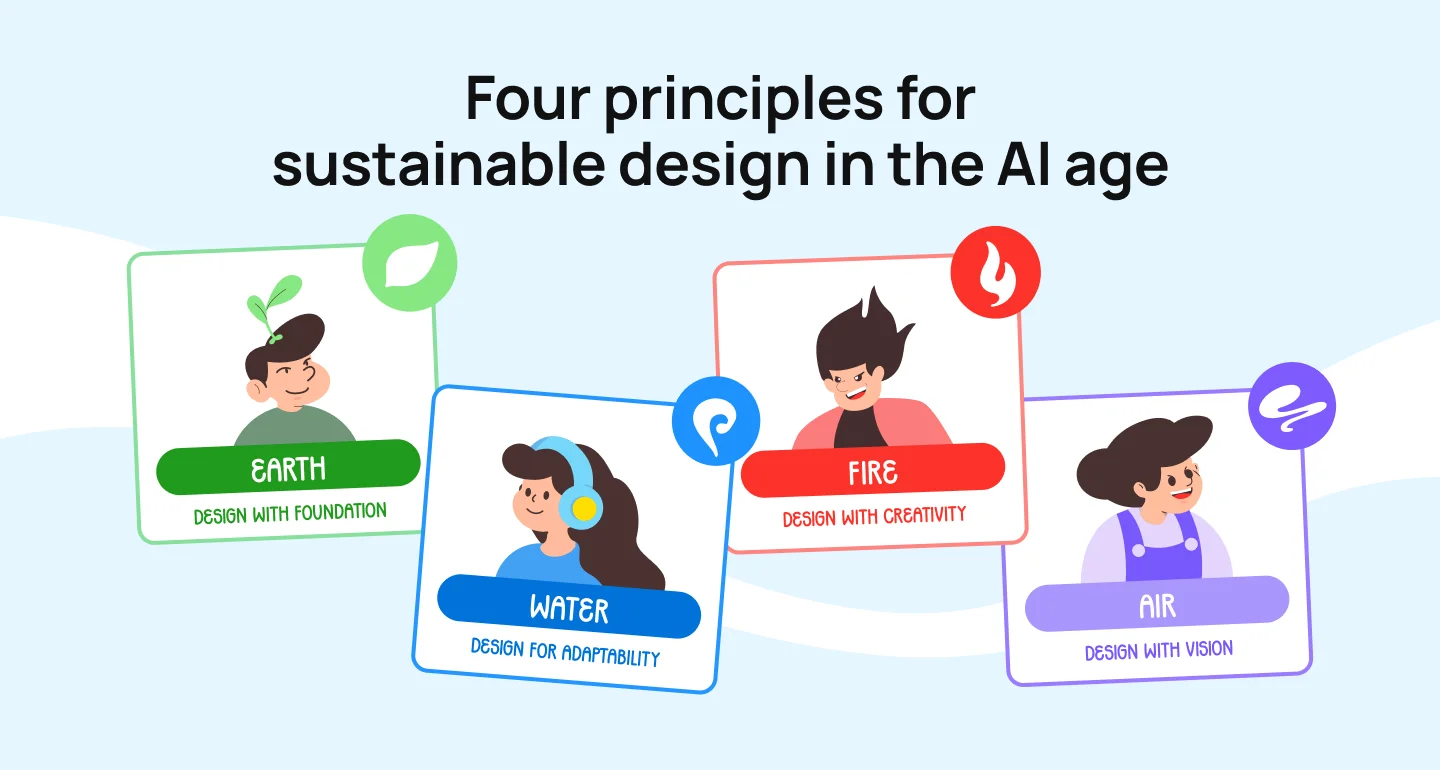
The four elements of this year’s theme represent four qualities designers can bring into the challenge.
Earth represents grounding: start from what matters.
Water represents adaptability: stay open to change.
Fire represents intention: turn ideas into meaningful action.
Air represents perspective: look beyond the obvious.
Together, they form a simple idea: Good design doesn’t come from one way of thinking. It comes from knowing when to stand your ground, when to adapt, when to act, and when to look beyond.
And that is where the challenge begins.
Start with what matters.
AI makes it increasingly easy to start with possibility: generate an idea, explore a direction, or produce a solution in seconds.
Earth asks designers to pause before that.
Sustainable design starts by understanding the people, context, and evidence behind a problem. Who actually needs this? What is happening today? What makes the problem meaningful? And what would happen if we chose not to solve it?
This matters even more when AI can turn an assumption into a polished output almost instantly. The faster we can produce something, the more important it becomes to make sure we are producing the right thing.
Grounding a design means understanding what matters before deciding what to make.
Stay open to change.
Design rarely moves in a straight line. New information can challenge an assumption. A user’s behavior can reveal something unexpected. Another perspective can completely change how a problem is understood.
Water represents that ability to adapt.
In the age of AI, designers have more opportunities to explore, test, and revise ideas quickly. But speed should not make us attached to the first direction that works.
Sustainable design requires the willingness to listen, learn, and change course when the challenge demands it.
The goal is not to predict every possible future.
It is to design with enough openness to respond when the future changes.
Explore different directions.
AI can expand the number of ideas a designer can explore. But having more options does not automatically lead to a better solution.
Fire represents the energy to keep moving: to challenge the first idea, test different possibilities, and push a direction further.
Instead of using AI simply to produce faster, designers can use it to widen the field of exploration. Generate alternatives. Compare approaches. Test assumptions. Find the unexpected direction that would have been harder to reach through a single linear process.
The value is not in generating more for the sake of more.
It is in using more possibilities to discover a better one.
Look beyond the immediate solution.
A design does not exist in isolation.
Behind every interface is a wider network of people, technology, business, culture, infrastructure, and decisions. What seems like a small design choice can create very different consequences when it reaches a new audience or scales to millions of people.
Air represents the ability to step back and broaden the view.
Who is affected but not represented? What happens when the product scales? How might the experience change across different contexts? What assumptions are built into the system? And what happens after the user leaves the interface?
These questions move sustainable design beyond the product itself.
Good design considers the experience. Sustainable design considers what that experience becomes part of.
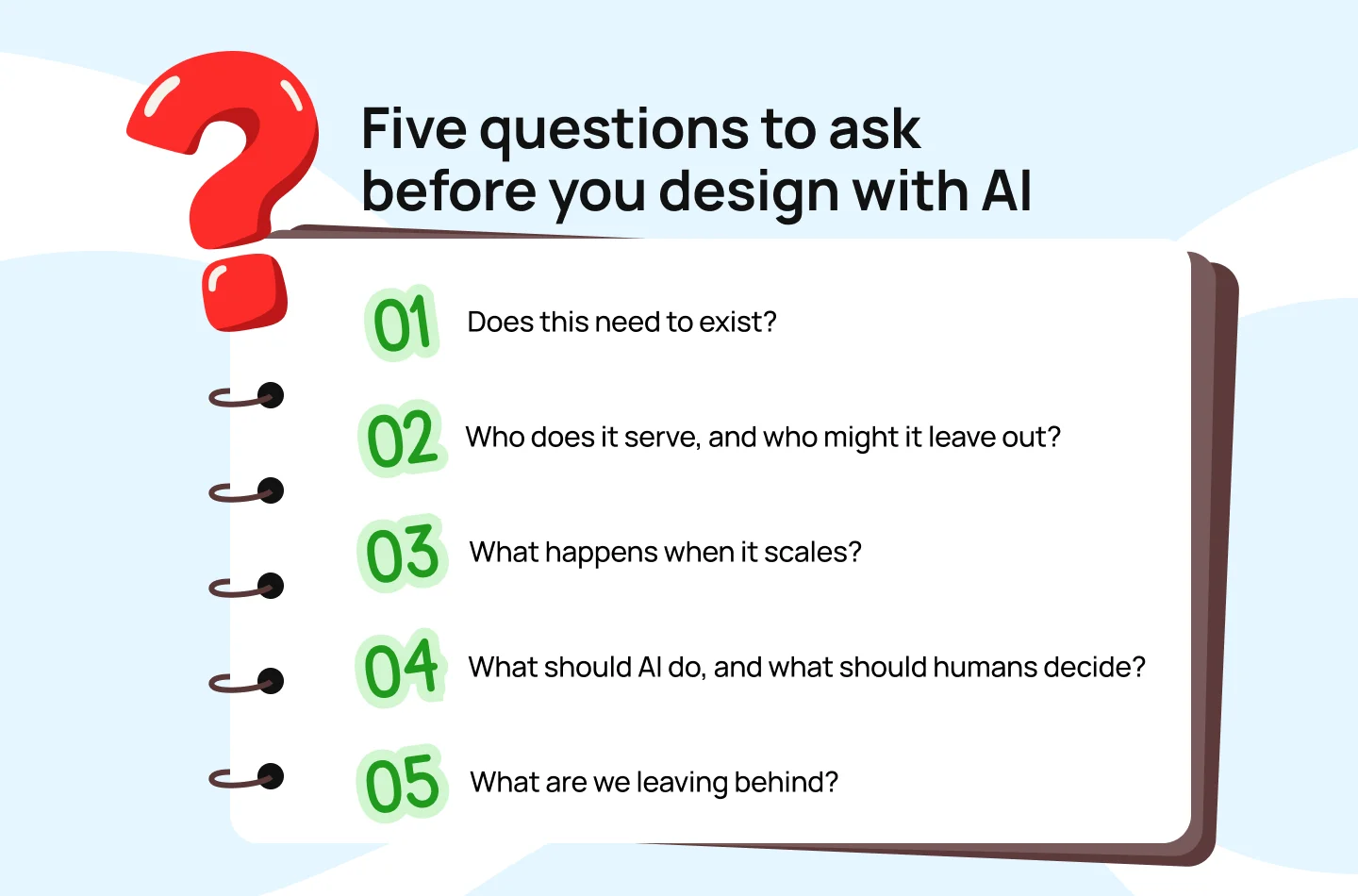
Sustainable design does not necessarily require a completely new design process. Sometimes, it starts by asking better questions at the right moments.
Before turning an AI-generated possibility into a real design direction, designers can pause and ask:
AI makes it easier to create. That does not make every idea necessary.
Start with the problem, not the technology. What need are we addressing, and what would happen if we chose not to build the solution?
A solution can work well for the people we designed for and still overlook everyone outside that picture.
Consider different abilities, backgrounds, behaviors, cultures, and contexts—not only the imagined “average” user.
A small decision can have very different consequences when repeated across thousands or millions of people.
Think beyond the prototype. What happens when the system grows, enters a new context, or becomes part of a larger ecosystem?
Not every decision needs to be automated simply because it can be.
Consider where AI can improve the process and where human judgment, accountability, or empathy should remain central.
Every design creates more than an output. It can consume resources, change behavior, replace existing practices, or make certain things more visible—or invisible.
Ask not only what the design creates, but what it changes, consumes, and leaves behind.
These questions are not a formula for sustainable design.
They are a way to create space for better judgment—especially when technology makes it easier than ever to move from an idea to an output.
These questions are difficult precisely because there are no simple answers. And that is what makes them worth exploring together.
Designathon 2026 brings designers from around the world to Ho Chi Minh City, Vietnam, for a 24-hour offline design challenge built around a real-world brief.
Across one intense day, participants will research, collaborate, challenge assumptions, explore different directions, and make decisions under pressure—working alongside people with different disciplines, experiences, and perspectives.
This year’s theme, “Sustainability in the Age of AI,” asks designers to look beyond what AI can do and consider what responsible design can become when technology, people, and the planet are increasingly interconnected.
It is not simply about designing faster.
It is about thinking deeper, making more thoughtful decisions, and designing with intention.
AI is changing how designers create. It is making exploration faster, production easier, and possibilities more abundant.
But abundance also creates a new responsibility.
When almost anything can be made, designers need to become more thoughtful about what deserves to be made.
That means understanding the problem before reaching for the solution. Staying open when assumptions change. Exploring beyond the first answer. And considering what a design becomes once it leaves the screen.
Sustainable design in the age of AI is therefore not about slowing technology down or rejecting what it makes possible.
It is about becoming more intentional with what we choose to do with it.
The future will bring better tools, faster systems, and more ways to create. The role of the designer is to bring something equally important to that future: judgment about what is worth creating.
Sustainable design in the age of AI means considering the long-term impact of what we create—not only on the environment, but also on people, resources, and the systems around a product or service. It asks designers to consider what a design consumes, changes, and leaves behind as it scales.
AI is making many forms of design production faster and easier. As a result, designers are increasingly expected to focus on problem framing, critical thinking, systems thinking, judgment, and decision-making—not only on producing design outputs.
AI can expand what designers are able to create, but greater creative possibility also brings greater responsibility. Designers need to consider whether a solution is necessary, who it serves, how it may scale, what resources it requires, and what consequences it could create.
The four elements are Earth, Water, Fire, and Air. They represent four ways of approaching a design challenge: Earth — Ground It, Water — Adapt It, Fire — Move It, and Air — See Beyond It.
Designathon 2026 is a 24-hour offline global design challenge taking place in Ho Chi Minh City, Vietnam. Designers from around the world come together to work on a real-world brief, collaborate across different perspectives, and develop a design solution within 24 hours.
Designathon 2026 is open to designers from around the world who are at least 18 years old. Participants can come from backgrounds including Research, UX Design, UI Design, Product Design, and Graphic Design.
Designathon 2026 takes place on 14–15 November 2026 in Ho Chi Minh City, Vietnam. The event is held offline and runs as a 24-hour design challenge.