94.8% of home pages had detected WCAG failures in 2025, with an average of 51 accessibility errors per page (WebAIM Million Report, 2025). What’s more telling is when these issues are discovered. For most teams, it happens during audits or after complaints, not during design.
That gap points to a larger shift in how accessibility is understood within product teams. Instead of being treated as a final compliance check, it is now closely tied to how users navigate products, how content is indexed by search systems, and how experiences convert across devices.
At that point, web accessibility guidelines stop being a checklist and become a design baseline. They define how digital products should be structured and built so people with visual, motor, or cognitive limitations can use them without friction.
In this guide, we’ll break down what the web accessibility guidelines actually require, what WCAG compliance means in practice, and where most products fall short today. We’ll also cover key areas like color contrast text formatting, mobile web accessibility guidelines, and the legal frameworks shaping accessibility decisions in 2026.
The web content accessibility guidelines (WCAG) are a global standard that defines how websites and digital products should be designed so people of all abilities can use them. Instead of focusing on visuals alone, WCAG sets clear requirements for how content should be structured, interacted with, and understood.
They are developed by the W3C with input from designers, developers, and accessibility experts, which is why they are widely adopted across industries and referenced in legal web accessibility guidelines. For product teams, WCAG acts as a shared baseline, not a suggestion.
The standard has evolved over time, but the core structure has remained consistent. Each version builds on the previous one, so meeting the latest version typically covers earlier requirements as well.
These are some practical examples of how WCAG guidelines translate into real design decisions:
WCAG is built on 4 core principles: Perceivable, Operable, Understandable, and Robust (POUR). In simple terms, they answer one question: can every user access and use your product without barriers?
Each principle focuses on a different part of the experience. If one fails, part of the product becomes unusable for certain users.

WCAG defines 3 levels of compliance. Each level represents how thoroughly accessibility barriers are removed, from basic access to more complete usability.
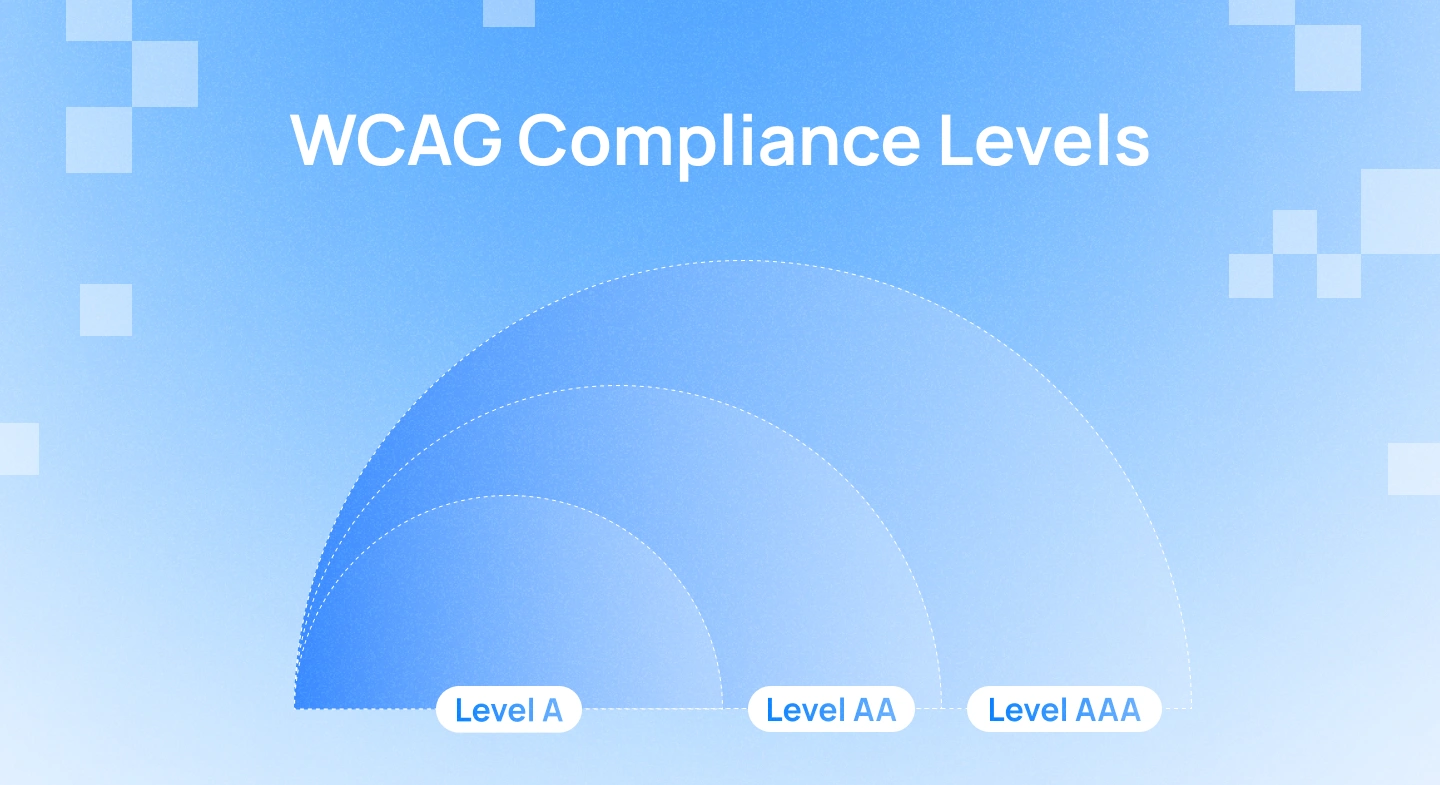
Below is a breakdown of what each level means in practice:
Level A removes the most critical blockers that prevent users from accessing content at all. If a product does not meet this level, some users will be completely excluded from key tasks.
Typical requirements at this level include:
Example: A checkout form without labels or instructions cannot be understood by screen reader users, making the flow unusable.
Level AA builds on Level A and focuses on making the experience usable, not just accessible. This is the level most products are expected to meet and is referenced in most legal web accessibility guidelines.
Typical requirements at this level include:
Example: Text with low contrast may technically be visible, but users with low vision cannot read it comfortably, which directly affects task completion.
Level AAA introduces stricter requirements to improve accessibility further, often for specific contexts such as public services or specialized platforms. It is not always practical to achieve across an entire product.
Typical requirements at this level include:
Example: Providing sign language interpretation for video content goes beyond captions, offering a more inclusive experience, but may not be feasible for all teams or products.
Most accessibility issues are not caused by complex systems or advanced engineering problems. They usually come from small design decisions that seem minor on a single screen but get repeated across the entire product, making their impact much larger over time.
The areas below are where accessibility issues most commonly appear in real products:
Color contrast directly affects whether users can read content comfortably. When the difference between text and background is too low, users with low vision, poor lighting conditions, or smaller screens may struggle to read, even if the content is technically visible.
WCAG 2.2 Level AA requires a minimum contrast ratio of 4.5:1 for normal text and 3:1 for large text.
In practice, this means:
Readable content depends not only on the font but also on how text is structured on the page. Poor spacing, long dense paragraphs, or inconsistent layout can make even simple content harder to read and understand, especially for users who rely on scanning rather than reading word by word.
In practice, this means:
Accessibility needs to work consistently across all devices, especially mobile. Smaller screens, touch interactions, and varying user environments make mobile experiences more sensitive to design issues that might not be noticeable on desktop.
In practice, this means:
Read more: How Lollypop Builds Accessible Design Systems for Enterprise Products
Accessibility is no longer just a design best practice. In many regions, it is a legal requirement. This means organizations are expected to make their websites and apps usable for people with disabilities. If they don’t, they can face complaints, legal action, or restrictions on their products.
Although the laws differ by region, most of them use WCAG as the reference standard for what “accessible” means in practice:
In the United States, accessibility requirements mainly come from the ADA (Americans with Disabilities Act) and Section 508. These laws define who must provide accessible experiences and where those requirements apply.
In practice, private businesses are generally expected to align with WCAG 2.1 Level AA, even though the ADA does not name a single mandatory technical standard for all cases.
The European Accessibility Act (EAA) sets accessibility requirements across EU member states and harmonizes expectations for key digital products and services.
This extends accessibility requirements beyond the public sector to many private businesses offering digital services in the EU.
Canada follows the AODA (Accessibility for Ontarians with Disabilities Act), one of the earlier laws covering digital accessibility.
Even though it references an older WCAG version, the practical expectations are similar: content must be readable, navigable, and usable across devices and assistive technologies.
In the United Kingdom, accessibility is governed by the Public Sector Bodies (Websites and Mobile Applications) Accessibility Regulations.
While these regulations target the public sector, many private companies adopt the same standard to reduce legal risk and ensure consistent usability.
WCAG 2.2 Level AA has become the practical benchmark for accessible digital products. It covers the fundamentals that directly affect usability, including color contrast, text readability, keyboard navigation, mobile interaction, and semantic structure.
At the same time, accessibility gaps remain widespread. A significant majority of websites still fail basic WCAG checks (WebAIM Million Report, 2025), and legal actions related to digital accessibility continue to rise, with over 4,500 lawsuits filed in the US in 2024 (Accessibility.Works, 2025).
For product teams, this signals a clear shift. Accessibility can no longer be treated as a checklist applied at the end of a project. It needs to be embedded into design decisions from the beginning, shaping how products are structured, built, and tested.
Explore our UI/UX Design Services, Design Systems expertise, and Inclusive Design approach to see how accessibility can be integrated into your product strategy.
At Lollypop Design Studio, accessibility is built into design systems, interaction patterns, and testing workflows, so products are usable, scalable, and aligned with global standards from the start. If you are evaluating your product’s accessibility or planning improvements, you can also schedule a consultation with our team to identify gaps and define a clear path to compliance.
The web content accessibility guidelines (WCAG) are a global standard created by the W3C that defines how websites and digital products should be designed to be accessible to people with disabilities.
WCAG 2.0 introduced the core framework and principles. WCAG 2.1 expanded the guidelines to better support mobile devices, low vision, and cognitive accessibility. WCAG 2.2 builds on this by improving interaction patterns, such as focus visibility and touch target sizes.
For WCAG Level AA, the minimum contrast ratio is 4.5:1 for normal text and 3:1 for large text. These thresholds ensure that text remains readable for users with visual impairments.
In many regions, yes. Laws such as the ADA (US), EAA (EU), AODA (Canada), and UK accessibility regulations require digital products to meet accessibility standards, typically aligned with WCAG.
Non-compliance can lead to legal complaints, financial penalties, and reputational risk. More importantly, it can prevent users from accessing your product, directly impacting usability and conversion.