In these modern hyper-connected times, user-centered design strategy is essential, attention can seem fleeting, and competition is merely a click away; thus, the creation of digital experiences that truly speak to target users is a critical differentiator. Be it fintech applications for simple money movements, e-commerce portals for a trouble-free buying experience, or government sites for enabling faster public service, people want more than just functionality. They want clarity at every step, ease of use, and fast-tracked delight at every interface.
Hence, this approach to design should not even be considered optional: it is a principle. User-centric design, which means designing from concrete user data, combining an understanding of user behaviors, shipping motivations, and pain points, works to build not only usability but trust, loyalty, and emotional resonance between the brand and its users. In turn, this translates into better business performance and long-term client relationships.
For business owners, entrepreneurs, UI/UX designers, product managers, and tech-savvy professionals, a human-centered design attitude is the first step toward user satisfaction and ultimately business success. In this post, I will teach you step-by-step how to develop a user-centered design strategy for better UX for business growth.
📢 Need expert help building a user-centered design strategy? Talk to our design consultants to get a free audit tailored to your product and audience.
User-centered design (UCD) is a cyclic approach to developing a solution; it focuses on who will use the solution, their behaviors, goals, and what they provide as feedback as part of the design process. UCD has also been referred to as user-focused design, human-centered design, or customer-driven design.
UCD does not begin with the product idea and then fits the users into it; instead, it begins with user research to find out what people need and want. UCD has a goal of making the user experience as intuitive, enjoyable, and effective as possible.
A user-centered design strategy involves:
When you consider real user needs, you can prevent expensive design mistakes, create more engagement, and make a product that has long-term value. This is a hallmark of a customer-first product strategy and an integral part of UX design tips that lead to stronger user experience.
This is especially valuable to appreciate if you contrast a user-centered design strategy with some of the more traditional design approaches:
| Feature | User-Centered Design | Traditional Design |
|---|---|---|
| Focus | End-user needs | Internal goals or stakeholder preferences |
| Process | Iterative, research-driven | Linear, assumption-driven |
| Validation | Continuous testing with real users | Internal review or limited testing |
| Risk | Reduced, due to user feedback loops | Higher, due to guesswork |
In conventional design practices, teams often develop products based on assumptions or business-centric viewpoints, expecting the users to adapt their behaviors. UCD turns this approach on its head: products are designed around the users’ reality. This approach supports data-driven product development and is essential for any enterprise UX strategy.
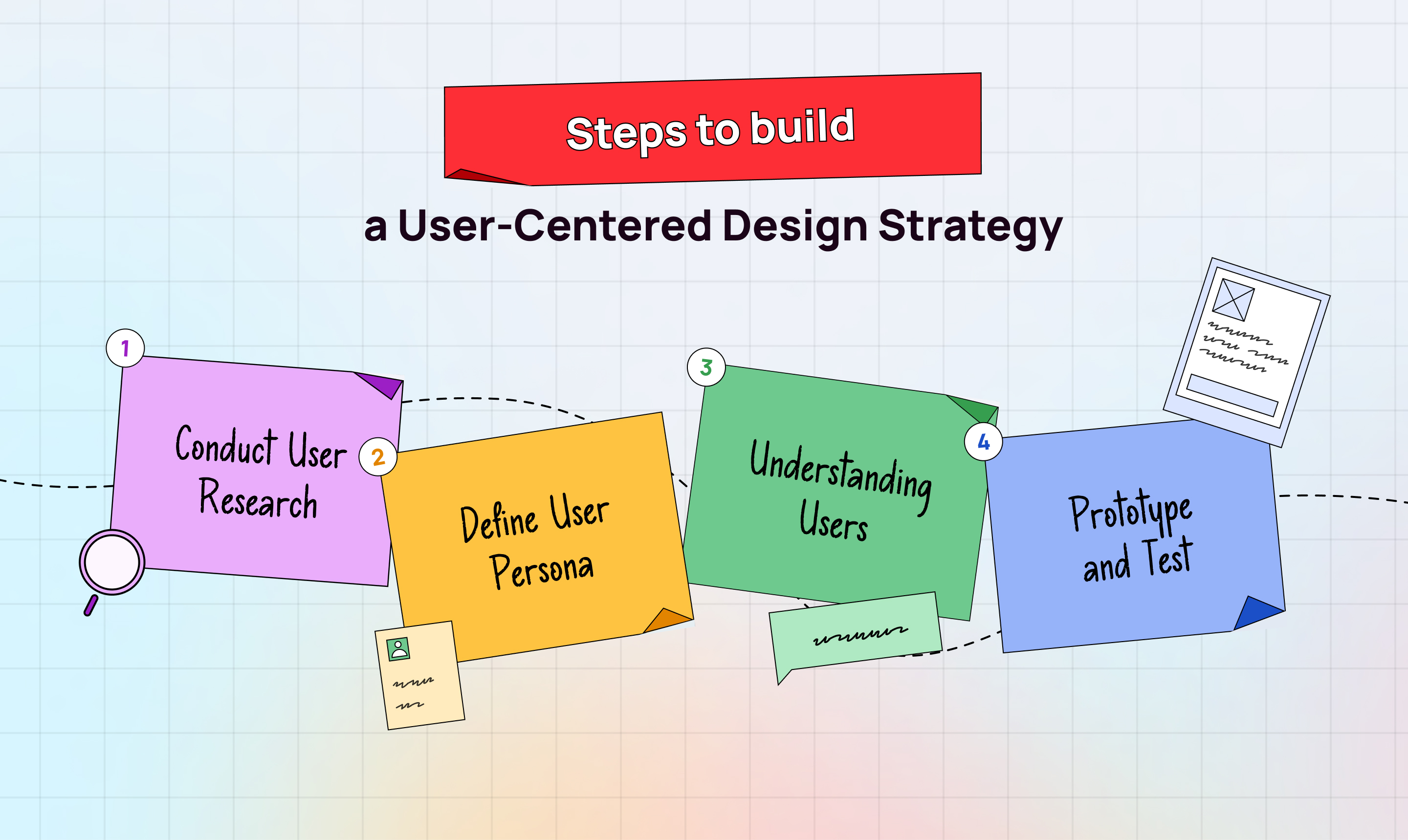
Establishing an effective user-centered design approach requires a number of deliberate steps. This is how to turn theory into practice.
The starting priority for UCD is about knowing your users. Your understanding needs to be based on qualitative and quantitative research methods, such as:
Research helps you uncover the challenges users deal with and why they make the decisions they do, which is essential for designing valuable products. These are foundational components of design thinking for digital transformation.
🎯 Want to discover your users’ biggest pain points? Book a UX research workshop with our team today.
Tip: Begin with empathy. Using empathy maps and user diaries can uncover the emotional drivers behind user actions.
User personas are fictitious profiles representing key segments of your audience. User personas keep your team focused on the real needs instead of internal biases.
Each persona should include:
When everyone on your team knows the personas, they design with empathy and awareness. Personas are critical for customer-centric design and help avoid the pitfalls of assumption-based design approaches.
User journeys are an important part of any user-centered design strategy. A user journey is a visual or narrative representation of the overall experience a user has when interacting with your product or service. User journey highlights the path users take from the moment they become aware of your brand to their final decision to engage, buy, or repeat.
This includes:
Mapping these journeys allows for friction points to be recognized and improved. This understanding is essential for creating a customer-centric design that improves customer satisfaction and loyalty.
Once you generate insights and flow maps, you proceed to make low- or high-fidelity prototypes. Prototyping helps you visualize your solution and test it before going for complete development.
Performing usability testing with real users allows you to prove your ideas. Gathering feedback, converging the information into iterations, and going around this loop continue until the experience meets user expectations. This design process is foundational for successful UI/UX design in B2B or enterprise settings.
User-centered design strategy does better than just looking good or being easy to use: it positively affects a business’ performance.
The objective was to create a more global concept of a logistics platform from a regional logistics player. The Lollypop team began conducting stakeholder workshops with in-depth market research to understand the unique problems logistics companies go through across geography. This resulted in a scalable design system whose transaction values reflected trust, efficiency, and professionalism, colored elements for a sector that still depends on timing and reliability.
Impact: The redesign enabled smooth entry into new markets, onboarding of thousands of drivers and partners, scaling, and placement of Trukkin as an attractive investment opportunity.
FarmRise sought to connect rural farmers, many of whom were illiterate and hardly conversant with technology, to the right agricultural information timely. The guys did ethnographic research in Indian villages, interacting with more than 150 farmers directly. Based on the interest and affliction of farmers with technologies, they came up with a tap-first interface with very little text, fonts for local languages (like the Noto Sans family), and simple illustrations.
Impact: Making the app more inclusive and accessible, it won accolades for empowering rural communities with the use of technology.
Cryptocurrency is often considered complex and risky, especially in places like India. The app design team from Lollypop looked at this challenge differently by simplifying the app through a 3-step onboarding process, trusting design visual elements like color and font, plus accompanying users via educational micro-interactions.
Impact: The redesign took away the complexities from crypto trading, building trust among those users who were initially hesitant to enter the market for digital assets.
Emaar wanted to bring together its range of tourist products—Burj Khalifa ticketing on one consolidated platform, and waterparks were just two of many. The team created personas in multiple languages, utilized mobile-first UX strategies, and addressed pain points tied to information architecture that interfered with smooth browsing and bookings.
Impact: Complex services were simplified into a new interface, which increased conversions and supported multiple languages. Demonstrates how UI/UX design contributes to a broader enterprise UX strategy.
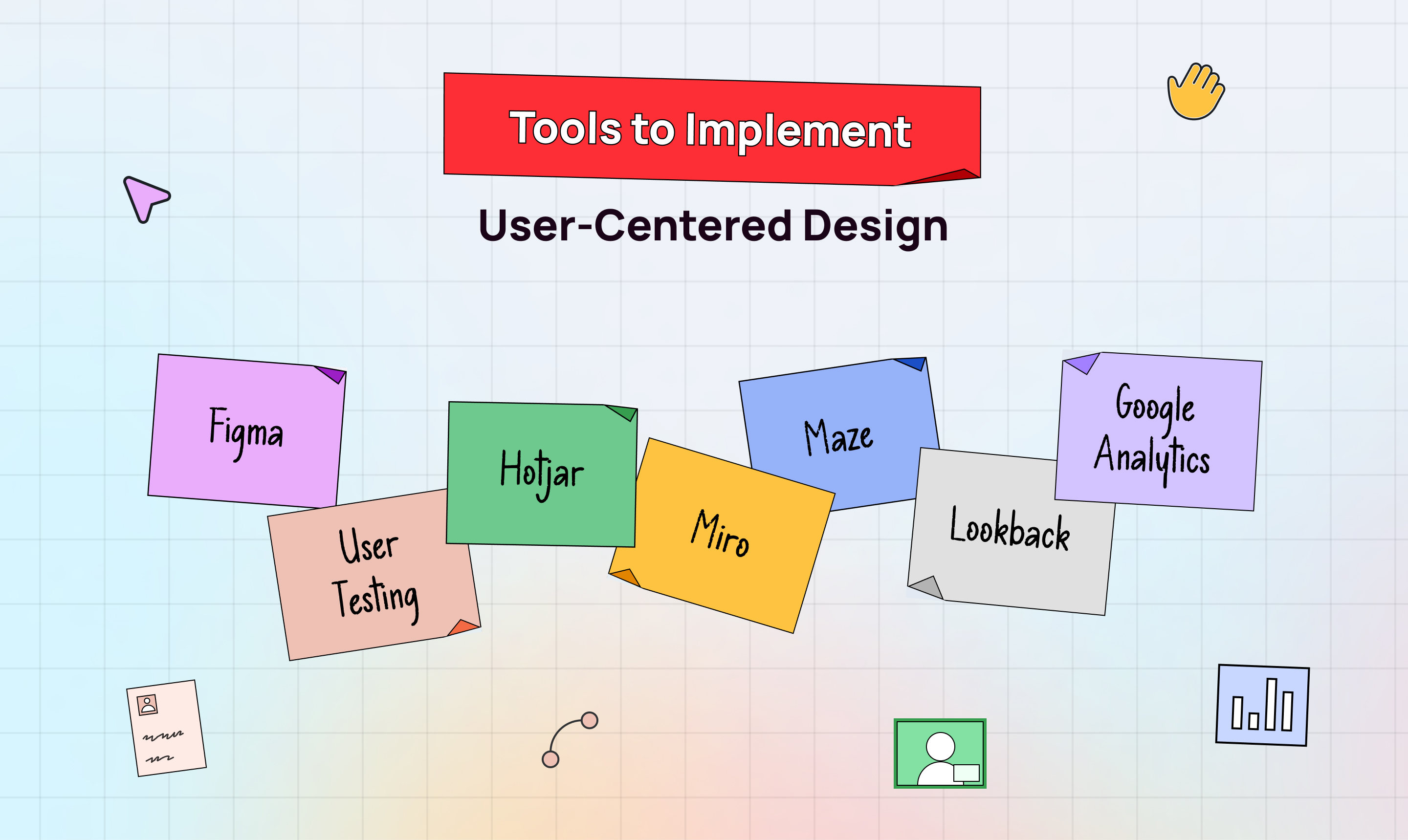
Having tools at the ready makes it suitable to adopt user-centered methods. Here’s one selection of tools for each stage:
| Tool | Purpose |
| Figma | UI/UX design, prototyping, real-time collaboration |
| UserTesting | Remote user testing with video feedback |
| Hotjar | Heatmaps, session recordings, and surveys |
| Miro | Brainstorming, journey mapping, stakeholder collaboration |
| Maze | Usability testing and data-driven design validation |
| Lookback | Live interviews and in-product testing |
| Google Analytics | Behavioral insights and performance tracking |
These tools empower your team to act on real user feedback, refine your design process, and stay aligned with customer-centric design principles.
Developing a user-centered design strategy isn’t just a fad; it’s a business imperative. Startups and global corporations have found that organizations that use user-centered, human-centered, and design-thinking approaches consistently achieve better results than organizations that don’t. A user-centered design strategy consists of four steps: conducting in-depth user research, creating real-life user personas, mapping out detailed user journeys, and iterative prototyping and testing.
This method leads to better experiences, increased brand loyalty, lower customer turnover, and increased business growth. If you are unsure where to begin, it starts in your mind—design for your users and not for yourself. In doing so, you align with enterprise UX strategy, data-driven product development, and long-term digital success.
🚀 Ready to future-proof your business with customer-first UX? Schedule a strategy call and let’s transform your digital product experience.
User-centered design bases itself on real users—their needs, pain points, and context. On the other hand, traditional design has largely been founded on assumptions made within the company or with business goals in mind. The UCD approach makes continuous use of testing and iteration, whereas traditional design methods tend to place emphasis on a rigid, linear process.
Low engagement, high bounce rates, and negative feedback are tough signs that are hard to overlook for bad user-focused designs; UCD will identify those friction points that make designing for the user a better-facing and fun experience.
UCD benefits all businesses and in particular tech, fintech, healthcare, e-commerce, education, or government agencies. Hence, if your product involves human interaction, a smooth and intuitive design experience is the key to its adoption, satisfaction, and retention.
The length depends on the complexity of the projects, but an average UCD cycle (research, personas, journey mapping, prototyping, testing) takes from 4 to 12 weeks. An iterative one, in fact, where they will normally circle back to one or more of these steps later through the development of their product.
Not at all. UCD does not always demand massive investments; instead, simple and cheap tools like Google Forms, Figma, and Hotjar may bring crucial insights. Starting small using real user feedback almost always saves money, which avoids costly redesigns later in the product life cycle.