
Your product looks good, but are people finding it easy to use? Maybe users are dropping off halfway through important journeys, struggling to find features, or contacting support for things they should be able to do themselves. These patterns often point to deeper UX problems that aren’t immediately visible.
That’s where a UX audit comes in. It helps uncover what’s creating friction, why users are struggling, and what needs attention first. But before choosing an agency, it’s worth understanding what goes into an audit, what the deliverables should include, and why one proposal might cost considerably more than another.
Quick Answer: How Much Does a UX Audit Cost?There is no fixed UX audit cost. Published estimates from Indian providers place a standard product UX audit at approximately ₹80,000–₹3 lakh, depending on the scope and depth of evaluation. The actual investment depends on the number of user journeys, product complexity, research methods, usability testing requirements, and expected deliverables. These figures represent individual provider estimates, not a verified industry-wide average or Lollypop’s fixed project pricing. |
The UX audit cost depends on how much of the product needs to be evaluated, what evidence the team must collect, and how detailed the recommendations need to be.
A review of one sign-up journey requires a different level of effort from a multi-platform SaaS product with several user roles and complex workflows.
The number of flows included in the audit is one of the first things that affects scope.
Reviewing a checkout flow, for example, may involve product discovery, cart management, payment, error handling, and confirmation. A broader product audit may also cover onboarding, account management, search, navigation, and user settings.
More journeys mean more screens, interactions, edge cases, and potential friction points to investigate.
A straightforward website and an enterprise dashboard do not require the same evaluation effort.
Costs can increase when the product involves:
The audit may also need to account for different interaction states, such as loading, empty, error, and confirmation screens. These states often reveal usability problems that a review of the primary screens alone can miss.
The number of screens alone is not a reliable measure of complexity. A single dashboard can contain more interactions and decision points than several simple pages.
For a website UX audit cost estimate, teams should also account for the number of important page templates, conversion journeys, responsive layouts, and interactions that need review.
An expert heuristic review and moderated usability testing are different services.
A heuristic evaluation identifies potential usability issues through expert inspection. Usability testing examines how real users navigate the product and where they struggle. Neither method automatically replaces the other; the right combination depends on the questions the audit needs to answer.
A heuristic review allows UX specialists to inspect the product against established usability principles. It can identify issues with navigation, feedback, consistency, and interaction design.
Usability testing adds another layer: observing relevant users as they attempt real tasks. This involves participant recruitment, screening, incentives, research sessions, and analysis.
The additional work can increase the fee, but it also provides evidence about how people actually experience the product rather than relying entirely on expert judgment.
The quality of an audit also depends on the evidence available to support its findings. Reviewing screens can reveal visible usability issues, but product data and customer feedback help establish where those problems occur and how they affect users.
Depending on the agreed scope, the team may need:
Without behavioral evidence, an auditor may identify a confusing interface but struggle to establish how frequently it affects users or where the business impact occurs.
A short findings summary requires less effort than a comprehensive report with annotated screens, prioritized recommendations, redesign concepts, and stakeholder workshops.
Similarly, implementation support is separate work unless explicitly included. A proposal should distinguish between identifying a problem, designing its solution, and helping the engineering team implement it.
The experience of the people conducting the audit can influence both its cost and the quality of its recommendations. An experienced UX researcher or designer may identify deeper problems across multiple journeys, while a checklist-only review may focus primarily on visible interface issues.
The engagement model also matters. A fixed-fee audit works well when the journeys, methods, and deliverables are clearly defined. When the scope is still evolving, an hourly or retainer-based arrangement may provide more flexibility.
Before accepting a proposal, understand who will perform the evaluation, how their time is allocated, and what happens if the scope changes.
Published pricing examples show how the cost of a UX audit can vary with its scope and research depth. The following figures are taken from F1Studioz’s 2026 pricing guide and represent one provider’s global estimates, not standardized market rates. Use them as a comparison reference, not as a guaranteed quotation.
The following ranges are indicative examples published by F1Studioz in its 2026 UX audit pricing guide. Providers define their packages differently, so these should not be treated as standardized market rates.
| Audit scope | Published estimate (USD) | Typical coverage |
| Lightweight teardown | 500–2,500 | One page or critical user journey |
| Expert heuristic audit | 3,000–8,000 | Expert review and severity-ranked findings |
| Diagnostic audit | 8,000–25,000 | Analytics, session recordings, benchmarking and usability testing |
| Audit + redesign sprint | 15,000–40,000 | Diagnostic findings and design solutions for selected flows |
| Enterprise or multi-product audit | 30,000–75,000+ | Multiple user roles, extensive research and accessibility evaluation |
For an India-specific reference, AppWizards publishes an estimated range of ₹1 lakh–₹3 lakh for a product UX audit, while F1Studioz lists ₹80,000–₹2.5 lakh. The difference reinforces why buyers should compare scope and deliverables rather than treat any single figure as a market average.
When comparing UX audit pricing, look beyond the total amount. Check what the team will investigate, what evidence it will use, and what your organization will receive.
| Scope dimension | Focused audit | Product-wide audit | Multi-product audit |
| Coverage | One critical flow | Main product journeys | Multiple products and platforms |
| User roles | Limited | Relevant product roles | Multiple user groups |
| Evidence | Expert review and available data | Broader analytics and research | Cross-product evidence and benchmarking |
| Deliverables | Focused findings | Prioritized product-wide recommendations | Consolidated findings and roadmap |
| Client involvement | Access to selected flow | Product and analytics access | Multiple teams and stakeholders |
For example, a SaaS company reviewing its onboarding flow should not automatically purchase an enterprise-wide audit. A focused review may be sufficient to identify the friction affecting new users. Conversely, a multi-role platform with interconnected workflows may need a broader investigation.
Good UX audit deliverables should help your team understand what is wrong, why it matters, and what to fix first. A long report filled with screenshots is not necessarily a useful audit.
A decision-ready engagement should define the following outputs.
| Deliverable | What it should include |
| Executive summary | Main usability problems and their business relevance |
| Annotated findings | Screenshots, issue descriptions and supporting evidence |
| Severity-ranked issue list | Problems prioritized by impact and urgency |
| Impact vs. effort matrix | A practical view of implementation priorities |
| Recommendations | What should change and why |
| Quick wins | High-impact improvements that require relatively little effort |
| Redesign concepts | Wireframes or visual suggestions for selected issues |
| Accessibility and technical review | Checks explicitly included in the agreed scope |
| Final walkthrough | A presentation explaining findings and next steps |
| Measurement recommendations | KPIs to monitor after improvements are implemented |
Every finding should connect an identified problem to the affected user journey, supporting evidence, its severity, and a recommended action. Where possible, the report should also explain implementation effort and why the issue deserves attention. This helps product teams move from a list of observations to a practical improvement backlog.
A report with 20 well-supported, prioritized findings can be more useful than one with 100 loosely documented observations.
The distinction between findings and recommendations matters. “The navigation is confusing” identifies a problem. Explaining which labels should change, how the navigation structure should improve, and which user task is affected gives the product team a direction for action.
Also clarify whether wireframes, high-fidelity designs, prototypes, and development support are included. They are not automatic components of every audit.
Before choosing an agency, make sure every proposal is based on a comparable scope. Ask the following eight questions.
An audit should address a defined business or user-experience problem. Ask the agency whether an audit is the right starting point or whether your product needs user research, a redesign sprint, or another form of evaluation.
Find out who will perform the hands-on evaluation. Ask about their experience with similar products, their responsibilities, and whether senior practitioners will remain involved throughout the engagement.
Ask whether the team needs analytics, session recordings, support tickets, user research, and product documentation. If the proposal only covers a visual inspection, understand what that review can and cannot establish.
The agency should define which workflows, user roles, and edge cases are included. If real-user testing is proposed, ask how participants will be selected and recruited.
If participant testing is included, ask how many participants are planned, how they will be recruited, and which user profiles they represent. The sample should reflect the research objectives rather than follow an arbitrary participant count.
Ask whether issues will be evaluated by severity, user impact, business relevance, and implementation effort. A useful report should tell your team what deserves attention first.
Request a sample or anonymized audit report. Check whether it contains evidence, clear recommendations, priorities, and practical next steps rather than an unstructured list of observations.
Agree on how unexpected issues, additional journeys, and changes to scope will be handled. Clarify what is covered by the original fee and what would trigger additional charges or a change order.
Establish whether the engagement ends with the report or includes a stakeholder walkthrough, design recommendations, engineering handoff, and support during implementation.
A clear brief helps an agency estimate the work accurately and prevents unexpected changes to scope later.
Before requesting a quote, prepare:
You do not need to have every answer before contacting an agency. However, the clearer these inputs are, the easier it becomes to define a realistic scope and compare proposals.
A UX audit is most useful when a product is already in use, the team can identify a problem but does not understand its root cause, and a redesign decision needs better evidence.
| Business situation | Recommended starting point |
| Users abandon an important flow | Focused audit of that journey |
| Conversion is underperforming for unclear reasons | Audit combined with behavioral data analysis |
| Several features have accumulated usability issues | Broader product audit |
| Different user roles face different problems | Multi-role workflow evaluation |
| A complete redesign is being considered | Audit before committing redesign budget |
An audit may also reveal that the problem is deeper than the interface. For example, redesigning navigation will not solve a product whose information architecture is fundamentally misaligned with user needs.
However, an audit is not always necessary. If the problem is already well understood and the team has enough evidence to define the solution, investing directly in design or implementation may be more appropriate.
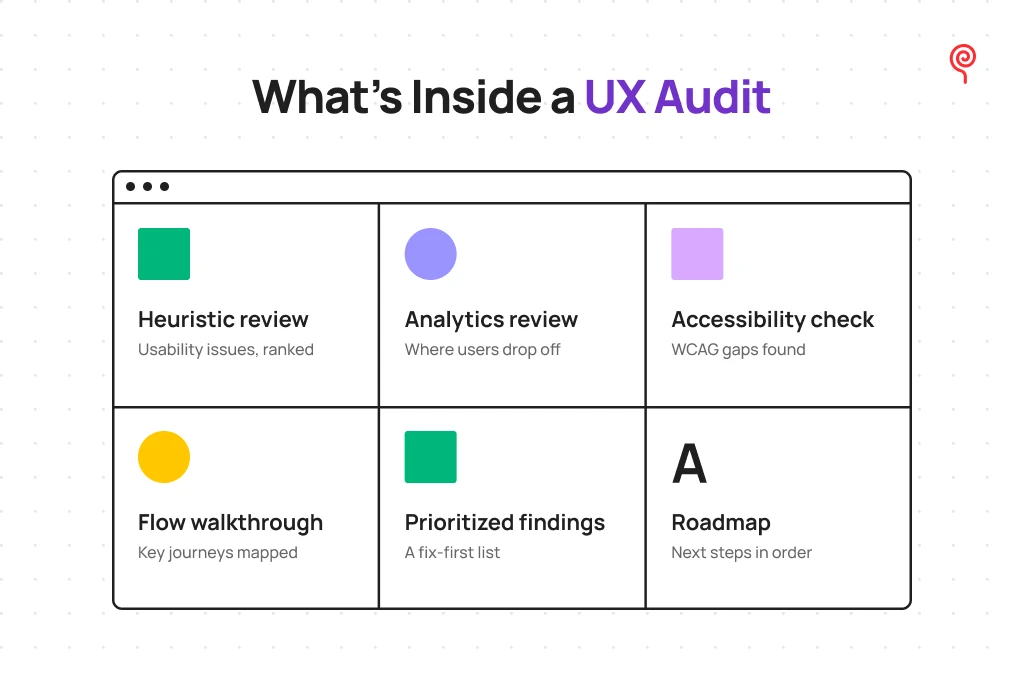
At Lollypop, a Design Audit begins with understanding the product’s business and usability objectives. The team reviews relevant customer journeys, applies heuristic evaluation and design principles, records the gaps, and recommends practical improvements.
Lollypop’s published Design Audit service describes a typical team comprising a UX Researcher, UX Designer, and UI Designer. Larger engagements may involve a Project Manager and Design Lead.
The stated engagement duration ranges from one week to one month, depending on the size and complexity of the product. Typical outputs include a written evaluation, actionable recommendations, a roadmap, and a final presentation.
Lollypop does not publish one fixed price for every Design Audit. Its engagement pricing depends on the product’s complexity, scope, and terms of engagement. The studio offers different pricing models depending on whether the work is clearly defined or requires ongoing research and exploration.
For an accurate estimate, the first step is to agree on the user journeys, evaluation methods, expected deliverables, and level of support required
The right UX audit pricing is not necessarily the lowest quote or the largest package. It is the proposal that matches your product’s complexity, uses appropriate evidence, and gives your team a practical route from identifying problems to fixing them.
Before requesting a quote, define the journeys you want reviewed, the evidence available, the research depth required, and the outputs your team expects.
If your product has usability gaps that need a structured evaluation, explore Lollypop’s Design Audit services or discuss your project with the team.
A UX audit cost depends on product complexity, the number of user journeys, research depth, and deliverables. Published estimates from Indian providers range from approximately ₹80,000 to ₹3 lakh for product audits. These are individual provider estimates, not a verified industry average. The most reliable way to establish your budget is to request a quote based on a clearly defined scope.
A focused review may take a few days, while broader product evaluations take longer. Lollypop’s published Design Audit guidance gives a typical range of one week to one month, depending on product size and scope.
Not always. A heuristic review is conducted by UX experts evaluating the product against usability principles. Moderated usability testing involves observing real users completing tasks. Recruitment, incentives, and research analysis must be confirmed in the proposal.
A standard audit generally identifies problems and recommends improvements. Wireframes, high-fidelity concepts, prototypes, and development support should be listed separately in the scope if required.
This is already covered by the new preparation section. I would not add it as a fifth FAQ unless the article’s final length comfortably allows it.