
How do buyers find the right vendors today?
Not long ago, the answer often involved searching supplier directories, browsing company websites, reading case studies, and requesting referrals. Procurement teams spent significant time gathering information before they could confidently create a shortlist of potential vendors.
Today, AI is becoming part of that process. Instead of manually researching every supplier, buyers can ask AI tools to recommend vendors, compare capabilities, summarize company information, and narrow down their options in just a few prompts. AI is helping procurement teams spend less time searching and more time evaluating the suppliers that best fit their requirements. This shift aligns with the article’s focus on how AI is reshaping vendor discovery and sourcing.
For B2B vendors, this changes the rules of visibility. Winning new business is no longer determined solely by having a strong reputation or ranking well in search engines. Vendors also need a digital presence that AI systems can understand, verify, and confidently recommend when buyers ask for suppliers in a specific industry or capability.
In this article, we’ll explore how AI is transforming procurement and vendor sourcing, how it’s used throughout the procurement lifecycle, and what AI systems evaluate when recommending vendors. You’ll also learn what these changes mean for B2B suppliers and how to improve your visibility in an AI-driven procurement landscape.
The use of AI in procurement extends far beyond automating repetitive tasks. Today, AI supports procurement teams throughout the buying lifecycle, from identifying potential suppliers to comparing proposals and preparing purchasing decisions. Rather than replacing procurement professionals, AI reduces the time spent on research-intensive activities so buyers can focus on strategic evaluation and supplier relationships.
While organizations adopt AI in different ways, its role in procurement can generally be grouped into 3 key stages:
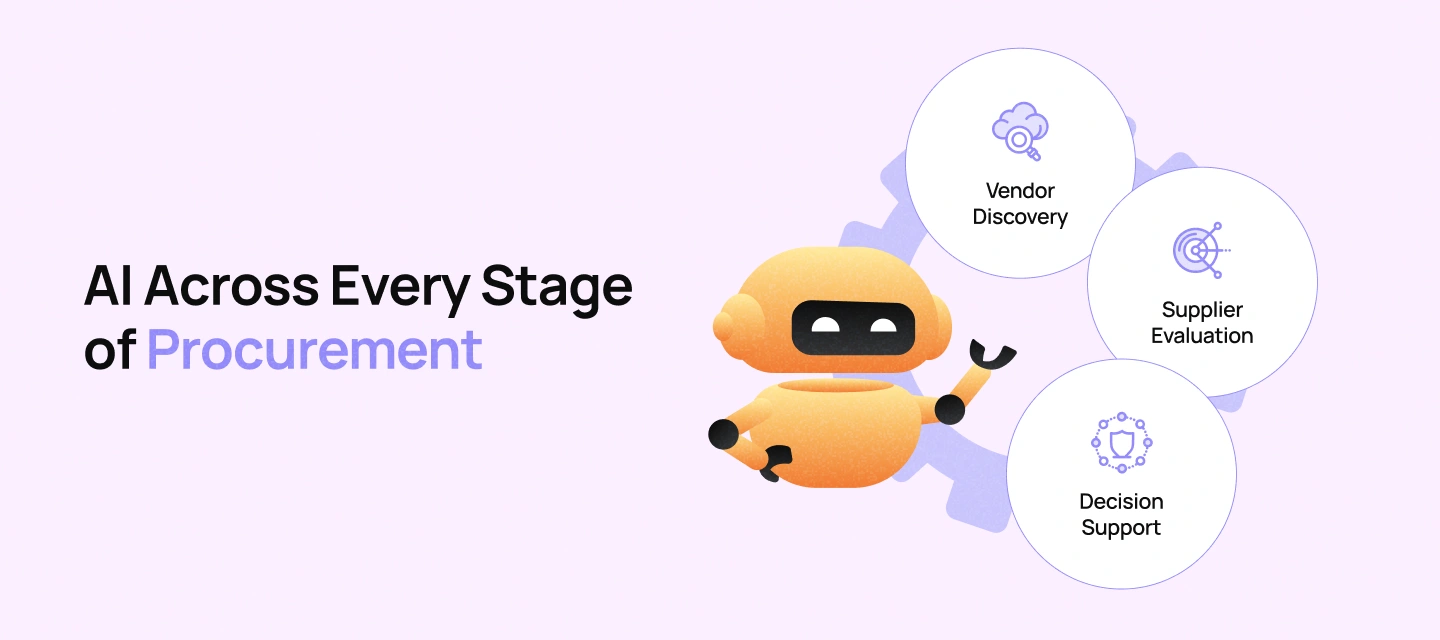
The procurement process often begins with finding suppliers that match specific business requirements. Traditionally, this meant searching through supplier directories, industry websites, referrals, and search engines before creating an initial shortlist.
AI streamlines this step by allowing buyers to ask natural language questions such as, “Find ISO-certified electronics manufacturers in Vietnam” or “Recommend enterprise UX design agencies with healthcare experience.” Instead of reviewing dozens of websites manually, buyers receive a curated list of potential vendors along with summarized information about their capabilities.
Once potential vendors have been identified, procurement teams need to determine which suppliers best meet their requirements. This often involves comparing certifications, service offerings, industry experience, pricing information, and other qualification criteria.
AI accelerates this evaluation by collecting information from multiple sources and organizing it into a structured comparison. Rather than switching between websites and documents, buyers can review summarized insights that make it easier to identify strengths, gaps, and differences between suppliers.
The final procurement decision still depends on human judgment, but AI can simplify the preparation process. It helps procurement teams review RFQ responses, summarize supplier proposals, identify potential risks, and generate side-by-side comparisons that support informed discussions.
Instead of replacing procurement expertise, AI provides decision-makers with organized, relevant information so they can evaluate vendors more efficiently and focus on selecting the supplier that best fits their business needs.
AI has transformed how procurement teams build their first vendor shortlist. Instead of manually searching through trade directories, referrals, or search engines, buyers can ask AI tools to recommend suppliers that match specific requirements. As a result, vendor discovery is becoming faster, more conversational, and increasingly driven by AI.
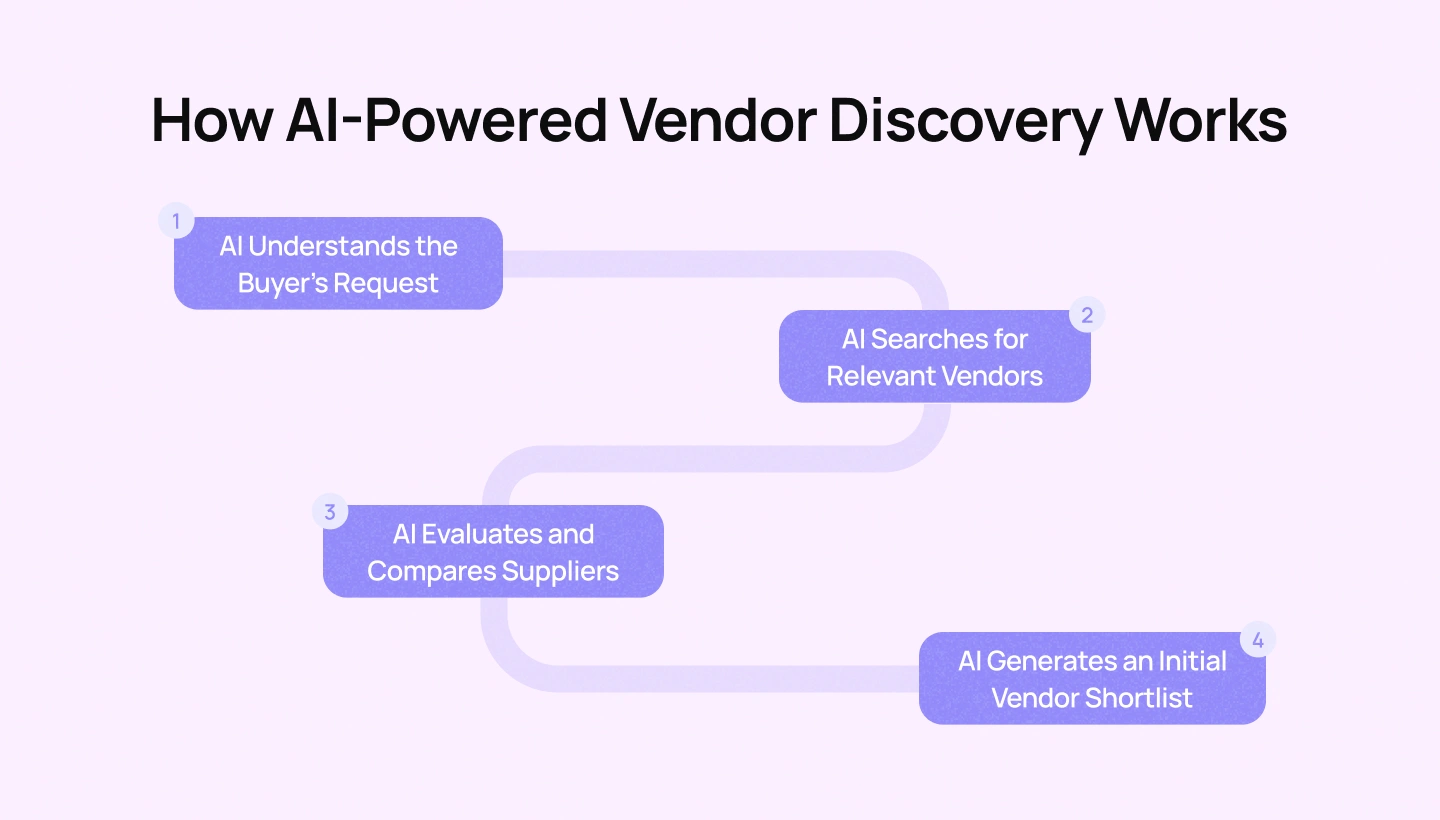
Unlike traditional search engines that primarily match keywords, AI interprets the buyer’s intent. It analyzes the complete request, including the required products or services, industry, certifications, location, budget, and other procurement criteria before beginning the search.
For example, a procurement manager searching for an ISO-certified electronics manufacturer in Vietnam is not simply looking for companies that mention those keywords. AI understands that the request combines manufacturing capability, certification, geographic location, and industry requirements.
Once it understands the request, AI searches across multiple sources to identify potential suppliers. Depending on the platform, this may include company websites, supplier directories, business databases, certifications, case studies, and other publicly available information.
Rather than relying on a single source, AI combines information from multiple places to build a broader list of vendors that match the buyer’s requirements.
After identifying potential vendors, AI compares them against the buyer’s criteria. It analyzes the available information to determine which suppliers are the most relevant, credible, and capable of meeting the requested requirements.
This process allows AI to narrow hundreds of potential suppliers into a manageable shortlist, helping procurement teams spend less time on initial research while focusing their attention on the strongest candidates.
The final output is a ranked list of suppliers that best match the buyer’s request. Procurement teams can then review the recommendations, compare vendors, and perform additional due diligence before making sourcing decisions.
While AI significantly speeds up vendor discovery, the shortlist should be viewed as a starting point rather than a final recommendation. Human evaluation remains essential for assessing commercial fit, negotiating contracts, and validating supplier capabilities.
AI is no longer limited to automating repetitive procurement tasks. Today, it supports nearly every stage of the procurement lifecycle, from identifying qualified suppliers to reviewing contracts and analyzing spending patterns. Rather than replacing procurement professionals, AI augments their work by reducing the time spent on research, document analysis, and data processing. As adoption grows, these practical applications are reshaping how procurement teams source, evaluate, and manage suppliers.
Choosing the right supplier involves more than comparing products or pricing. Procurement teams must also assess financial stability, regulatory compliance, operational resilience, and external risks that could disrupt the supply chain. Traditionally, gathering this information requires reviewing multiple reports, databases, and news sources, making risk assessment both time-consuming and resource-intensive.
AI solution: AI continuously monitors and aggregates supplier data from financial reports, compliance records, sanctions lists, ESG disclosures, news articles, and geopolitical updates. By analyzing these signals together, AI can identify potential risks early, prioritize suppliers that require closer review, and provide procurement teams with a more comprehensive risk profile before contracts are signed.
Example: Before selecting a logistics provider, a procurement team uses AI to assess potential suppliers. The AI identifies that one supplier has recently been affected by regulatory investigations and operates in a region experiencing political instability. Based on these insights, the procurement team conducts additional due diligence before moving forward with negotiations.
Creating a Request for Quotation (RFQ) is often one of the most administrative stages of procurement. Buyers must translate internal project requirements into detailed procurement documents, define evaluation criteria, and ensure suppliers receive complete and consistent specifications. This process can delay sourcing, especially for complex purchasing projects.
AI solution: AI assists procurement teams by transforming internal project briefs, technical requirements, or engineering specifications into structured RFQ documents. It can organize procurement requirements, suggest evaluation criteria, and generate draft documentation, reducing the time between identifying a business need and engaging potential suppliers.
Example: A manufacturing company needs to source custom components for a new production line. After uploading the project specifications, AI generates a draft RFQ that includes technical requirements, delivery expectations, and supplier qualification criteria. The procurement team reviews the document, makes minor adjustments, and distributes it to suppliers within hours instead of spending days preparing it manually.
Supplier contracts often contain hundreds of clauses covering pricing, service levels, liability, payment terms, and regulatory obligations. Reviewing these agreements manually is time-intensive and increases the likelihood that important risks or inconsistencies will be overlooked.
AI solution: AI analyzes procurement contracts to identify non-standard clauses, compliance gaps, missing provisions, and potential legal or financial risks. Rather than replacing legal review, it highlights sections that require closer human attention, allowing procurement and legal teams to focus on the most critical issues.
Example: A procurement team receives contract proposals from several suppliers for the same project. AI compares the agreements and flags differences in liability limits, payment terms, and data privacy clauses, enabling legal reviewers to quickly identify which contracts require negotiation before approval.
Large organizations generate significant amounts of procurement data across multiple departments, suppliers, and purchasing categories. Without the right tools, identifying spending patterns, duplicate purchases, or cost-saving opportunities can be difficult.
AI solution: AI analyzes historical purchasing data to identify spending trends, supplier utilization, maverick spending, and opportunities to consolidate purchases. It transforms procurement data into actionable insights, helping organizations optimize supplier relationships and improve purchasing efficiency.
Example: After analyzing a year’s worth of purchasing data, AI discovers that several business units are sourcing the same office equipment from different suppliers at varying prices. It recommends consolidating purchases under a preferred supplier, allowing the organization to negotiate better pricing and reduce procurement costs.
Successful procurement negotiations depend on understanding supplier pricing, historical purchasing patterns, and current market conditions. Collecting and comparing this information manually can be difficult, particularly when managing multiple suppliers or categories.
AI solution: AI benchmarks supplier quotations against historical contract data, market pricing trends, and previous purchasing activity. By providing procurement teams with data-driven pricing insights, it helps buyers enter negotiations with stronger evidence and a clearer understanding of reasonable pricing expectations.
Example: Before renewing a software licensing agreement, a procurement team uses AI to compare the supplier’s proposed pricing with previous contracts, historical purchasing volumes, and current market benchmarks. The analysis reveals that the proposed increase exceeds market trends, giving the team stronger evidence to negotiate more favorable commercial terms.
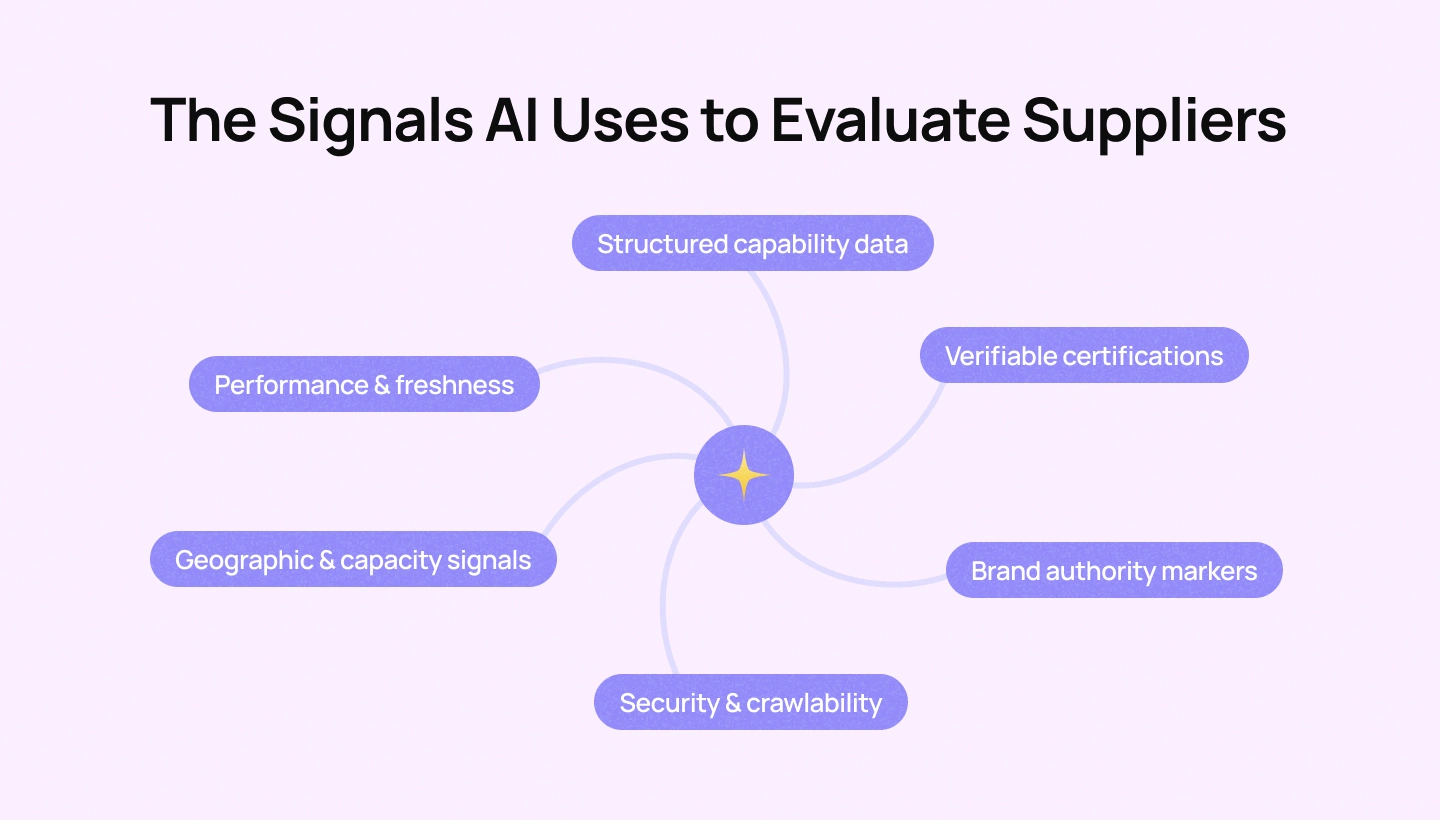
Understanding how AI evaluates vendors is one of the most valuable insights for B2B suppliers. AI does not recommend companies based on brand recognition or existing business relationships. Instead, it relies on structured, verifiable signals to determine whether a vendor is relevant, credible, and capable of meeting a buyer’s requirements.
When evaluating suppliers, AI commonly looks for the following signals:
While AI delivers significant efficiency gains across the procurement lifecycle, it is not without limitations. Procurement teams should view AI as a decision support tool rather than a replacement for human expertise. Understanding these challenges helps organizations use AI more effectively while reducing potential risks.
AI recommendations are only as reliable as the information they can access. If supplier data is outdated, inconsistent, or incomplete, AI may present inaccurate company information, reference expired certifications, or generate incorrect conclusions. Procurement teams should always verify critical supplier information before making purchasing decisions, while vendors should keep their digital information accurate and up to date.
AI naturally favors vendors whose information is well organized and easy to interpret. Companies with structured product catalogs, detailed service pages, and machine-readable data are more likely to appear in AI-generated recommendations. This means equally capable suppliers with poor digital documentation or outdated websites may be overlooked simply because AI cannot confidently understand their offerings.
AI can quickly narrow hundreds of suppliers into a shortlist, but it cannot fully assess factors such as long-term business relationships, innovation potential, cultural fit, or specialized expertise. Relying too heavily on AI-generated recommendations may cause procurement teams to miss qualified vendors, particularly those operating in niche industries or specialized markets with limited digital visibility.
Procurement often involves sensitive business information, including contracts, pricing agreements, supplier proposals, and sourcing strategies. Uploading this information into third-party AI tools may introduce confidentiality, privacy, or regulatory risks if proper governance is not in place. Organizations should establish clear policies on what procurement data can be shared with AI systems and which information must remain confidential.
As AI becomes a common tool for supplier discovery, some vendors may optimize their digital presence primarily to improve AI visibility rather than accurately represent their capabilities. While structured data helps AI understand a business, it does not guarantee that a supplier can deliver the promised quality or performance. Procurement teams should therefore treat AI recommendations as the starting point for evaluation and continue validating suppliers through due diligence, reference checks, and commercial assessments before making a final decision.
AI is transforming procurement by changing how buyers discover, evaluate, and shortlist suppliers. Instead of relying solely on search engines, directories, or referrals, procurement teams can now ask AI platforms for recommendations and receive qualified vendor lists within seconds.
This shift is redefining what it means to be visible online. It’s no longer enough for your business to have a professional website or rank well in traditional search results. Vendors also need to ensure that AI systems can accurately understand their products, services, certifications, and capabilities so they can be confidently recommended during the sourcing process.
The good news is that becoming AI-ready isn’t about manipulating algorithms. The same qualities that build trust with procurement teams also help AI evaluate your business: structured information, verified credentials, up-to-date content, and a technically accessible website.
At SPOT by Lollypop, we help B2B organizations improve their visibility across AI platforms such as ChatGPT, Claude, Gemini, and Perplexity. Through AI readiness assessments, structured data implementation, citation analysis, and practical optimization recommendations, SPOT helps ensure your business is discoverable when buyers use AI to research and compare suppliers.

As AI becomes an integral part of procurement and vendor sourcing, businesses that invest in AI discoverability today will be better positioned to win tomorrow’s sourcing opportunities.
AI in procurement is the use of artificial intelligence to support or automate procurement activities such as supplier discovery, vendor evaluation, contract analysis, spend analysis, and risk assessment. Today, AI is having the greatest impact on vendor sourcing by helping procurement teams identify and compare qualified suppliers much faster than traditional manual research.
AI replaces manual searches with natural language queries. Instead of browsing directories or reviewing dozens of websites, buyers can ask AI to find suppliers that match specific requirements, such as industry expertise, certifications, location, or capabilities. AI then analyzes available information and generates a shortlist based on the most relevant and trustworthy vendors.
Organizations use both general-purpose AI platforms and procurement-specific software. General AI tools such as ChatGPT, Gemini, Claude, and Perplexity are commonly used for supplier research and market analysis, while enterprise procurement platforms embed AI into workflows such as supplier management, contract review, spend analytics, and risk monitoring.
B2B vendors can improve their visibility by making it easier for AI systems to understand and verify their business. This includes publishing structured information about products and services, maintaining up-to-date certification and company details, implementing structured data such as JSON-LD schema, earning credible third-party mentions, and ensuring their website is technically accessible to AI crawlers. Together, these practices help AI generate more accurate and confident supplier recommendations.