Insurance claims are often the defining moment in a customer’s relationship with an insurer. While purchasing a policy is important, it’s during the claims process that customers truly experience whether their insurer delivers on its promise. When filing a claim after a car accident, medical emergency, or property damage, people expect a process that is simple, transparent, and responsive.
For insurers, however, claims management is one of the most operationally complex parts of the insurance value chain. Many organizations still rely on legacy claims processing systems built around manual reviews, disconnected workflows, and multiple internal applications. These inefficiencies slow down claim resolution, increase administrative costs, and create frustration for both policyholders and claims teams.
Modern claims management systems are transforming this experience. By combining digital workflows, automation, and user-centered design, they help insurers process claims more efficiently. At the same time, they deliver a seamless experience for everyone involved, from policyholders submitting claims to adjusters reviewing documentation and back-office teams managing approvals.
In this article, we’ll explore what a claims management system is and why it has become a critical part of modern insurance operations. We’ll also look at the challenges of legacy claims platforms, and the UX principles behind designing digital claims experiences that are efficient, scalable, and intuitive for both policyholders and internal teams.
A claims management system is a software platform that manages the entire lifecycle of an insurance claim, from the moment a policyholder reports an incident to the final settlement and claim closure. It serves as the operational hub where insurers receive claims, collect supporting documents, assign cases to adjusters, validate information, approve payments, and maintain a complete record of every action taken throughout the process.
A modern insurance claims management system also connects people, workflows, and data into a single digital environment. Instead of relying on emails, spreadsheets, or disconnected applications, insurers can manage claims through standardized workflows that improve visibility, reduce manual effort, and ensure every claim follows the appropriate review and approval process.
It’s easy to confuse a claims management system with a policy administration system (PAS), but they serve different purposes. A policy administration system manages the insurance policy itself, including issuing policies, processing renewals, and updating coverage. A claims management system comes into play only after a policyholder files a claim, helping insurers review, process, and settle that claim.
Although it operates as a single platform, a claims management system must support several groups of users with very different goals.
Many insurers have invested in digital transformation, yet their claims operations are still built on systems designed decades ago. While these legacy platforms may continue to perform core functions, they often struggle to meet the expectations of today’s policyholders, claims teams, and business operations.
The challenge isn’t simply that legacy technology is old. It’s that many claims processing systems were built for an era when paper forms, manual reviews, and siloed departments were the norm. As insurers adopt digital channels and customer expectations continue to rise, these limitations become increasingly difficult to ignore.
Legacy claims environments are often made up of multiple disconnected systems that have been added or customized over time. Claims data, policy information, customer communications, and payment records may all reside in separate applications, requiring employees to switch between systems throughout the claims process.
This fragmented approach slows productivity and makes it difficult to maintain a complete view of each claim. Information may need to be entered multiple times, increasing the risk of inconsistencies and making collaboration across departments more challenging.
Many insurers still depend on manual workflows for document verification, claim validation, approvals, and communication with customers. These repetitive tasks consume valuable time and increase the likelihood of processing errors.
As claim volumes grow, manual processes become even more difficult to manage. Straightforward claims that could be resolved quickly often move through the same review process as more complex cases, creating unnecessary delays for both customers and claims teams.
Modern insurance operations require systems that can integrate with digital channels, third-party data providers, AI-powered tools, and evolving regulatory requirements. However, many legacy platforms were built on outdated architectures that make these integrations difficult and expensive.
As insurers introduce new products, expand digital services, or process growing volumes of claims data, older systems often become a limiting factor. Instead of supporting innovation, organizations must devote significant resources to maintaining existing infrastructure and managing technical debt.
The shortcomings of legacy claims platforms reveal an important truth: simply digitizing existing workflows isn’t enough. Replacing paper forms with online forms or moving legacy software to the cloud doesn’t automatically create a better claims experience.
A modern claims management system should be designed around the entire claims lifecycle. It needs to reduce manual work, accelerate decision-making, improve communication, and remain flexible as insurers expand into new products and markets.
While every insurer has unique business rules and operational processes, the most effective claims management solutions share 4 core capabilities. Together, they help insurers process claims more efficiently while creating a better experience for policyholders, adjusters, and operations teams.
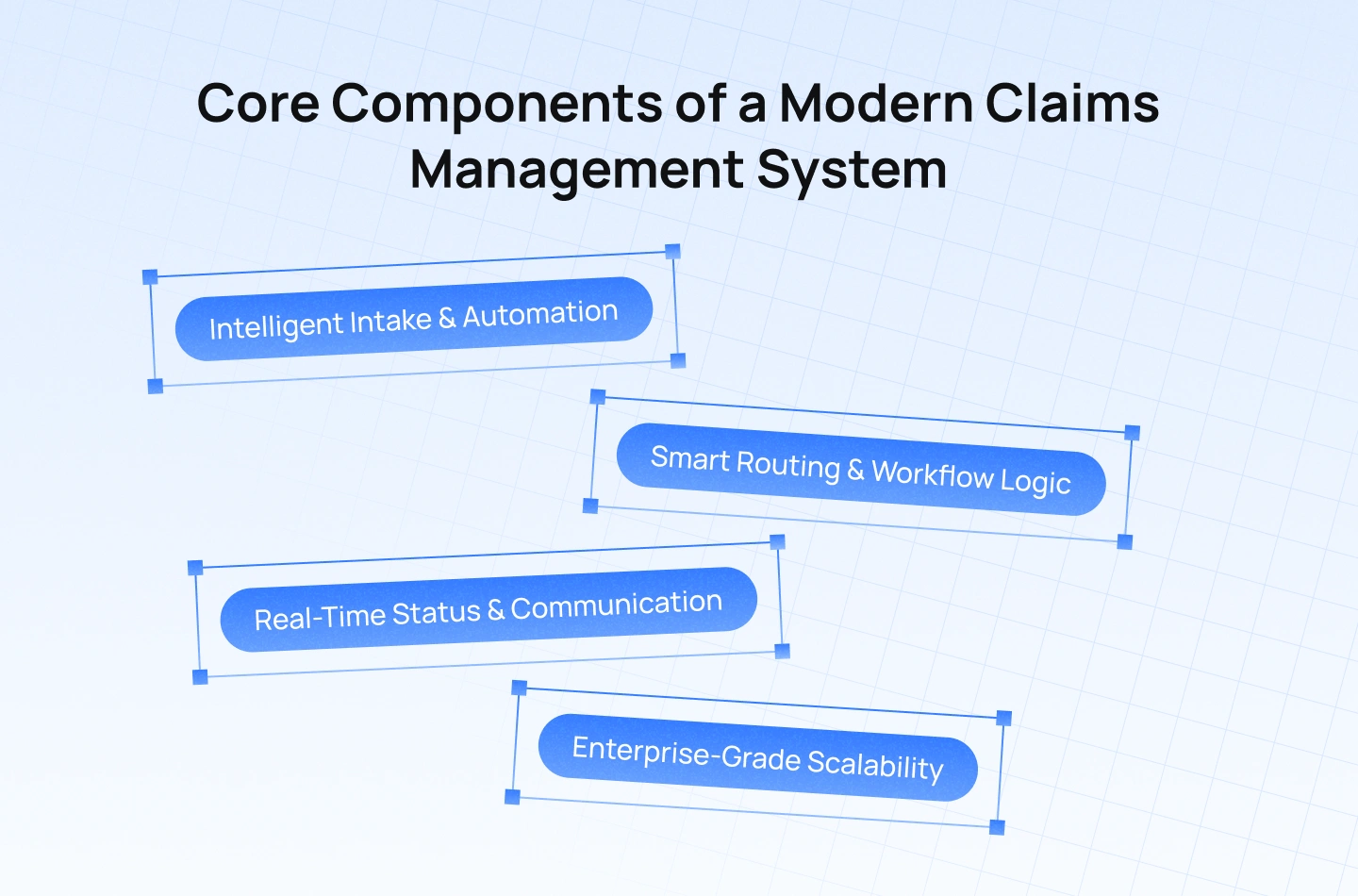
Every insurance claim begins with collecting information. If that information is incomplete, inaccurate, or requires significant manual review, delays begin before an adjuster even opens the case.
Modern automated claims management systems simplify this first step through guided digital claim submission. Instead of asking customers to complete lengthy paper forms or provide information through multiple channels, the platform walks them through a structured submission process. This helps ensure required information and supporting documents are captured from the start.
Many platforms also incorporate technologies such as optical character recognition (OCR) to extract data from uploaded documents automatically. Combined with automated validation, this reduces repetitive data entry, minimizes human error, and allows claims to move into the review process more quickly.
Not every claim should follow the same path. A straightforward windshield repair doesn’t require the same level of review as a complex liability claim involving multiple parties.
Modern claims processing systems use configurable business rules and, in some cases, AI-assisted decision-making to route each claim according to its complexity, value, and risk. Simple claims can be fast-tracked for automated approval, while more complex cases are assigned to adjusters with the appropriate expertise.
This intelligent routing improves operational efficiency by reducing unnecessary handoffs, balancing workloads across teams, and ensuring adjusters spend their time on cases that genuinely require human judgment.
For many policyholders, the most frustrating part of the claims process isn’t the outcome—it’s the uncertainty while waiting.
A modern claims platform keeps customers informed throughout the entire journey. After submitting a claim, policyholders should be able to track its progress, receive notifications when the status changes, and know immediately if additional information is required.
This level of transparency provides reassurance during an often stressful experience. It also reduces support inquiries, allowing claims teams to focus on resolving cases rather than responding to routine status requests.
Insurance organizations rarely offer a single type of coverage. Most manage multiple lines of business, such as auto, health, property, travel, or commercial insurance, each with its own workflows, regulations, and documentation requirements.
Rather than maintaining separate platforms for each product line, an enterprise claims management system should support them on a shared architecture. A modular design allows insurers to configure workflows, business rules, and user experiences for different insurance products while maintaining a consistent technology foundation.
This approach makes it easier to introduce new products, integrate emerging technologies, and scale operations without creating additional system complexity.
While the principles above apply broadly across the insurance industry, seeing them in a real product brings them to life. One example is our work with Royal Sundaram General Insurance, where we redesigned the digital claims experience to streamline adjuster workflows while making claim submission and tracking more intuitive for policyholders. Explore the project here: https://lollypop.design/projects/royal-sundaram-general-insurance/
Designing a great claims management system isn’t just a technical challenge. It’s a UX challenge.
The same platform needs to support 2 users who interact with it in completely different ways. A policyholder may use the system only once every few years, often after an unexpected event. A claims adjuster, on the other hand, spends hours in the platform every day, reviewing dozens of claims and making decisions under tight deadlines.
If both users are given the same interface, neither is likely to have a good experience. Modern insurance claims management platforms solve this by tailoring the experience to each user’s needs while keeping them connected through the same underlying workflow.
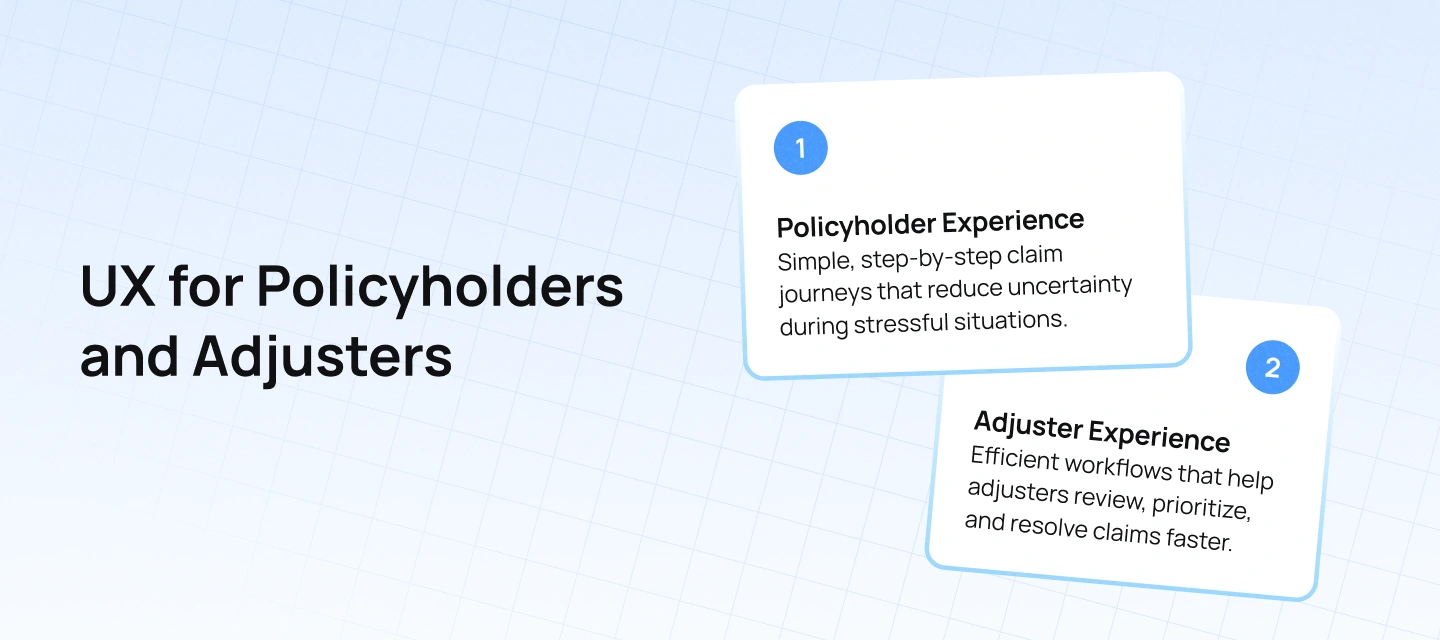
For policyholders, filing a claim usually begins after something has gone wrong. It could be a car accident, water damage at home, or an unexpected medical expense. At this stage, users aren’t trying to learn how insurance works—they simply want to know what to do next.
A well-designed claims experience should remove uncertainty instead of adding to it. Rather than presenting long forms or technical insurance terms, the platform guides users through the process one step at a time.
For example, a digital claims journey might:
Claims adjusters have a completely different objective. Their priority isn’t reassurance, it’s efficiency.
An adjuster may review dozens of claims in a single day. Every extra click, unnecessary screen, or manual task adds time that could be spent evaluating cases and helping customers.
Instead of a simplified customer interface, adjusters need a workspace that helps them process information quickly. Common design priorities include:
Most insurance companies don’t offer just one product. A customer may have auto insurance, home insurance, and health insurance with the same provider. While each product has its own claims process, customers expect one consistent digital experience when interacting with the insurer.
This creates a unique UX challenge. Every type of claim requires different information, workflows, and business rules, but the platform should still feel familiar regardless of which insurance product the customer is using.
A successful enterprise claims management system solves this challenge by separating what should remain consistent from what needs to be customized. The following design principles help insurers deliver a seamless experience across multiple lines of business.
Some parts of the platform should remain the same, regardless of the type of insurance. These shared experiences help customers navigate the system with confidence instead of learning a new interface every time they file a claim.
For example, someone who files an auto insurance claim today may need to submit a property insurance claim a year later. Although the claims themselves are completely different, they should immediately know where to upload documents, check claim status, or contact support because those interactions remain consistent across the platform.
To create that familiarity, insurers should keep key experiences consistent across every product line, including:
While the interface should feel familiar, the workflow behind each claim often needs to be different. Every insurance product requires its own information, validation steps, and supporting documentation. Designing every claim journey the same way would either oversimplify complex processes or introduce unnecessary steps for simpler ones.
For example, different insurance products typically require different workflows:
Supporting multiple insurance products doesn’t require building multiple applications from scratch. Instead, insurers can create a shared design system that provides reusable interface components across every product line.
Think of it like building with LEGO® bricks. The individual pieces remain the same, but they can be assembled in different ways to create completely different models. A claims platform works in a similar way. Components such as forms, document upload widgets, status trackers, notification cards, and buttons can be reused throughout the system, while the business logic behind them changes to fit each type of insurance.
This modular approach offers several advantages:
A claims management system is more than a tool for processing insurance claims. It’s a platform that shapes one of the most important interactions between an insurer and its customers. When designed well, it helps policyholders navigate stressful situations with confidence while giving adjusters the tools they need to work efficiently.
As customer expectations continue to evolve, insurers need more than digital versions of legacy workflows. They need platforms that simplify claim submission, automate routine processes, provide real-time visibility, and scale across multiple insurance products without sacrificing consistency.
From a UX perspective, successful claims management systems strike a careful balance between operational efficiency and human-centered design. By creating intuitive experiences for both policyholders and internal teams, insurers can reduce processing time, improve productivity, and strengthen customer trust throughout the claims journey.
At Lollypop Design Studio, we design enterprise insurance platforms that balance business complexity with intuitive user experiences. Whether you’re modernizing a legacy claims platform or building a new digital ecosystem, our team helps transform complex insurance workflows into seamless experiences that work for every user.
A claims management system is a software platform that insurers use to receive, process, track, and resolve insurance claims. It supports the entire claims lifecycle, including digital claim submission, document verification, adjuster workflows, approval processes, payment management, and policyholder status tracking.
A basic claims tool is typically designed to support a limited number of workflows or a single insurance product. An enterprise claims management system is built to handle multiple product lines, large claim volumes, and complex business rules on a shared platform.
For example, the same enterprise system can support auto, health, and property insurance while allowing each product to have its own workflows, approval rules, and documentation requirements. This modular approach improves scalability and provides a more consistent experience across the organization.
Automated claims management reduces repetitive manual work throughout the claims lifecycle. Instead of requiring employees to review every submission manually, the system can automate routine tasks before a claim reaches an adjuster.
Common automation capabilities include:
This allows straightforward claims to move through the system more quickly while ensuring complex cases are routed to the right adjusters for further review.
Although they use the same platform, policyholders and adjusters have very different goals.
A policyholder may use the system only occasionally, often after an accident, medical event, or property damage. They need a simple, guided experience with clear instructions, transparent status updates, and reassurance that their claim is progressing.
Claims adjusters use the platform throughout the workday to manage multiple cases. They need fast access to claim information, prioritization tools, document management, and communication features that help them process claims efficiently.