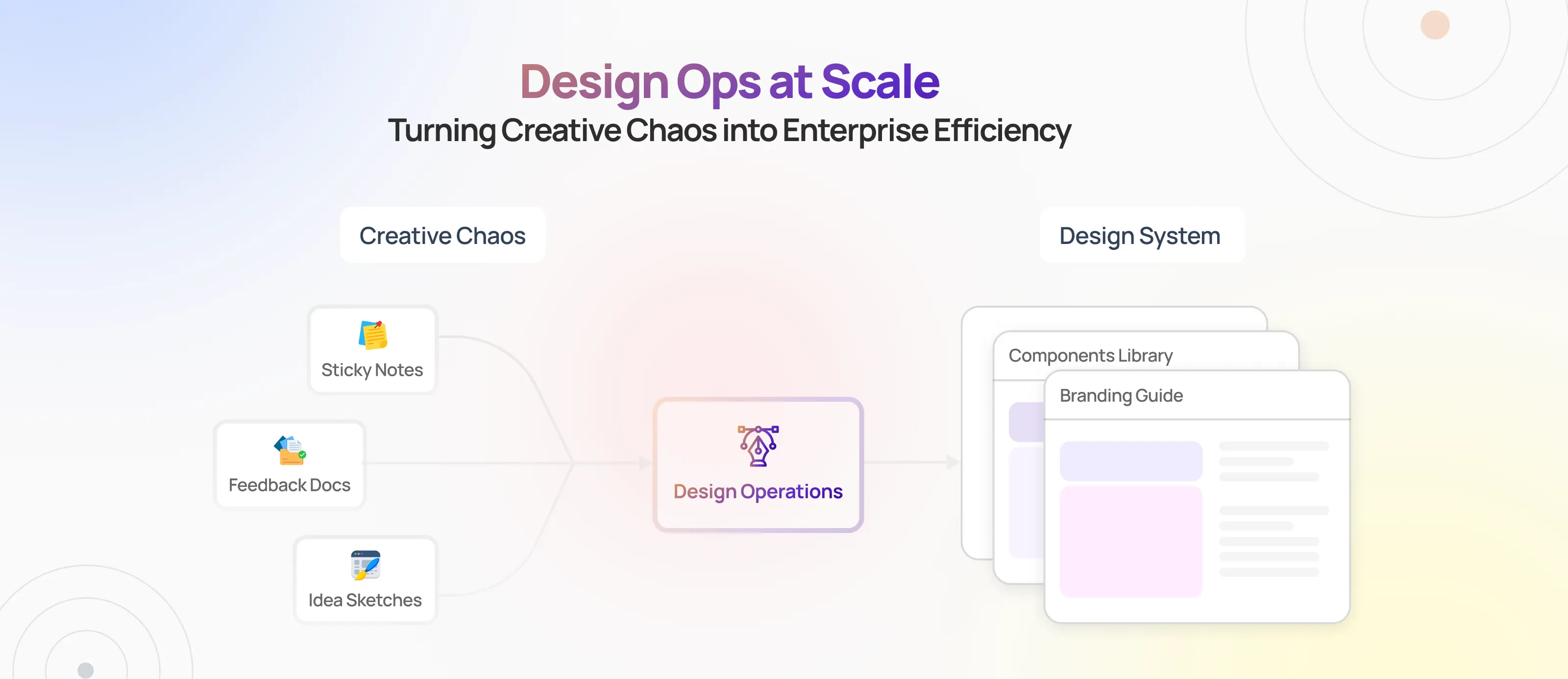
Here’s a situation that plays out in enterprise UX teams everywhere: You hired 50 brilliant designers last year. You’ve got design systems, Figma licenses, and Slack channels for everything. Yet somehow, three teams just built the same dropdown component in three different ways.
Your engineers are frustrated. Your designers are drowning in process debt. And leadership keeps asking why design is “taking so long.”
Sound familiar? This is what happens when Design Ops at scale is neglected. As the enterprise UX team grows from dozens to hundreds of designers across products and regions, the creative process doesn’t just slow down—it actively works against itself.
This is where Design Ops at scale comes in: not as another layer of bureaucracy, but as the operating system that makes creativity scale without breaking.
Design Ops (or UX Operations) acts as the operating system that makes creativity scale without breaking. It enables organizations to unify tools, workflows, and culture, optimizing design-to-development workflows and business strategy.
At smaller scales, design thrives on spontaneity. But in enterprise ecosystems where hundreds of designers, developers, and product managers collaborate, without process optimization, scale amplifies friction.
Let’s paint a scenario. A company goes from 15 designers to 150 over three years. It adds new product lines, opens offices in different countries, and uses design systems built in-house, by external agencies, and by contractors. What can go wrong?
Designers duplicate work: The same UI pattern is reinvented by two teams.
Visual inconsistencies: Brand or UX language fragments across teams.
Hand-off friction: Engineers receive designs that are outdated or lack clarity.
Tooling fragmentation: Some teams use Sketch, others Figma; component libraries diverge.
Lack of measurement: Nobody knows how fast design is flowing or what the bottlenecks are.
The result: design efficiency plummets, and teams spend more time managing chaos than crafting experiences.
In a distributed, multi-product environment, scaling design means scaling clarity. This is where Design Ops frameworks bridge the gap by establishing standards, aligning teams, and defining repeatable methods that deliver enterprise design efficiency.
Design Ops or UX operations, acts as the “engine room” behind the design organization. It does not mean killing creativity with rigid processes. Rather, it means introducing just enough structure to let creativity thrive consistently and reliably.

At scale, Design Ops succeeds when four core pillars work together.
1. People & Culture: building the team, onboarding, career paths, design leadership, and rituals.
For instance, the Zalando Design Ops lead described their role as “chaos absorber, therapist, diplomat, and older sister all in one.”
2. Process & Workflow: establishing how design work happens, from request to hand-off, review loops, triage, and prioritization.
As one article by Creately states, scaling Design Ops means orchestrating “people, tools, workflows, and metrics” to deliver consistent outcomes across products, regions, and teams.
3. Tooling & Infrastructure: design systems, component libraries, shared repositories, versioning, and hand-off automation.
The UXPin article states that Design Ops is “the optimization of design processes, people, and technologies to streamline product design and add business value.”
4. Governance & Measurement: aligning design to business strategy, defining KPIs (speed, reuse, quality), and tracking outcomes.
Without measurement, improvement is aimless: “If you can’t measure it, you can’t improve it.”
How do you actually scale DesignOps in an enterprise environment? Here are some practical steps and patterns in design ops at scale:
One common model: A central Design Ops team that defines standards, tooling, and governance, and federated embedded Design Ops leads in each product or regional team. For example, the Spotify Design Ops team uses embedded design program managers in each unit, while central functions handle shared infrastructure.
A robust design system (UI components, style guide, documentation, and accessible patterns) is essential. It reduces duplication, speeds up delivery, and ensures consistency. The Design Ops team makes the design system live, evolvable, and consumable.
[Expert Insight: Using Design Tokens] To further bridge the gap between design and code, mature teams use Design Tokens. This ensures that variables like colors and spacing are automatically synced from Figma to the code repository, eliminating manual handoff errors.
Standardizing on a core set of design and hand-off tools (e.g., Figma + Storybook + design system) eliminates tool fragmentation. Automating repetitive tasks (asset export, versioning, hand-off) frees designers to focus on meaningful work.
Define metrics tied to design efficiency, e.g., average time from request to delivery, percentage of components reused, and number of mis-spec hand-offs. For example, one piece emphasizes that design ops needs to define both operational efficiency and operational efficacy metrics.

Scaling Design Ops without measurement is like steering blindfolded. Mature organizations establish KPIs that capture both efficiency and impact.
Key metrics include:
Velocity Improvement: Reduced time from design kickoff to developer-ready specs.
Defect Reduction: Fewer design-to-development mismatches due to standardized components.
Adoption Rate: Percentage of projects using the unified design system.
Design Ops ROI: Cost savings and productivity gains from reusable assets and automation.
Team Satisfaction: Qualitative measure of reduced friction and better alignment.
By connecting operational data with business outcomes, teams can articulate the true ROI of Design Ops: faster delivery, better product quality, and higher employee engagement.
Consider a global technology company managing 1,000+ designers across multiple regions. Their early challenge mirrored many enterprises’ fragmented tools, inconsistent patterns, and inefficient communication between design and development.
The Design Ops transformation began by centralizing collaboration tools and creating a unified design system. A core Design Ops team governed component standards, while embedded Design Ops leads localized processes for each product vertical.
Through workflow automation and real-time design audits:
Design duplication dropped by 45%.
Average design-to-development handoff time decreased by 30%.
Developer rework due to design mismatches fell by 40%.
This transformation proves that optimizing design-to-development workflows at scale leads not only to operational excellence but also to measurable business efficiency.
To scale Design Ops successfully, enterprises can follow this practical playbook:
Audit the Current State: Identify friction points, redundant tools, and process gaps
Centralize Assets: Build a design system that’s accessible, modular, and version-controlled
Automate Repetition: Eliminate redundant handoffs and manual QA through integrations and bots
Create Feedback Loops: Ensure design, product, and development teams have structured retrospectives
Measure and Iterate: Track metrics, adjust workflows, and evolve design maturity
Why should business leaders care? Because Design Ops bridges design and business outcomes. The benefits:
Speed to market: With fewer bottlenecks and clearer workflows, design cycles shorten.
Consistency at scale: A unified experience across products, platforms, and regions.
Better ROI on design investment: Less duplication, fewer hand-off issues, and higher reuse.
Higher designer satisfaction and retention: Removing the “firefighting” burden lets designers focus on craft.
Stronger alignment with strategy: Design becomes a predictable, measurable function, not an artisanal outlier.
Over-process: too much control stifles creativity
Tool sprawl: introducing yet another tool without consolidation increases chaos
Ignoring culture: Change fails when designers feel the process is imposed
Lack of metrics: you can’t show value without data
Treating Design Ops as an afterthought: For scaling teams, Design Ops needs investment early
As organizations enter distributed work, global teams, AI-augmented workflows, and increased product complexity, the role of Design Ops will evolve further. Expect:
AI/automation in hand-off and QA: Pre-checking design specs, component usage, accessibility
Distributed design ecosystems: Remote design communities, federated tooling, more asynchronous collaboration
Design Ops as a strategic partner: Not just enabling craft, but shaping business outcomes, product portfolio strategies, and cross-functional alignment
In large organizations, “more designers” doesn’t automatically mean “better design.” Without structure, scale alone can magnify chaos. Design Ops is the discipline of turning that scale into strength, enabling enterprises to move fast, innovate boldly, and deliver consistent, high-quality design at scale.
If you’re leading or embedded in a design organization now embarking on growth or already scaling, investing in Design Ops at scale is not optional. Lollypop will help you build a Design Ops system preserve creativity and deliver enterprise efficiency!
To scale Design Ops in an enterprise, you must move from a centralized model to a hybrid “Federated” model. This involves a central “Ops Guild” that sets global standards (like Design Tokens and Tooling) and embedded “Design Program Managers” (DPMs) within specific product squads. Success at scale requires automating the design-to-development workflow through tools like Storybook and establishing a clear governance framework for the design system.
While often confused, a Design System is the “product” (the library of UI components, tokens, and documentation), whereas Design Ops is the “infrastructure” and process that makes that product usable. Design Ops manages the people, the budget, the vendor relationships (Figma, Jira), and the cross-functional rituals that allow the Design System to be adopted across 100+ person teams.
Enterprises typically reach a “friction tipping point” when they hit 40–50 designers or manage more than three distinct product lines. If your senior designers are spending more than 20% of their time on “work about work”—managing licenses, fixing broken handoff files, or recruiting research participants—it is time to hire a dedicated Design Ops lead to recapture that lost productivity.
Design Ops reduces “handoff debt” by standardizing the technical specifications sent to engineers. By implementing automated QA checks, shared naming conventions between Figma and GitHub, and using Design Tokens, teams can reduce developer rework by up to 40%. This ensures that what is designed is exactly what is built, accelerating the overall time-to-market.
The ROI of Design Ops is measured through Operational Efficacy and Efficiency:
Velocity: Reduction in time from design concept to “developer-ready” status.
Adoption: The percentage of new features built using the core Design System.
Quality: Decrease in the number of design-related bugs found during UAT (User Acceptance Testing).
Retention: Qualitative scores reflecting reduced designer burnout and administrative friction.
Yes, Design Ops is often described as the “UX equivalent of DevOps.” It bridges the gap between the creative process and the sprint-based cycles of Agile. By aligning design “Definition of Ready” with engineering “Definition of Done,” Design Ops ensures that designers are always one to two sprints ahead of development, preventing bottlenecks in the CI/CD pipeline.
The biggest mistake is over-standardization. Introducing too many rigid processes too quickly can stifle creativity and lead to “process rebellion.” Mature organizations avoid this by practicing “Just Enough Process”—standardizing the output (handoff files and components) while leaving the creative exploration phase flexible for individual designers.