Scaling a digital product requires more than adding features. As your roadmap grows, your team needs enough design capacity to research user needs, improve existing experiences, maintain consistency, and support product development without slowing delivery.
Dedicated product designers offer one way to meet that demand. They work continuously with your product team through a design partner, combining ongoing product involvement with access to external design expertise. Unlike a freelancer hired for a specific task or an agency engaged for a defined project, dedicated designers can become an extension of your existing team.
But this model is not right for every business. Some teams need a specialist for a few weeks, while others benefit from building permanent in-house capabilities.
The right choice depends on how much design work you have, how closely designers need to collaborate with your team, and how you want to manage resources over time.
In this guide, we compare dedicated product designers, freelancers, project-based agencies, and in-house designers to help you choose the model that fits your product’s needs.
Dedicated product designers are designers assigned to work continuously on a client’s product through an external design partner. Rather than delivering a single project and moving on, they become integrated into the client’s product development process.
They may work on user research, user flows, wireframes, prototypes, interface design, design systems, and ongoing product improvements, depending on the engagement scope.
Consider a SaaS company preparing to expand its platform. The product team has a growing backlog of features, usability issues to address, and a design system that needs ongoing maintenance. Hiring another full-time designer could take time, while outsourcing every initiative separately would require repeated onboarding.
A dedicated product designer can provide a more continuous solution.
The designer works with the product manager to understand priorities, collaborates with engineers during implementation, and participates in regular product and design reviews. Over time, they build familiarity with the product, its users, technical constraints, and business goals.
The client typically retains responsibility for product strategy and prioritization, while the design partner provides the agreed design capacity and associated support. Depending on the contract, this may include talent selection, design quality processes, and replacement arrangements.
The defining characteristic is continuity: the designer remains involved as the product evolves.
The distinction is primarily about how the engagement is structured.
A project-based agency is usually commissioned to deliver a defined scope, such as researching and redesigning an application or developing an MVP. The agency manages delivery against agreed objectives, timelines, and deliverables.
A dedicated design engagement focuses on providing ongoing design capacity. The work may change as the product roadmap evolves, with priorities agreed upon through the client’s established workflows.
These models are not mutually exclusive. An agency can provide dedicated designers through a team-extension arrangement, and a dedicated engagement can include multiple designers or other specialists.
The important question is whether you need a defined project delivered or continuous design support embedded in your product development process.
Each engagement model offers a different balance of flexibility, continuity, expertise, and management responsibility. Comparing them against your actual working requirements is more useful than assuming one is inherently better than the others.
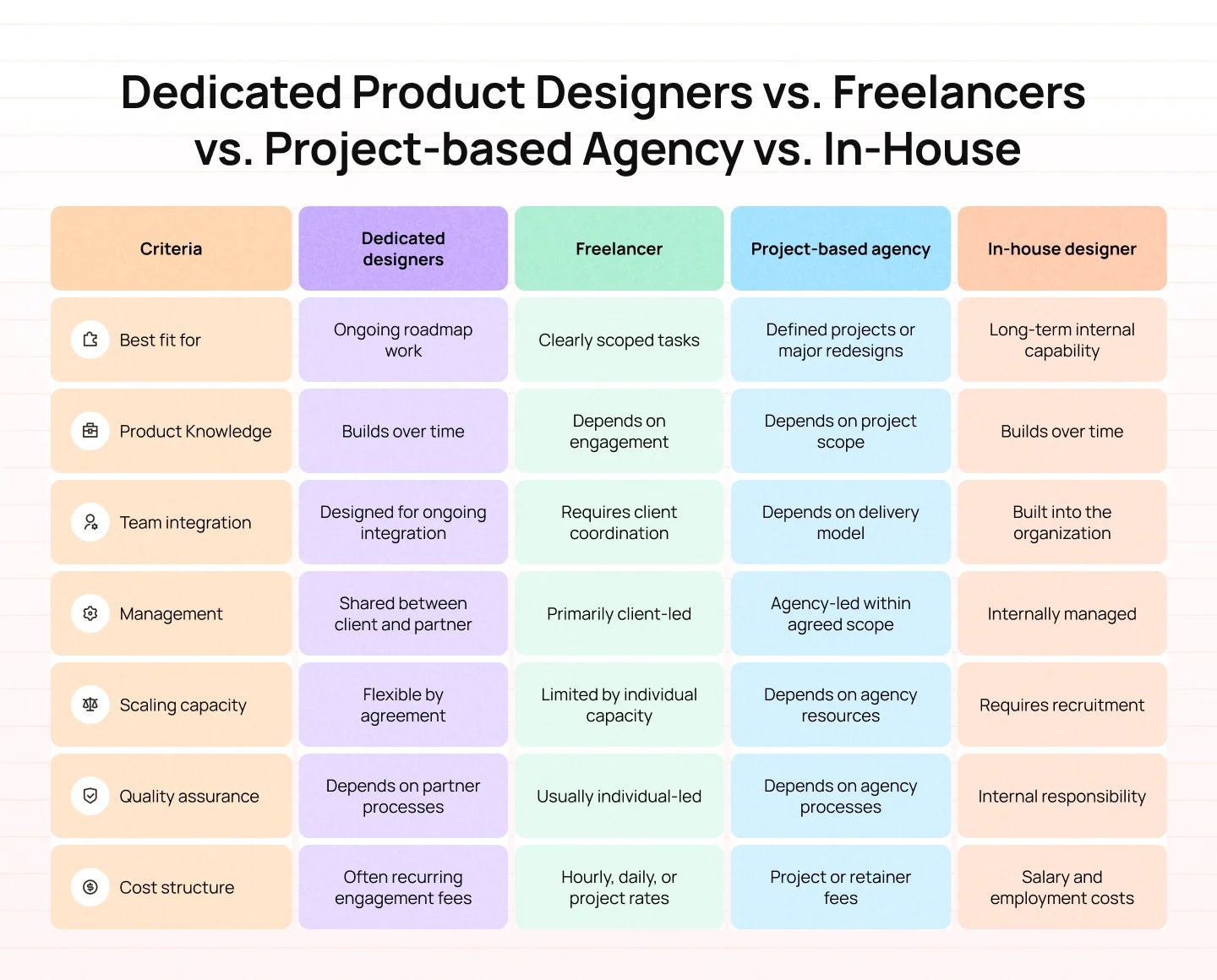
Actual arrangements vary by provider, contract, seniority, and scope. For example, some freelancers offer long-term embedded support, and some agencies provide ongoing teams.
Freelancers can be a practical choice when you have a clearly defined need, such as designing a landing page, auditing an existing interface, or producing a limited set of screens.
The trade-off is coordination. If the freelancer must repeatedly depend on your internal team for product context, feedback, and technical clarification, the management effort can increase. Continuity may also become difficult when the engagement ends.
Agencies are useful when a project requires several capabilities, such as UX research, product strategy, UI design, and prototyping. Their established processes can help teams tackle complex initiatives without assembling every specialist internally.
However, when the project concludes, ongoing design capacity may no longer be available unless a follow-on engagement is agreed.
In-house designers are part of the organization and can build deep relationships with stakeholders, understand internal constraints, and contribute to long-term product strategy.
The trade-off is the investment required to recruit, onboard, retain, and develop talent. Hiring also does not automatically provide every specialty a product may need.
Dedicated designers are worth considering when design work continues across multiple sprints and your existing team needs additional capacity. They can build product knowledge while benefiting from the resources and expertise available through a design partner.
Their effectiveness depends on the quality of integration, the designer’s experience, and the clarity of responsibilities. They are not automatically cheaper or easier to manage than every alternative.
Dedicated designers are most relevant when your product needs ongoing design work but your current team cannot consistently meet demand.
The following signals can help you determine whether team extension is worth considering.
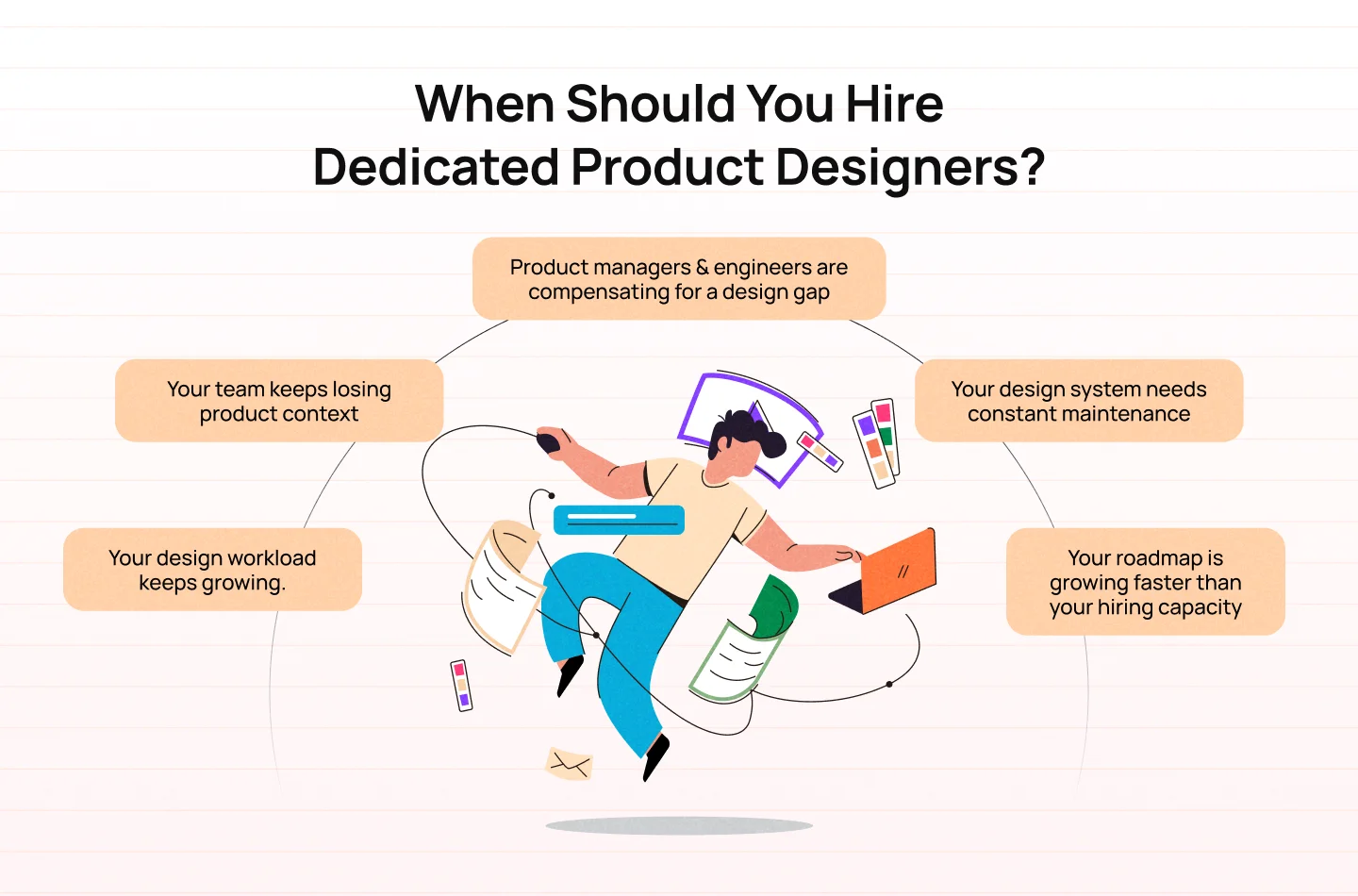
New features, usability improvements, and product experiments compete for limited design time. When design becomes a persistent bottleneck, adding continuous capacity may help the team keep pace with its roadmap.
If each new freelancer or agency must repeatedly learn your product, internal stakeholders may spend considerable time explaining the same workflows, decisions, and constraints. A continuing engagement can reduce repeated onboarding and help preserve context.
When product managers start creating interface specifications or engineers make design decisions without sufficient UX input, the team may be operating beyond its intended capacity. Dedicated design support can restore clearer ownership and collaboration.
A design system requires more than an initial set of components. It needs documentation, maintenance, consistency checks, and coordination with engineering as the product evolves. Continuous design capacity can help sustain that work.
You may need more design support before a permanent role can be approved or filled. Team extension can provide an alternative, provided the engagement terms and onboarding requirements align with your timeline.
Your company’s stage can provide useful context, but it should not determine the engagement model on its own.
The decision should ultimately reflect your backlog, internal expertise, management capacity, and expected duration of the work—not simply your funding stage.
Team extension is effective when external designers are integrated into the way your product team already operates. Simply assigning a designer to a project does not guarantee continuity or collaboration.
Step 1: Understand the product and its goals.
The engagement begins with an understanding of the business objectives, target users, product roadmap, existing design work, and technical constraints. Where necessary, the team may review user research, analytics, support feedback, and existing design documentation.
Research support can be particularly useful when product decisions depend on assumptions that have not yet been validated. See Lollypop’s UX Research services for examples of research activities that inform product design.
Step 2: Integrate into the team’s workflow.
The client and design partner establish responsibilities, communication channels, design tools, review processes, and expectations for collaboration.
For example, designers may use Figma for design work, Jira for task management, and the client’s existing communication and sprint-planning processes. The specific tools matter less than having a shared, predictable workflow.
Step 3: Deliver design work continuously.
Depending on the product’s needs, designers may work on user journeys, wireframes, prototypes, interface design, usability improvements, or design system components.
They collaborate with product managers to understand priorities and with engineers to ensure that designs are feasible to implement.
Step 4: Review, test, and iterate.
Design quality depends on more than visual polish. Teams should review usability, accessibility, consistency, and alignment with product requirements. Where appropriate, usability testing and user feedback help validate design decisions before or after implementation.
Step 5: Evaluate the engagement.
Regular reviews should examine agreed measures such as delivery reliability, design quality, implementation readiness, and progress against product priorities.
Product outcomes such as task completion, adoption, or conversion may also be relevant, but they depend on multiple factors beyond design alone.
A design partner can provide expertise and capacity, but it cannot replace the client’s product leadership.
The client remains responsible for setting business priorities, providing access to stakeholders and users, coordinating internal teams, and making timely decisions. The designer needs this context to make informed recommendations rather than simply produce requested screens.
For SaaS businesses, this collaboration is particularly important because workflows, user permissions, integrations, and product requirements can become increasingly complex as a platform grows. Explore Lollypop’s SaaS Product Design services for more on designing scalable SaaS experiences.
Design is most useful when it informs product decisions rather than operating as a separate production function.
A designer who understands the product’s objectives can question assumptions, identify usability problems, explore alternatives, and collaborate with engineering before decisions become expensive to change.
When designers are disconnected from product managers, engineers, and business stakeholders, work can become fragmented. Teams may spend more time resolving misunderstandings, and design decisions may be made without sufficient context.
Research from McKinsey’s The Business Value of Design study found a strong correlation between financial performance and organizations’ ability to integrate designers with other functions. The research highlights the importance of cross-functional collaboration as part of a broader set of design practices. It does not establish that any single staffing model guarantees better financial results. Read the McKinsey research.
For product leaders, the practical lesson is straightforward: adding design capacity is only part of the solution. Designers also need access to the people, information, and decisions that shape the product.
Integrating designers into your product team is only the first step. To create lasting value, design work must remain connected to user needs, product priorities, and engineering decisions throughout the development process. This requires more than additional design capacity; it requires a design partner who understands how to translate business goals into meaningful product experiences.
At Lollypop, we bring product thinking, UX research, and UI/UX design together to help businesses solve user problems and build digital products with purpose. Explore Lollypop’s design services to see how design can support your product goals.
There is no universal price for a dedicated product designer. Rates vary with experience, location, specialization, engagement length, and the scope of support included.
The more useful approach is to compare the total cost of obtaining the design capacity your product needs.
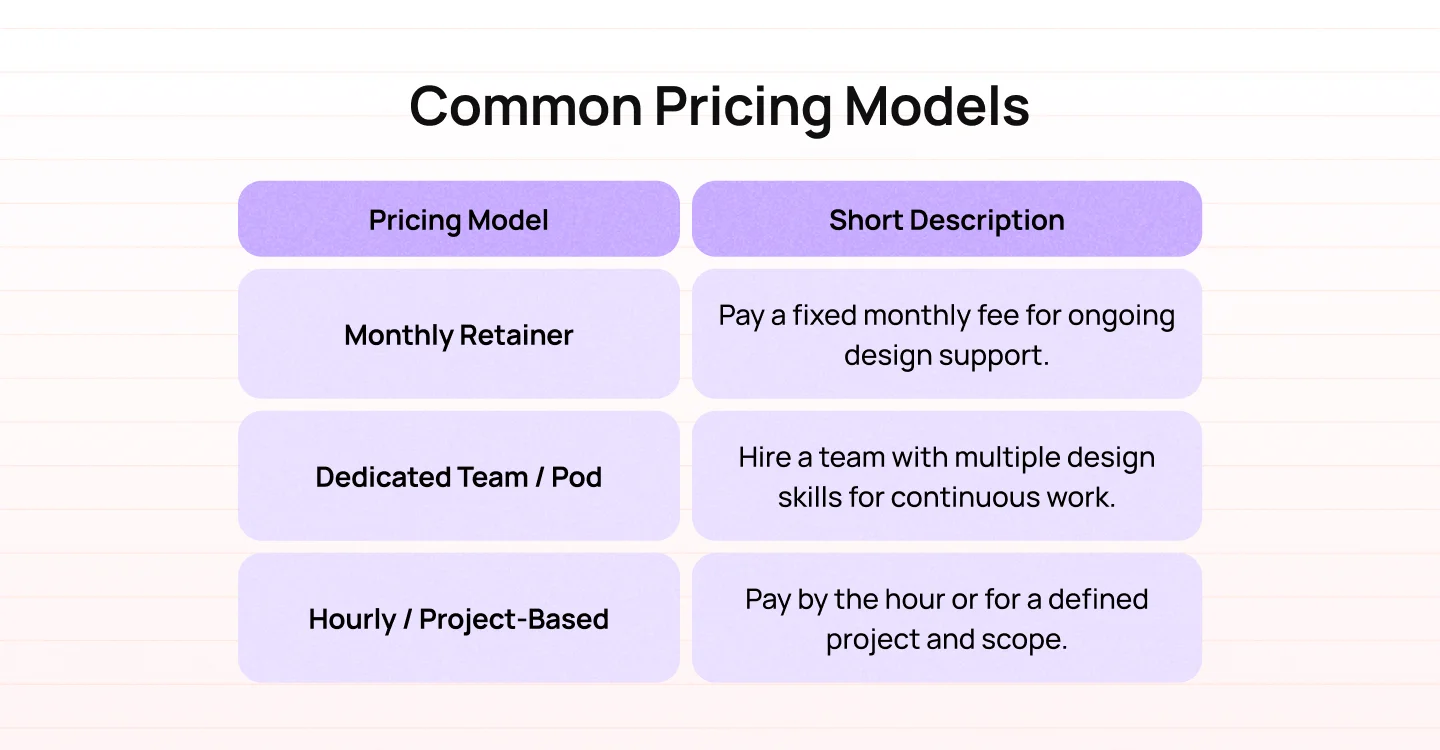
When comparing options, consider more than the quoted design fee.
For example, a freelancer may have a lower quoted rate but require substantial coordination from your internal team. A dedicated designer may involve a higher recurring fee while providing more consistent capacity. An in-house hire may require a larger long-term employment commitment but provide stronger internal ownership.
None of these outcomes is guaranteed. The right comparison uses equivalent seniority, scope, expected output, and engagement duration.
The key question is not which option has the lowest rate, but which option provides the right design capacity at an acceptable total cost.
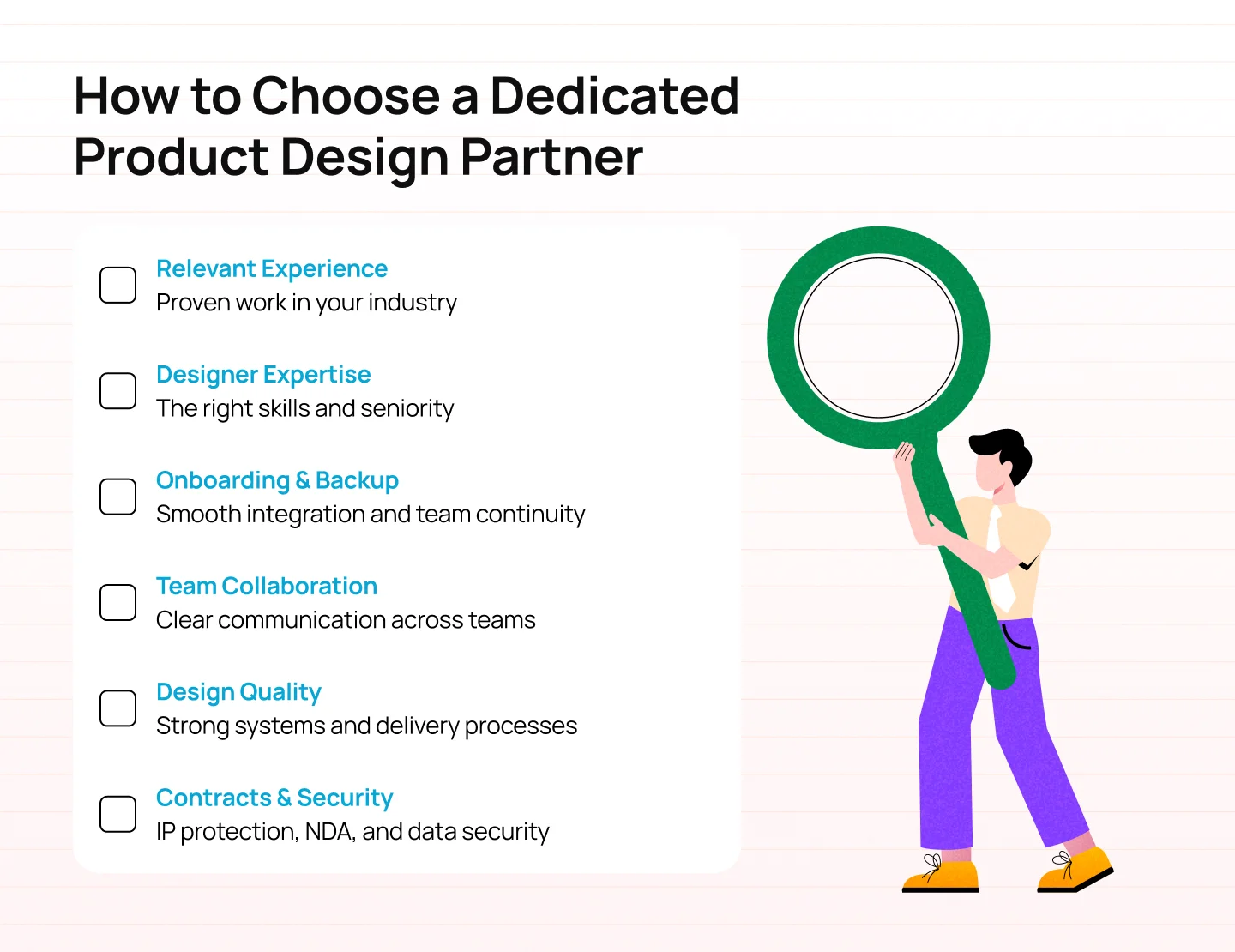
The quality of the engagement depends on more than the designer’s portfolio. You also need a partner whose working model supports continuity, collaboration, and accountability.
Before committing, make sure you can answer these questions:
Clear answers help establish a productive working relationship and reduce the risk of treating team extension as a simple staffing transaction.
If you are exploring design support for your product, view Lollypop’s projects to understand its design experience, or discuss your project with the team to explore your requirements.
Freelancers, agencies, in-house designers, and dedicated product designers each serve different needs. Freelancers can be effective for clearly scoped tasks. Project-based agencies can support defined initiatives requiring structured delivery and broader expertise. In-house designers provide long-term internal ownership. Dedicated designers can help when a product team needs continuous design capacity and closer integration without immediately expanding permanent headcount.
The best choice comes down to the nature of your design workload, how your team collaborates, and the level of continuity your product requires.
If your roadmap demands ongoing design support, consider whether extending your existing team could help you maintain momentum while keeping product decisions, engineering collaboration, and design work connected.
Looking to scale your product design capacity? Talk to Lollypop about your team’s goals and explore an approach that fits your product’s needs.
A dedicated design team is a group of designers assigned to work continuously with a client’s product or business team. It may be supplied by an external design partner and integrated into the client’s workflows, with responsibilities defined by the engagement agreement.
It depends on the designer’s seniority, the duration of the engagement, the scope of support, and the costs of recruitment, employment, onboarding, and management. Dedicated designers may reduce the need for permanent headcount expansion, but they are not automatically less expensive than in-house employees.
UX design team extension is a model in which an organization adds external UX or product design professionals to its existing team. These designers work alongside internal stakeholders to support ongoing product work, rather than operating solely as an independent project delivery team.
The timeline depends on designer availability, the required skill set, selection and approval processes, and onboarding readiness. Before committing, ask the provider for a realistic start date and clarify what is needed from your team to begin.