Artificial intelligence is changing how real estate and SME lending businesses work. In real estate, AI is already helping professionals write listings, create marketing content, summarize market information, and review documents. In lending, AI is being used to process information, support analysis, and automate parts of increasingly digital financial workflows.
But there is another shift happening outside these products and services. AI is becoming part of how people search for information, compare options, and decide which businesses to consider. Google reports that AI Overviews now reach more than 2.5 billion monthly active users, while AI Mode has surpassed one billion monthly active users. Its research also shows that people are using AI-powered Search differently, asking more complex questions and continuing conversations rather than relying only on individual keyword searches.
For a real estate company, that could mean a potential client asking, “Which commercial real estate firms specialize in healthcare properties?” For an SME lender, it could be, “Which lenders offer working capital financing for small manufacturers?” The question is no longer only whether your website can be found in search. It is whether AI can find, understand, and surface your business when it becomes relevant to the question.
That is where AI Visibility becomes a new consideration for businesses operating in real estate, lending, and financial technology.
AI adoption in these industries is no longer a distant prediction. It is already becoming part of everyday business workflows. The National Association of REALTORS®’ 2026 Technology Report found that 23% of REALTORS® use AI daily and another 25% use it weekly. Only 12% said they were not using AI and did not plan to, down from 32% in the previous year’s survey.
Among REALTORS® who use AI, the most common applications are practical rather than futuristic. Seventy-five percent use AI to write listing descriptions, 56% use it for social media posts, and 52% use it to create emails and follow-up communications. Other applications include market summaries, marketing content, document review, client education, and pricing insights.
The shift is also visible among small businesses. The Federal Reserve’s 2026 Small Business Credit Survey found that 46% of employer firms currently use AI, while another 15% plan to begin using it within the following 12 months. Among firms already using AI, 71% reported increased productivity, while accuracy was the most commonly reported challenge, cited by 46% of AI users.
Lending itself is becoming more digital as well. Among businesses that applied for financing, the share that sought funding from online fintech lenders increased from 17% in the 2020 survey to 29% in the 2025 survey. The same Federal Reserve research shows that online lenders are now a significant part of the financing landscape for small businesses.
Together, these changes point to a broader shift. AI is moving closer to the workflows where businesses create information, analyse options, and make decisions. But that is only one side of the transformation. The other is what happens when customers begin using AI to make decisions about the businesses themselves.
The impact of AI in real estate and lending becomes clearer when viewed through the workflows it is changing rather than through AI as a technology category.
In real estate, many of the most common applications are focused on reducing repetitive work. Listing descriptions can be drafted faster, social media content can be generated from existing property information, and client communications can be prepared with less manual effort. The 2026 NAR report shows that content and communication remain the dominant applications, while 27% of AI-using REALTORS® use AI for document review and summarization and 23% use it for pricing insights or comparable-property support.
This matters because AI is becoming embedded in the processes through which real estate professionals create and communicate information. A listing is no longer simply a page a broker writes. It can become an AI-assisted information asset that is adapted for different channels, audiences, and stages of the customer journey. The same applies to market summaries, educational content, client communications, and other information that helps a buyer or seller make a decision.
SME lending presents a different but related challenge. Lending decisions depend on large amounts of financial and business information, including applications, financial records, transaction data, and repayment history. AI can help process and analyse this information at scale, but that does not make the underlying decision automatically reliable. The Federal Reserve’s finding that accuracy is the leading AI challenge among current users is a useful reminder that AI adoption still comes with questions around data quality, output reliability, and how much human judgment should remain in the process.
For product and experience teams, this distinction is important. The goal is not simply to put AI into an existing workflow. The product still needs to help people understand what the system is doing, evaluate its output, and decide what to do next. As AI moves closer to consequential decisions, the experience around the technology becomes just as important as the technology itself.

For years, the digital discovery journey was relatively familiar: a buyer searched for something, reviewed a list of results, visited several websites, compared options, and eventually contacted a business. AI is introducing another layer to that journey.
Instead of searching only for pages containing a particular phrase, a buyer can ask a conversational AI system to interpret a need and suggest relevant options. Google describes its AI-powered Search experience as a shift toward more complex questions and ongoing conversations, while its AI Mode has surpassed one billion monthly active users globally.
Consider a commercial real estate buyer searching for a specialist. A traditional query might be “commercial real estate firms healthcare.” An AI-assisted query might be, “Which commercial real estate firms specialize in healthcare properties, and what makes them relevant?” The second question asks the system to do more than retrieve information. It asks AI to interpret the need and identify businesses that could satisfy it.
The same pattern can apply to SME lending. A business owner might ask, “Which lenders offer working capital financing for small manufacturers?” The expected answer is not a collection of pages that mention working capital. It is a set of relevant businesses, products, or options that AI believes fit the request.
This changes what visibility means. The business needs to be more than searchable. It needs to be understandable within the context of the question.
Traditional search visibility still matters. Search rankings, organic traffic, content quality, technical SEO, and website performance remain important parts of a strong digital presence. But these signals do not tell the entire story of how a business may appear in AI-generated answers.
Imagine a commercial real estate company with a polished website, strong organic rankings, and decades of experience. Its website may clearly state that it provides commercial real estate services. But can an AI system also understand that the company specializes in healthcare properties, operates in a particular market, and has relevant expertise supported by credible external sources?
Those are different questions.
Traditional SEO largely asks whether a search engine can discover and rank a page for a query. AI Visibility asks a broader question: can an AI system understand the business well enough to include it when a relevant question is asked?
This does not mean SEO has become irrelevant. Search visibility remains part of the digital foundation. It means that search visibility and AI visibility should not be treated as identical measures of discoverability.
A business can have plenty of information online and still have an unclear digital identity. Its services may be described differently across pages. Its expertise may be obvious to an internal team but difficult to identify from the outside. Important information may exist only in unstructured text. Third-party references may be limited. Technical issues may make parts of the website harder to access or interpret.
The problem is therefore not simply whether a business has content. It is whether the digital presence creates a sufficiently clear and credible picture of the business for AI systems to interpret.
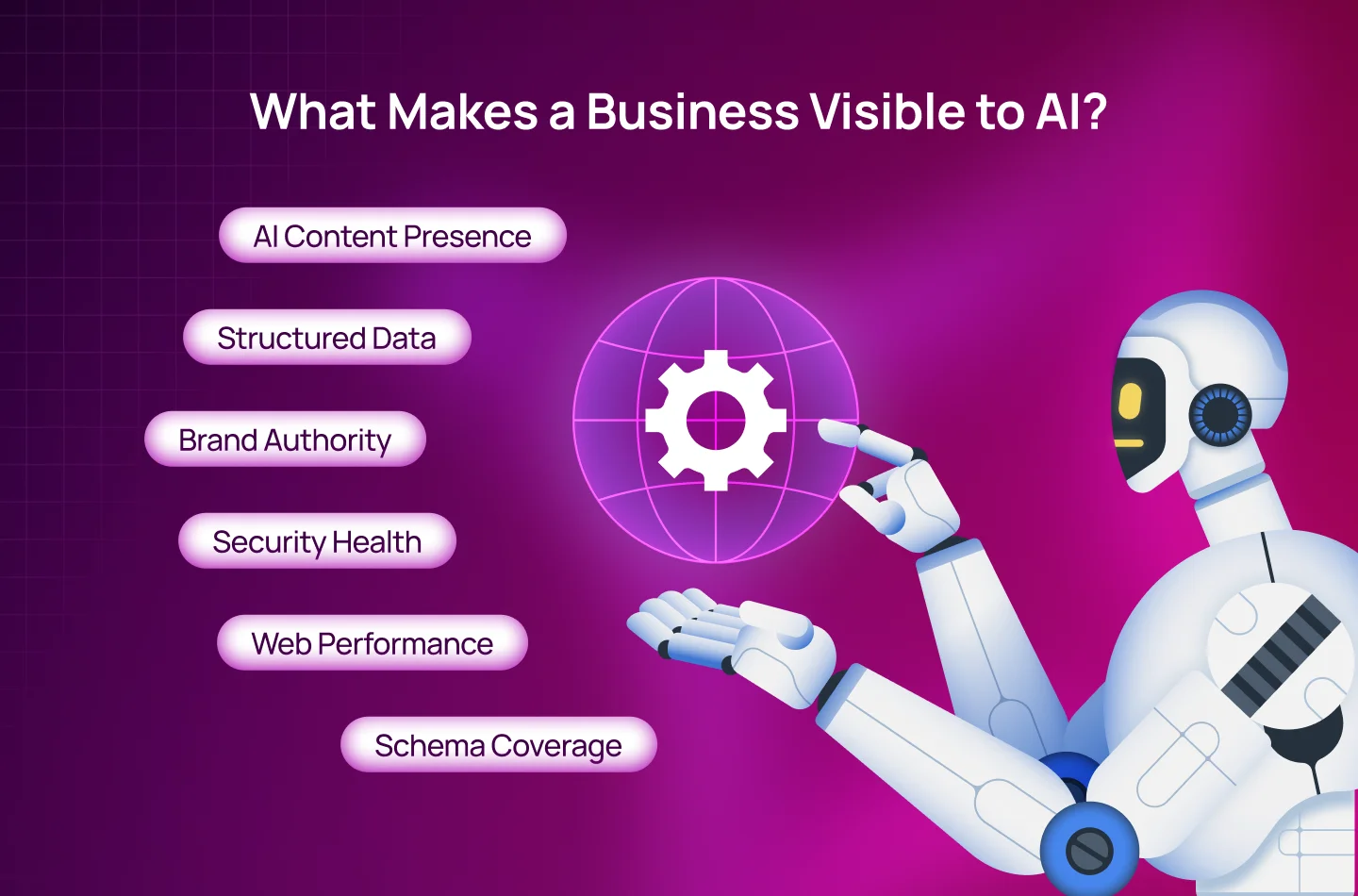
AI Visibility is not created by a single SEO tactic. It is the result of multiple signals working together to make a business easier to discover, understand, and verify.
The first layer is the information a business publishes about itself. AI needs to understand what the company does, which products or services it offers, who it serves, which industries it specializes in, and what problems it solves. For a real estate company, that might include its property types, markets, services, and areas of expertise. For a lender, it could include financing products, target businesses, eligibility criteria, and industries served.
This does not mean simply publishing more content. More pages do not automatically create more visibility. What matters is whether the important relationships within the business are clearly communicated. If a company serves healthcare organizations with commercial real estate solutions, for example, that relationship should be explicit rather than left for a reader—or an AI system—to infer from scattered references across the website.
Web pages are primarily designed for people, but structured data provides machines with additional information about the entities represented on those pages. Organization, product, service, location, article, and other structured information can help systems interpret what a page represents and how different pieces of information relate to one another.
This creates an interesting connection between information architecture and AI discoverability. Good design helps people understand where information belongs and how different pieces connect. Structured data adds another layer of clarity for machines. Neither replaces the other, but together they can create a more coherent digital representation of a business.
A company can describe itself as an expert, but external sources can provide another layer of evidence. Industry publications, professional organizations, reviews, partner websites, media coverage, and other credible references contribute to the broader picture of a business that exists beyond its own website.
This distinction matters because AI systems do not rely only on what a company says about itself. The wider digital ecosystem can provide additional context that helps establish whether a business, product, or area of expertise is consistently represented elsewhere.
A business’s digital presence also needs to be technically healthy. Security issues can affect the reliability and accessibility of a website and undermine the technical foundation on which its information is delivered.
Security should not be treated as a guarantee of AI citations or visibility. Instead, it is part of the broader health and readiness of the digital environment in which a business publishes its information.
A business can invest heavily in content and brand information, but that information still needs to be delivered through a website that is accessible and performant. Web performance is therefore not only a UX concern. It is part of maintaining a healthy digital presence that can reliably serve users and machines.
For product and design teams, this is a useful reminder that discoverability is connected to the experience layer. Content, structure, technical performance, and usability do not exist in isolation.
Finally, structured information needs meaningful coverage across the website. A business with multiple services, locations, products, or content types may have a much more complex digital identity than a single homepage can communicate.
Schema coverage helps extend structured information across the pages that actually explain those parts of the business. The goal is not to add markup for its own sake, but to create a more complete and consistent machine-readable representation of the business.
Taken together, these dimensions point to a broader principle: AI Visibility is not one optimization task. It is the combined strength of the digital signals that help AI understand what a business is, what it offers, who it serves, and why it is relevant.
The information AI needs to understand a business depends heavily on the questions its customers are asking.
For real estate companies, that context might include property types, markets, locations, brokerage or management services, asset classes, and industry specialization. Consider a question such as, “Which commercial real estate firms specialize in industrial properties in Chicago?” A company that simply describes itself as a commercial real estate firm provides only part of the context. To be relevant to the query, its digital presence needs to make the relationship between its service, property type, location, and expertise clear.
The same principle applies to SME lenders and fintech companies. A business may offer working capital financing, but the more useful question is often more specific: “Which lenders provide working capital for small manufacturers?” The answer depends on whether AI can connect the lender to the right product, audience, industry, and use case.
This is why generic descriptions of a business may not be enough in an AI-driven discovery environment. The more specific the buyer’s question becomes, the more important the surrounding business context becomes.

The easiest way to start thinking about AI Visibility is to ask AI the same kinds of questions your customers might ask.
Start with a branded query such as, “What does [Company] do?” Look at whether the answer accurately describes the business, its services, its audience, and its areas of expertise. If the description is incomplete or inaccurate, that is already a useful signal about how the company’s digital identity is being interpreted.
Then move beyond the brand. Ask a category-level question such as, “What are the leading commercial real estate firms for healthcare properties?” or “What are the best SME lending options for manufacturers?” Does your business appear when the query becomes relevant to your actual offering?
Problem-based questions can reveal another layer. Ask, “Who can help a small manufacturer secure working capital?” or “Which firms specialize in commercial real estate for healthcare facilities?” These questions test whether AI understands the connection between the business and the problem it solves, rather than simply recognizing the company name.
Finally, look at the evidence behind the answer. If AI recommends your business, what information does it use to support that recommendation? Does it rely on your own website, third-party publications, reviews, industry sources, or a mixture of them?
These tests can reveal useful gaps, but they are still snapshots. One query does not tell you how consistently your business appears, why it appears, how competitors compare, or which parts of your digital presence may be limiting discoverability.
That is where measuring AI Visibility becomes more useful than simply checking whether your brand appeared once.
SEO platforms help you understand rankings. You can use analytics tools to understand website traffic. But those tools don’t directly answer another question: how does AI currently understand your business?
Lollypop Spot is built around that question. It evaluates AI discoverability across six dimensions: AI Content Presence, Structured Data, Brand Authority, Security Health, Web Performance, and Schema Coverage.
The first step is measurement. Spot provides a Spot Score that gives businesses a structured view of their AI Visibility instead of relying only on occasional manual searches. This turns an abstract concern—“Are we visible to AI?”—into something that can be assessed across multiple aspects of the digital presence.
The second step is testing. Rather than looking only at whether a website contains certain technical elements, Spot is designed to examine how AI systems respond to relevant business queries. That makes the question more practical: not simply whether a website is technically prepared, but whether the business can actually be understood and surfaced in AI-driven discovery.
The third step is identifying where to improve. The AI Readiness Audit helps businesses understand the areas of their digital presence that may be limiting discoverability, so teams can move from a general concern about AI visibility toward specific areas that deserve attention.
For a real estate company, that might mean discovering that its market expertise is not clearly represented across its digital presence. For an SME lender, it might mean identifying gaps in how products, industries, or business information are structured and communicated.
The point is not to optimize for AI as an isolated channel. It is to make the business itself easier to understand across the digital environments where future customers may discover it.
A website has traditionally been one of the first major touchpoints between a business and a potential customer. AI introduces another possibility: the first interaction with a business may happen before the customer ever visits its website.
The journey can look more like question → AI answer → shortlist → website → evaluation → contact. In that journey, the website still matters enormously. But it may no longer be the first place where a customer forms an impression of the business.
This does not mean AI has replaced traditional search, nor does every buyer begin with an AI tool. It means AI is becoming another discovery layer, particularly for questions where people want recommendations, comparisons, explanations, or a starting point for further research. Google’s own data shows how quickly AI-powered Search is expanding, with AI Overviews reaching more than 2.5 billion monthly active users and AI Mode surpassing one billion monthly users.
For complex categories such as real estate and financial services, this creates an important strategic question. If a buyer asks AI to help narrow down a category, is your business represented clearly enough to become part of that consideration set?
If the answer is no, the quality of your website experience may never get the opportunity to influence that buyer.
This shift also creates an interesting challenge for digital and product teams. Traditionally, design has focused heavily on what happens after someone arrives: whether they can navigate the website, understand the product, compare options, complete a task, or find the information they need.
AI adds another layer to that experience.
Before someone reaches the interface, another system may already be interpreting the business on their behalf. That makes information architecture, content clarity, structured information, and digital consistency increasingly important. The challenge is no longer limited to designing an interface that helps a person understand the business. It also involves creating a digital presence that can be interpreted consistently by the systems increasingly involved in discovery.
A great digital experience helps people understand your business. An AI-ready digital presence helps machines understand it too.
For companies operating in real estate, lending, and financial technology, the distinction is becoming increasingly relevant. Their products often involve complex services, specialized expertise, and high-consideration decisions. If AI becomes part of how customers navigate that complexity, businesses need to think about what information they are making available, how clearly it is structured, and what evidence supports it.
In that sense, AI Visibility is not separate from the broader discipline of digital experience. It extends the question of usability from the interface to the information ecosystem around the business.
Your business may already be investing in SEO, content, website performance, and digital experiences. But as AI becomes another way for customers to research and compare businesses, there is another question worth adding to the checklist:
Can AI find, understand, and confidently surface your business?
Lollypop Spot helps you answer that question with a measurable view of your AI Visibility. Through its Spot Score and AI Readiness Audit, the platform evaluates the digital signals that contribute to how clearly your business can be understood and discovered.
Instead of guessing whether AI can find your business, you can start by seeing where you stand and which areas deserve closer attention.
Check your Spot Score. See how AI currently understands your business and uncover the gaps that could be limiting your AI Visibility.

AI is changing real estate and SME lending from the inside, helping businesses process information, automate repetitive work, and support increasingly complex decisions. But the more important shift may be happening outside the product itself. As people turn to AI to research providers, compare options, and make sense of complex categories, the way a business is discovered is changing too.
For companies in real estate, lending, and financial services, this creates a new layer of digital visibility to consider. Having a strong website, useful content, and an established search presence still matters. But those efforts are no longer the whole picture if potential customers are increasingly asking AI to help them decide who to consider.
The question, then, is not simply whether your business is using AI. It is whether AI can understand what your business does, recognize where it is relevant, and surface it when the right question is asked.
That is the shift from being search-visible to becoming AI-discoverable.
Lollypop Spot helps businesses understand where they stand in that shift. By measuring AI Visibility and identifying gaps across the digital presence, it gives teams a starting point for making their business easier for AI to understand.
AI Visibility refers to how easily AI systems can discover, understand, and reference a business when users ask questions relevant to its products, services, expertise, or industry. It goes beyond whether a website appears in traditional search results and looks at how clearly the business is represented across its digital presence.
SEO focuses on helping search engines discover, understand, and rank web pages. AI Visibility addresses a broader question: can AI systems understand the business, its offerings, expertise, and supporting signals well enough to include it in a relevant answer? SEO remains an important part of digital visibility, while AI Visibility adds another layer to consider as search becomes more conversational and AI-driven.
There is no single reason a business may not appear. Potential factors can include unclear or incomplete business information, weak structured data, limited external authority signals, inconsistent information, and technical issues affecting the accessibility or quality of the digital presence. AI-generated answers can also vary by query, model, location, and context, so a single search should not be treated as a definitive measure of visibility.
Real estate companies can start by making their expertise explicit. Clearly communicate the markets, property types, services, locations, industries, and experience that distinguish the business. Strengthening structured information and credible external references can also help create a clearer digital representation of the company. The goal is to make the relationship between the business and the questions potential customers ask as clear as possible.
Financial businesses should clearly communicate their lending products, target businesses, industries served, eligibility requirements, geographic availability, and areas of expertise. Structured data, consistent business information, credible external references, and a technically accessible website can further support how the business is represented across the web.
A Spot Score is Lollypop Spot’s measurement of a business’s AI discoverability across its AI Visibility assessment framework. It helps businesses move from an abstract question—“Are we visible to AI?”—toward a more measurable view of their current digital readiness.
The AI Readiness Audit evaluates six areas of a business’s digital presence: AI Content Presence, Structured Data, Brand Authority, Security Health, Web Performance, and Schema Coverage. It is designed to help businesses understand where their current digital presence may be limiting AI discoverability and where improvements can be prioritized.