In today’s SaaS landscape, seamless connectivity is everything—and APIs are the backbone that makes it possible. As businesses increasingly depend on multiple platforms like CRMs, analytics dashboards, and payment systems, APIs enable these tools to communicate, share data, and deliver a unified experience. Without strong APIs, even the most feature-rich SaaS products struggle to integrate or scale effectively.
That’s why many teams are adopting an API-first approach—designing APIs as the foundation of their product architecture from day one. This ensures every feature is built for interoperability, leading to faster development cycles, smoother integrations, and a future-ready SaaS ecosystem.
In this blog, we’ll explore what an API-first approach means, how it can transform SaaS development, and why many developers are adopting it as their blueprint for building modern cloud products.
An API-first approach means designing your APIs before building the rest of your SaaS product. An API (Application Programming Interface) allows different software systems to exchange information securely and efficiently. By designing APIs first, SaaS teams ensure that all internal modules, external tools, and third-party integrations speak the same language from day one.
This approach makes the entire SaaS architecture more flexible, scalable, and integration-ready. It allows front-end, back-end, and partner systems to evolve independently while staying connected. In a fast-moving SaaS ecosystem, this means faster releases, fewer conflicts, and easier innovation.
Traditionally, SaaS applications were built as self-contained systems. APIs were added later to expose specific functionalities or to connect with third-party tools. This approach often led to inconsistent integrations, higher technical debt, and slower innovation.
In contrast, API-first SaaS platforms are built from the ground up around APIs. Every feature and module communicates through clearly defined endpoints. This design ensures that front-end, back-end, and third-party integrations operate seamlessly.
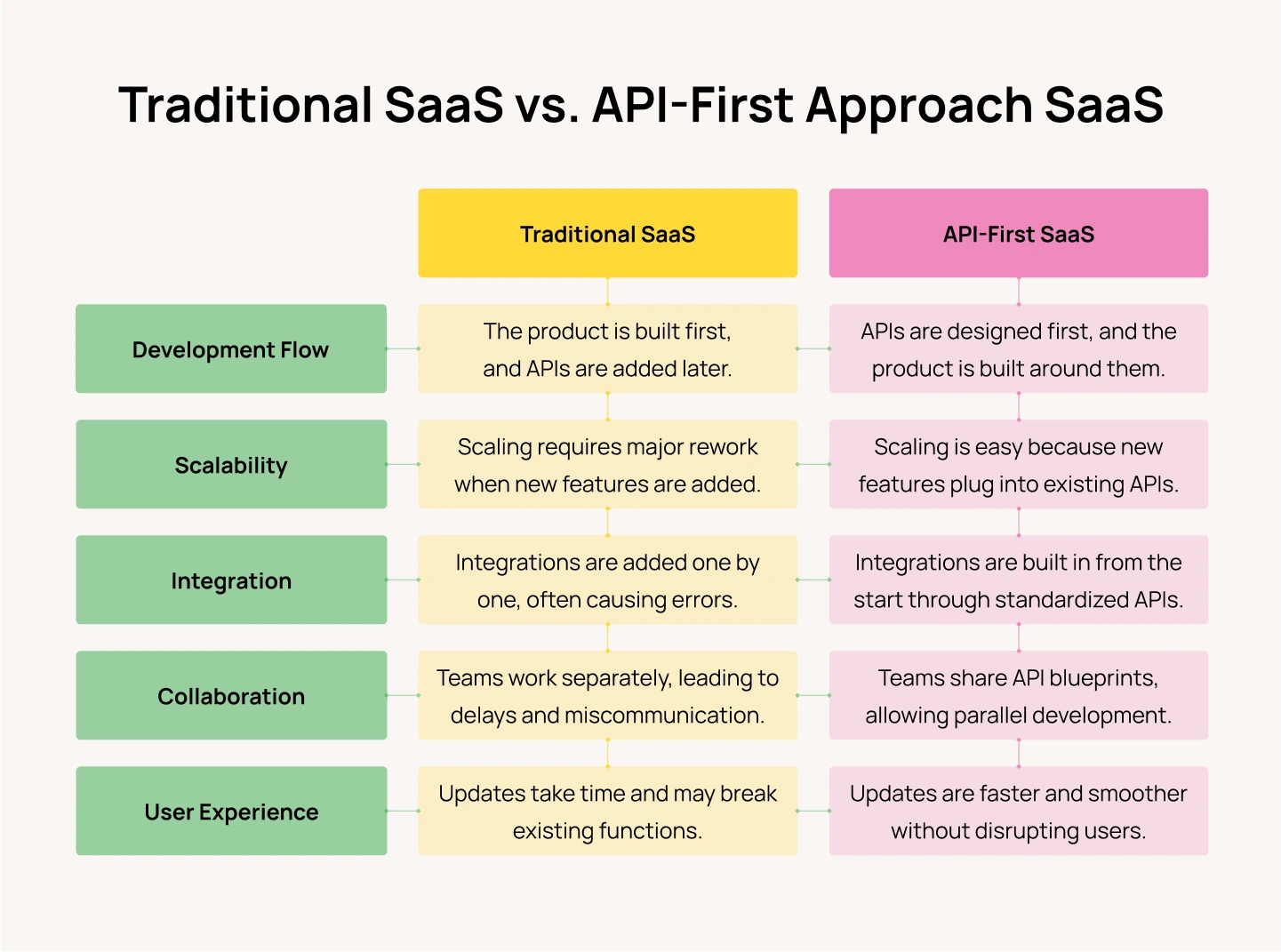
In an API-first SaaS platform, all parts of the product—like the interface, database, and third-party tools—talk to each other through APIs. Think of APIs as messengers that carry information back and forth safely and efficiently.
Here’s a simple way to look at the process:
For example, imagine a SaaS product with APIs for login, billing, and analytics. A CRM system could connect to those APIs to update customer data automatically. This setup keeps each part of the system independent but connected, making it easier to scale and maintain.
Read more: Top 7 SaaS Design Trends to Elevate B2B Products
Building an API-first SaaS requires structure, communication, and alignment between technical and business goals. Below is a step-by-step roadmap that makes the process clearer and more actionable.
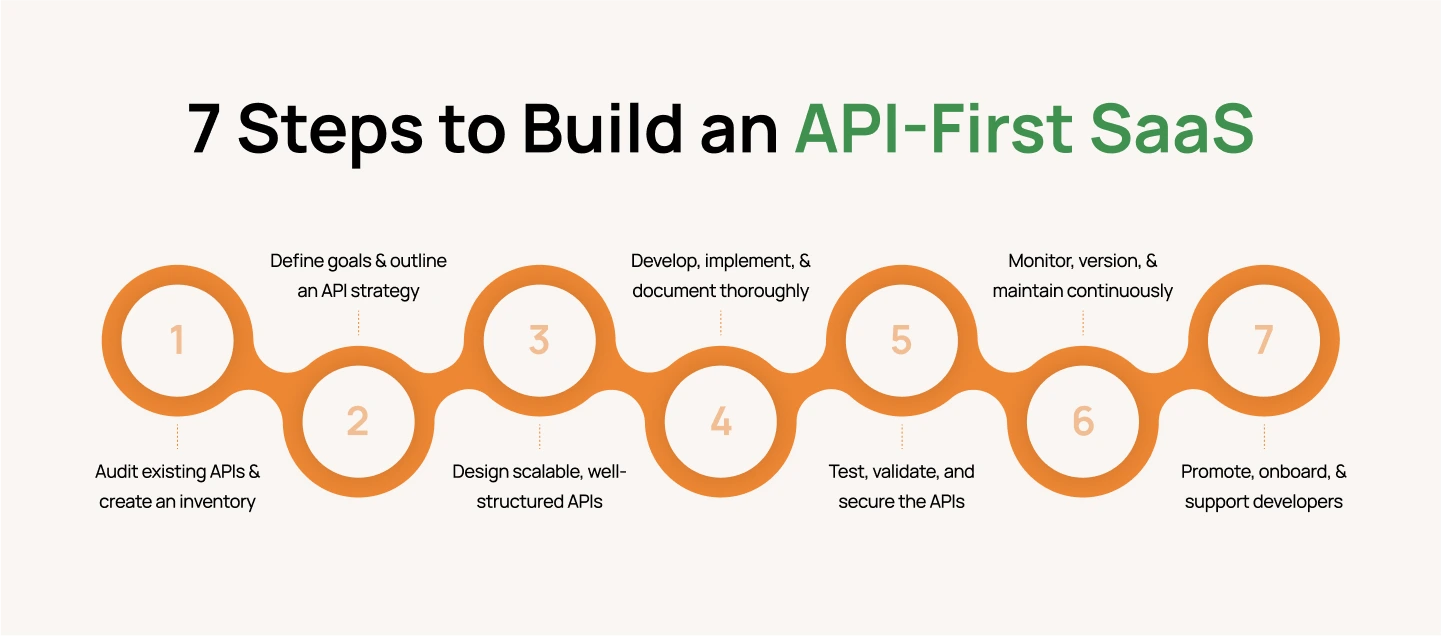
Begin by documenting every API and service your system currently uses. Categorize them as internal (used within your product), external (connecting to third-party services), or public (available to outside developers). Map out how they connect and where data flows between them.
Look for redundancies—are multiple APIs doing similar things? Identify bottlenecks where performance slows down. This inventory gives you a complete picture of your current architecture and helps you spot opportunities for consolidation or improvement before building anything new.
Before designing any APIs, clarify their purpose. Will they primarily serve internal teams, enable partner integrations, or be publicly available to third-party developers? Each audience has different needs and technical requirements.
Set specific, measurable objectives. For example, you might aim to reduce integration time from weeks to days, or enable 50 partner integrations within the first year. Make sure these goals align with your broader business strategy so your API development directly supports company priorities rather than existing in a technical silo.
Start with design, not code. Use API design platforms or specification tools to create detailed blueprints that outline every endpoint, the parameters it accepts, the data formats it uses, and the responses it returns. Think of this as creating architectural drawings before construction begins.
Share mock versions of these APIs with your team early—front-end developers, product managers, and even potential integration partners. Gather their feedback on usability and functionality. This collaborative approach catches misalignments before development starts, saving significant time and preventing costly redesigns later.
With finalized designs in hand, development can begin efficiently. The API-first approach enables parallel work: front-end developers can build user interfaces using the agreed-upon API contracts while back-end developers implement the actual endpoints.
As the APIs are built, documentation should happen alongside development—not afterward. Write clear, structured explanations for each endpoint, including what it does, how to use it, and what kind of responses it returns. Include sample requests, authentication steps, and common error messages. Keeping documentation current during development saves time and ensures accuracy.
This combined process shortens release cycles and reduces confusion. Teams work in sync, and integration issues are minimized. When developers have clear documentation from the start, they can test and integrate APIs faster and with fewer errors.
Comprehensive testing happens in layers. Start with functional tests: Does each endpoint return the correct data for valid requests? Does it handle invalid requests gracefully with clear error messages?
Next, run performance tests under realistic conditions. How does the system respond when hundreds or thousands of users make requests simultaneously? Identify breaking points before your users do.
Finally, test security rigorously. Simulate attacks and unauthorized access attempts. Implement multiple layers of protection: require API keys for identification, use authentication tokens that expire, and set rate limits to prevent abuse. Security isn’t optional; it protects both your system and your users’ sensitive data.
Once your APIs are live, monitoring becomes essential. Track key metrics like usage patterns, response times, and error rates to catch issues before they affect users. Use these insights to identify performance bottlenecks or unexpected behavior.
When you need to make changes or add features, use versioning (v1, v2, etc.) rather than modifying existing endpoints. This allows you to introduce improvements while keeping older integrations functional. Developers using your API can then migrate to new versions on their own timeline, avoiding sudden disruptions to their systems.
Treat your APIs as a product that needs users and advocates. Create a developer portal that serves as a one-stop resource: comprehensive documentation, interactive code examples, and a sandbox environment where developers can test integrations safely without affecting production systems.
Build a community around your APIs. Offer support channels where developers can ask questions and share solutions. Highlight successful integrations as case studies. The easier and more enjoyable you make the integration experience, the faster your ecosystem will grow and the more valuable your platform becomes.
Read more: Choosing the Right No-Code Platform for Your SaaS Development
An API-first SaaS model brings clear, practical advantages that make both development and long-term maintenance easier. Here are five main benefits:
APIs work like building blocks for your product. You can change or add features—such as improving analytics or payment tools—without affecting other parts of the system. This flexibility keeps your product stable while allowing quick improvements.
When teams agree on API structures early, front-end and back-end developers can work at the same time. This speeds up development and helps new features or updates reach users faster. Everyone knows how the pieces fit together, reducing mistakes and delays.
A well-built API makes it easy to connect with other software like CRMs, billing tools, or automation platforms. These connections save time for customers and let them use your product alongside their existing tools. It also helps your product reach new users through partner integrations.
As your user base grows or new needs appear, API-first systems expand easily. Instead of rebuilding, you can just plug in new APIs to add features or serve new markets. This keeps your platform ready for new technologies in the future.
Starting with clear APIs keeps your system organized. It prevents messy fixes, reduces bugs, and makes updates easier to manage. Over time, this structure saves both time and money while keeping your SaaS platform strong and reliable.
Several successful SaaS companies use an API-first approach to make their platforms flexible and integration-friendly. Here’s how a few of them do it in practice:
These API-first companies show how putting APIs at the center of product design leads to faster innovation, smoother integrations, and a stronger developer ecosystem.
You may want to read more about: Vertical SaaS Explained – Tailored Software for Specific Industries
The API-first approach isn’t just a technical choice; it’s a mindset shift toward building scalable, connected, and future-proof SaaS platforms. It empowers businesses to innovate faster, enhance interoperability, and deliver better experiences for users and developers alike.
At Lollypop Design Studio, we help organizations design SaaS platforms that are both user-centric and integration-ready. From API design and development to crafting seamless SaaS UX design, our team ensures your product scales effortlessly in an increasingly connected world.
Book a free consultation to explore how an API-first strategy can power your next SaaS innovation.
API-first focuses on building the product ecosystem around APIs from the start. It defines the vision and overall API first definition—how APIs shape the product architecture. API design-first, on the other hand, is a subset of this philosophy that focuses on the details of how APIs are planned, structured, and tested before coding begins. “Together, these two concepts illustrate the core principle: design carefully first, then build confidently.
Code-first means developers write code first and generate APIs from it. API-first means the API is designed and agreed upon before coding begins. The latter reduces miscommunication and ensures interoperability between teams.
API-first development powers digital transformation across industries: