“Did you know that in 2024, nearly 60% of Google searches ended without anyone clicking on a website?”
More and more users no longer browse through links—they expect instant answers! AI-powered search engines like Google AI Overviews, ChatGPT, and Perplexity are changing the game, delivering direct responses without sending users to traditional websites.
If your search optimization strategy still relies solely on SEO, you’re losing visibility. To stay ahead, businesses must adapt to Answer Engine Optimization (AEO) and Generative Engine Optimization (GEO)—or risk being left behind.
In this blog, we’ll break down these AI algorithms, highlight their key differences, and share practical tips to help you keep up with the future of search optimization!
What is SEO?
SEO (Search Engine Optimization) is the process of improving a website’s visibility on traditional search engines (Google, Bing, etc.). The goal is to achieve higher rankings in search results, increasing organic traffic and attracting potential customers.
How SEO Works?
A structured SEO strategy enhances website performance, increases discoverability, and drives sustainable growth.
What is AEO?
Answer Engine Optimization (AEO) is the process of optimizing content so that search engines and AI-powered assistants (like Siri, Alexa, and Google Assistant) can quickly extract and display answers to user queries. Unlike traditional SEO, which focuses on ranking web pages, AEO ensures that your content is structured for immediate retrieval in featured snippets, knowledge panels, and voice search results.
With users expecting quick, direct answers, AEO makes content more accessible to AI-driven search engines, increasing the chances of appearing in direct searches and voice queries without requiring users to navigate multiple pages.
How AEO works?
By 2024, voice searches are expected to make up 50% of all queries, making AEO essential for businesses to stay visible. Those who fail to adapt risk losing potential customers to competitors who optimize for AI-driven search.
What is GEO?
Generative Engine Optimization (GEO) ensures your content is structured in a way that AI search engines (ChatGPT, Google Gemini, Perplexity, etc.) can easily understand, retrieve, and present as part of its response.
Unlike traditional search engines that rank web pages, AI models analyze and synthesize vast amounts of data to deliver direct answers. Optimizing for GEO increases the chances of your content being featured in AI-generated results, enhancing visibility and engagement.
How GEO works?
By applying these strategies, businesses can increase their chances of being included in AI-generated search results, improving visibility and engagement.
Read more: How to Use AI for UI/UX Design: A 2026 Strategy Guide
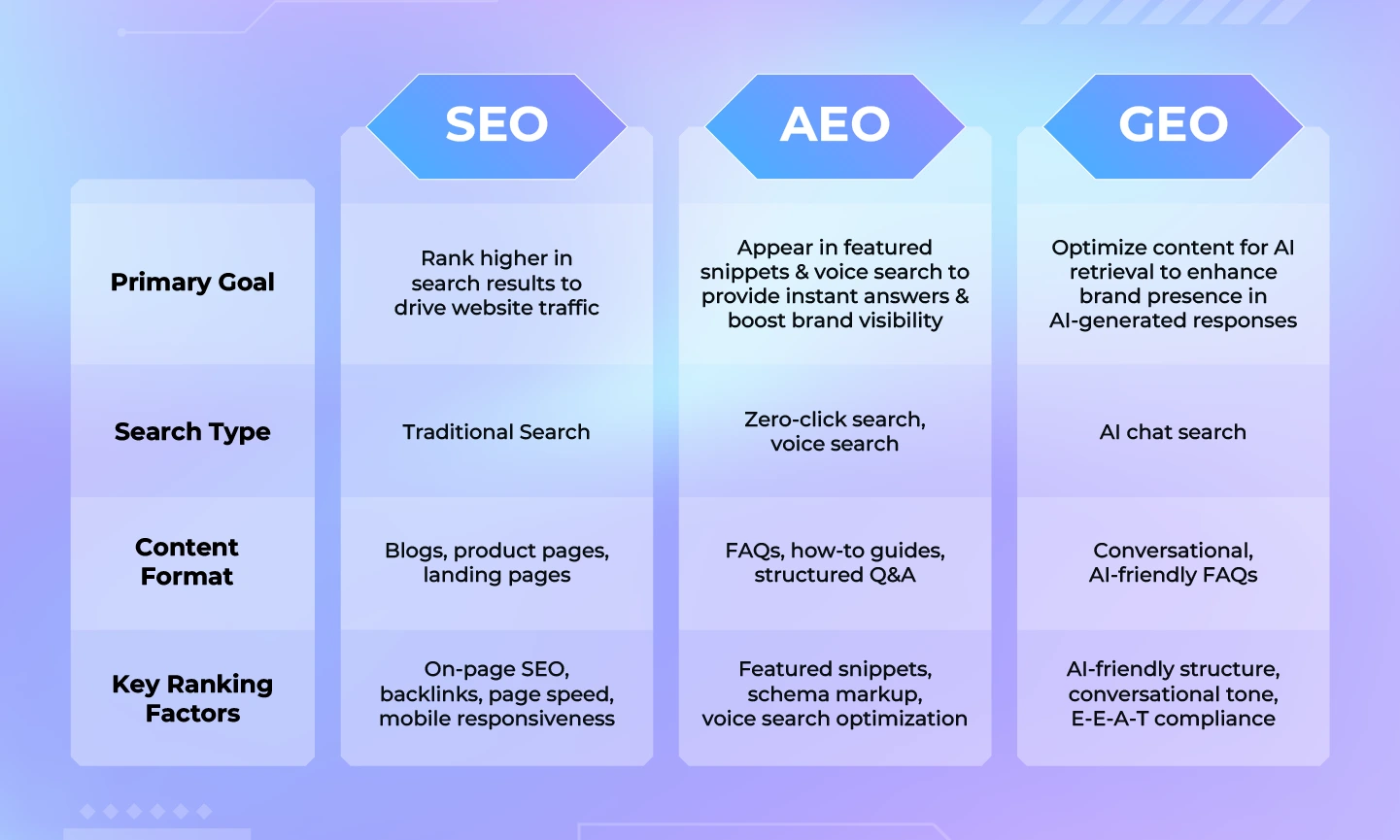
Integrating AEO (Answer Engine Optimization) and GEO (Generative Engine Optimization) isn’t about replacing traditional SEO strategy—it’s about enhancing them. You don’t need to abandon existing SEO practices or build an entirely new strategy. Instead, making targeted adjustments will help optimize your content for search engines, voice assistants, and AI-powered chat systems.
This section covers 3 key adjustments to improve your search optimization performance:
Optimizing for AI search requires a shift in keyword strategy. Instead of focusing only on short, high-volume keywords, you should:
These keyword adjustments ensure your content aligns with how users search and how AI systems process information, increasing your visibility across multiple search formats.
To rank in featured snippets, voice search, and AI-generated responses, content must be clear, structured, and easy for AI to process. AI search systems prioritize direct answers presented in an organized format, allowing them to retrieve and display information efficiently. Here’s how to structure content effectively:
To increase the likelihood that AI search engines prioritize your content, developers should focus on structured data, clean coding, and performance optimizations. These improvements enhance visibility in AI-driven search results while ensuring a smooth user experience. Key areas to optimize include:
By implementing these optimizations, websites can load faster, rank better in AI-driven searches, and provide a smoother user experience across all devices.
Read more: Driving AI Visibility in Search with Smart LLM Optimization
SEO, AEO, and GEO are often discussed as separate optimisation strategies, but in practice they complement one another. Traditional SEO builds the foundation by improving crawlability, technical performance, and keyword relevance. AEO focuses on structuring content so it can appear as direct answers in featured snippets, voice search, and AI Overviews. GEO extends these efforts by helping generative AI platforms understand, retrieve, and reference your content when generating responses.
Rather than creating separate strategies, businesses should adopt an integrated approach. High-quality content that demonstrates expertise, answers user questions clearly, and follows strong technical SEO practices can perform well across traditional search engines, answer engines, and AI-powered search platforms. By combining these approaches, brands increase their visibility wherever users choose to search.
AI-powered search is changing how users discover information online. Instead of browsing multiple webpages, users increasingly expect direct, conversational answers generated from multiple trusted sources. As a result, search optimisation is no longer focused solely on improving rankings—it also involves making content understandable, trustworthy, and easy for AI systems to reference.
This shift places greater importance on content quality, topical authority, and information structure. Clear headings, concise answers, logical content hierarchy, and credible supporting evidence all help AI models interpret information more accurately. While technical SEO remains essential, success in AI search increasingly depends on producing content that satisfies user intent while being easy for both people and machines to understand.
Optimising for AI search also requires a different way of measuring success. Traditional SEO metrics such as keyword rankings and organic traffic remain important, but they no longer provide the complete picture. Businesses should also monitor how frequently their content appears in AI-generated answers, whether their brand is cited as a trusted source, and how AI-driven traffic contributes to engagement and conversions.
Useful indicators include impressions in AI-powered search experiences, referral traffic from AI platforms, featured snippet visibility, branded search growth, and user engagement metrics such as time on page and conversions. Measuring both traditional SEO performance and AI discoverability helps organisations understand how effectively their content reaches users across the evolving search landscape.
In this blog, we’ve explored AEO (Answer Engine Optimization) and GEO (Generative Engine Optimization)—two emerging strategies that are reshaping how content is discovered and ranked. As AI-powered search engines evolve, traditional SEO tactics alone may no longer be enough to secure visibility.
User behavior is changing rapidly, with more people turning to voice search, AI-generated responses, and direct answers instead of browsing multiple search results. To stay ahead, businesses must adapt by leveraging long-tail keywords, structuring content effectively, and optimizing technical elements to ensure AI can easily interpret, retrieve, and prioritize their content.
Looking for expert guidance on website search engine optimization? Our design and AI experts at Lollypop Design Studio are here to support you. As a leading UI/UX design company, we go beyond aesthetics —we integrate AI expertise to help businesses future-proof their digital presence and enhance AI search engine optimization.
Contact us today to schedule a FREE consultation and unlock new opportunities for website optimization in the AI era!
As AI-powered search continues to reshape how people discover brands, businesses need to go beyond traditional SEO. Explore Spot by Lollypop to understand how B2B companies can improve their AI discoverability and increase visibility across ChatGPT, Gemini, Perplexity, and other AI-driven search experiences.