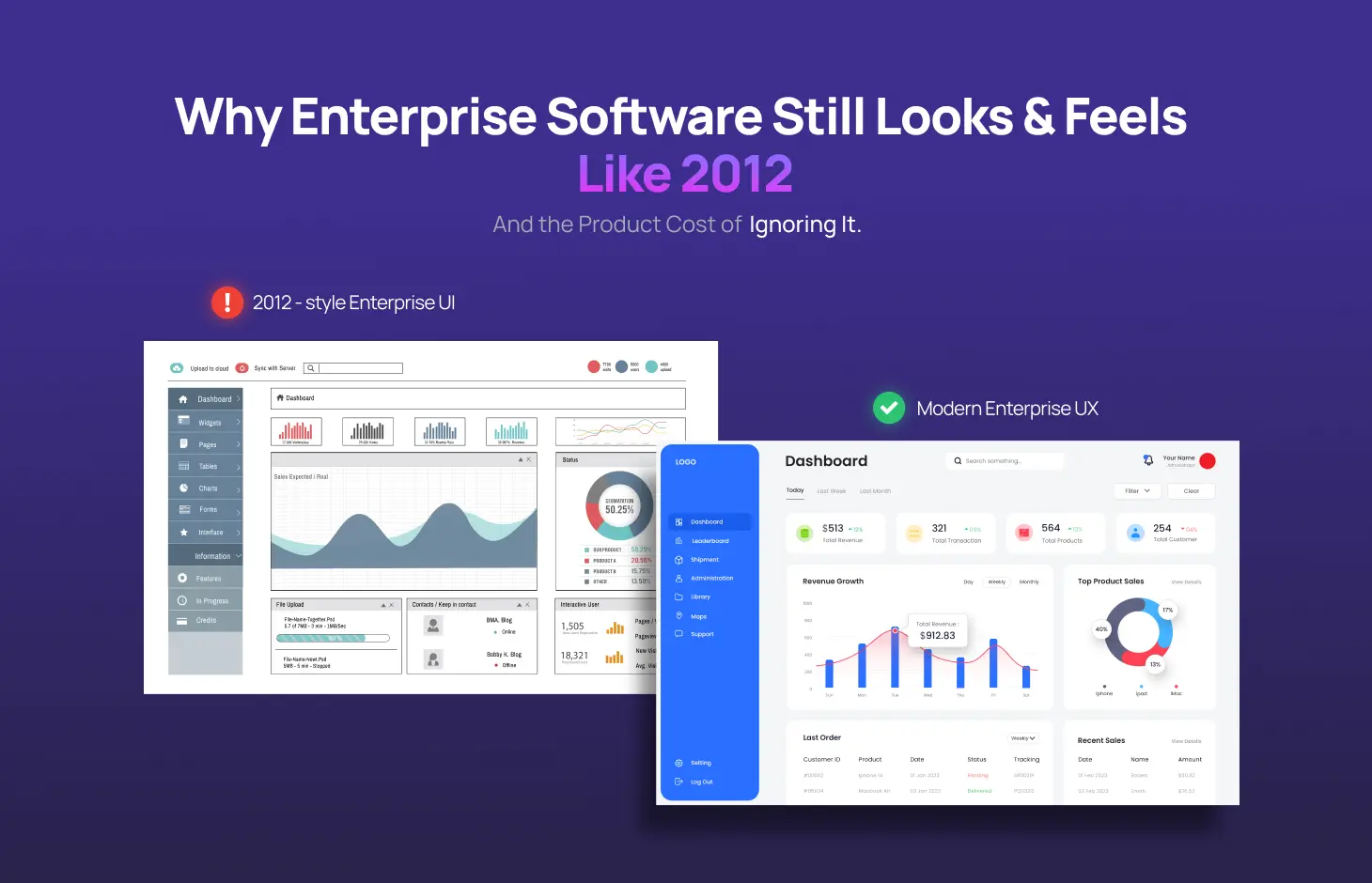
Imagine working on an enterprise product where every design discussion ends with, ‘That’s just how the system works.’
If you’ve heard this phrase in a boardroom lately, you’re looking at a massive red flag. At Lollypop, after performing a UX audit for enterprise across 50+ global platforms, we discovered a recurring, expensive truth: most corporate tools are trapped in 2012 design logic.
In an era of instant AI and seamless consumer apps, your team is likely fighting an interface that was built before the world went mobile-first. This isn’t just an “old look”; it’s a systemic legacy software ROI problem.
A decade ago, the gold standard was “function-first.” If the system could do it, we called it a success. We prioritized massive feature lists over the humans using them. Over time, this created enterprise software feature bloat, where every new business requirement was simply “bolted on” to an aging skeleton.
The result? SaaS product technical debt is not just in your code but in your experience. This function-first mentality created a problem we’re still paying for today.
The most common symptom of SaaS product technical debt? Enterprise software feature bloat. Over the last decade, we didn’t redesign; we just ‘added.’ The result? A cognitive load so high that employees spend 30% of their day just trying to find the ‘Submit’ button.
Enterprise UX modernization is the only way to reclaim that time. It’s about moving from a cluttered interface to a streamlined, industrial-grade UI design that prioritizes the task, not the tool. But here’s the kicker: cleaning up this mess isn’t just a design choice—it’s a financial necessity.
The cost of poor UX in enterprise software isn’t a vague feeling; it’s a mathematical certainty. At Lollypop, we use the 1-10-100 rule to explain the stakes of enterprise UX modernization to our clients:
But for enterprise systems, there is a $1,000 hidden cost: the productivity loss in enterprise tools. When your staff spends 30% of their day “fighting the software,” you aren’t just losing money on the tool; you’re losing the value of your most expensive assets: your people.
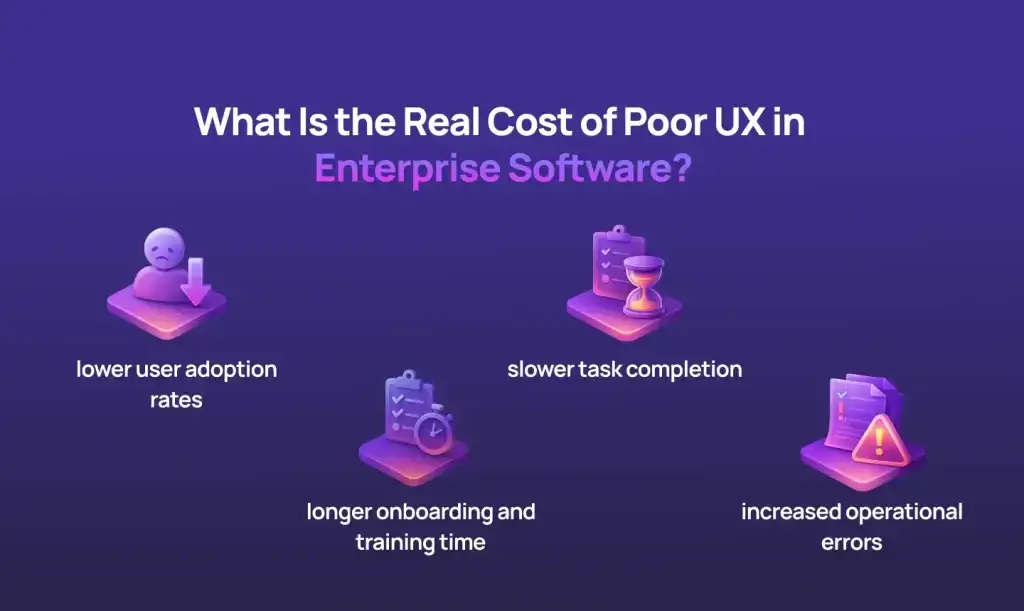
The cost of poor UX in enterprise software is often a “silent killer” because employees are paid to endure it. But the numbers don’t lie. According to enterprise software usability statistics, inefficient tools can drain up to 30% of an employee’s workday.
When you ignore Enterprise UX Modernization, you pay for it in
The consumerization of B2B software is no longer a trend; it’s a standard. Your employees use intuitive, AI-powered banking apps at home. When they log into work and see a cluttered enterprise UI that requires a 50-page manual, the friction is immediate.
According to recent B2B UX design trends, the leaders in the space are moving toward:
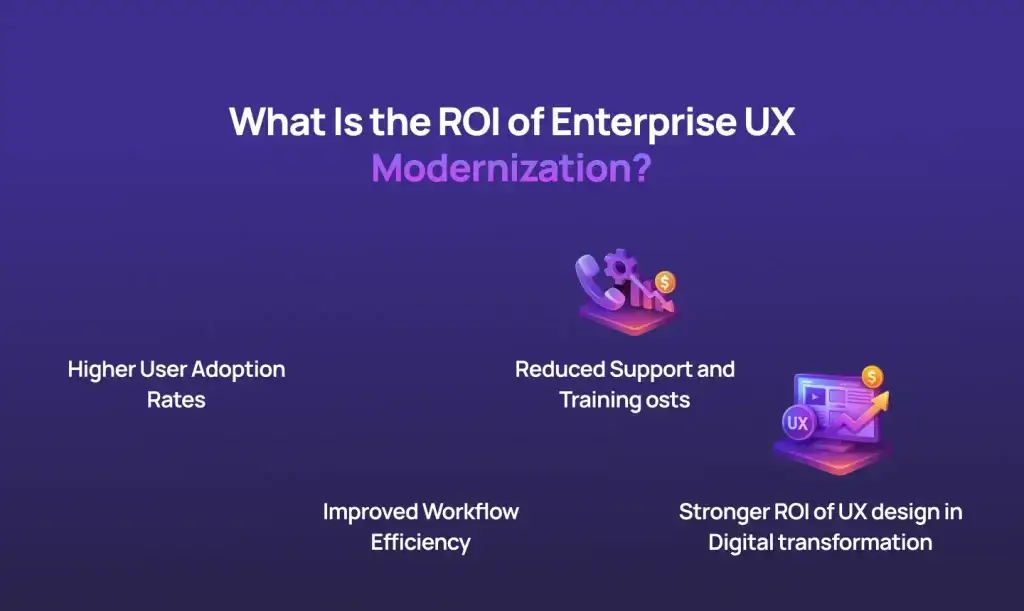
Modernizing a legacy system is a strategic investment, not a cosmetic refresh. A thorough UX audit for enterprises identifies the broken journeys currently costing you money.
By committing to a user interface overhaul and a structural rethink, organizations see a direct impact on their digital transformation. Every dollar spent on fixing a usability issue during the design phase saves $100 in post-launch training and support calls.
If you’re wondering how to fix feature creep in B2B products, the answer isn’t adding more features. It’s a strategy for modernizing system design:
You wouldn’t ask your sales team to use a flip phone. So why ask them to use software designed before the world went mobile-first?
The $100M leak isn’t theoretical. 30% of every employee’s day is lost to interface friction. It’s the 1-10-100 cost multiplier, turning $1 design fixes into $100 production nightmares. It’s the technical debt that caps your growth.
Stop accepting “that’s just how the system works.” Start treating UX as a lever for financial performance.
The organizations that win treat enterprise UX as core infrastructure, not an afterthought.
We’ve seen this firsthand designing enterprise platforms like VuNet, an AI-based IT operations platform, and Avesha, a cloud application platform.
Poor enterprise UX can create a $100M+ annual productivity leak. Employees lose 30% of their workday to interface friction, error rates spike, and adoption drops as users find shadow IT workarounds. When you factor in training costs, support tickets, and lost opportunity time, the financial impact compounds quickly.
Feature bloat happens when systems accumulate excessive features without strategic pruning, creating cognitive overload. To fix it:
Most updates add features instead of modernizing the user experience. Systems built before 2015 followed “function-first” logic, and bolting new features onto old frameworks creates technical debt. True modernization requires rebuilding information architecture around user goals, not just adding more buttons.
Enterprise UX modernization typically delivers 300-500% first-year ROI with 2-4 month payback periods. Benefits include 60-70% labor cost reduction, error rates dropping from 15-20% to under 5%, faster task completion, and scalability without adding headcount. Organizations reclaim the 30% of workday employees who lose to interface friction.
The 1-10-100 Rule shows the escalating cost of fixing UX issues: $1 to fix during design, $10 during development, and $100 after launch. For enterprise systems, there’s a hidden $1,000 cost—the productivity drain when employees spend 30% of their day fighting poor interfaces. This is why fixing UX early is a financial imperative, not a cosmetic upgrade.