Your business might rank well on Google. Your website might attract organic traffic. Your content might appear for the keywords your team has spent months optimizing. And yet, when a potential customer asks AI which companies they should consider, your business may not be part of the answer.
That is the uncomfortable gap emerging between search visibility and business visibility.
The shift is easy to underestimate because it does not look like a dramatic change in the way people search. People are still asking questions. They are still looking for information. They are still comparing companies before making a decision. What is changing is what happens between the question and the shortlist. Instead of navigating through pages of search results and deciding for themselves which companies are relevant, buyers can increasingly ask AI to interpret the landscape for them.
A buyer looking for an enterprise software provider does not necessarily want a list of ten thousand results for “enterprise software companies.” They may ask which providers are best suited for a multinational organization, which companies have experience in a regulated industry, or which solutions are appropriate for a specific business challenge. The more contextual the question becomes, the less the buyer is asking to be shown information and the more they are asking for help deciding what deserves consideration.
This is where the meaning of visibility begins to change.
Traditional search visibility is largely about whether a page can be found. AI-driven discovery increasingly introduces another question: whether a business can be recognized as relevant enough to be included in the answer. The distinction matters because a buyer may never search for your brand directly. They may ask about the problem you solve, the category you operate in, or the type of company they need. If AI is involved in narrowing those options, your business needs to be discoverable before the buyer knows your name.
The real shift, then, is not simply from Google to AI. It is from finding information to influencing consideration.
Google ranking can make a page visible. AI recommendation can make a business considered. These outcomes are connected, but they are not interchangeable. And as AI becomes more involved in the research process, businesses need to understand what happens between being found and being chosen.
That starts with understanding what AI Search is actually changing.
The most important thing about AI Search is not that it uses artificial intelligence. It is that it changes how much interpretation happens before the buyer reaches a decision.
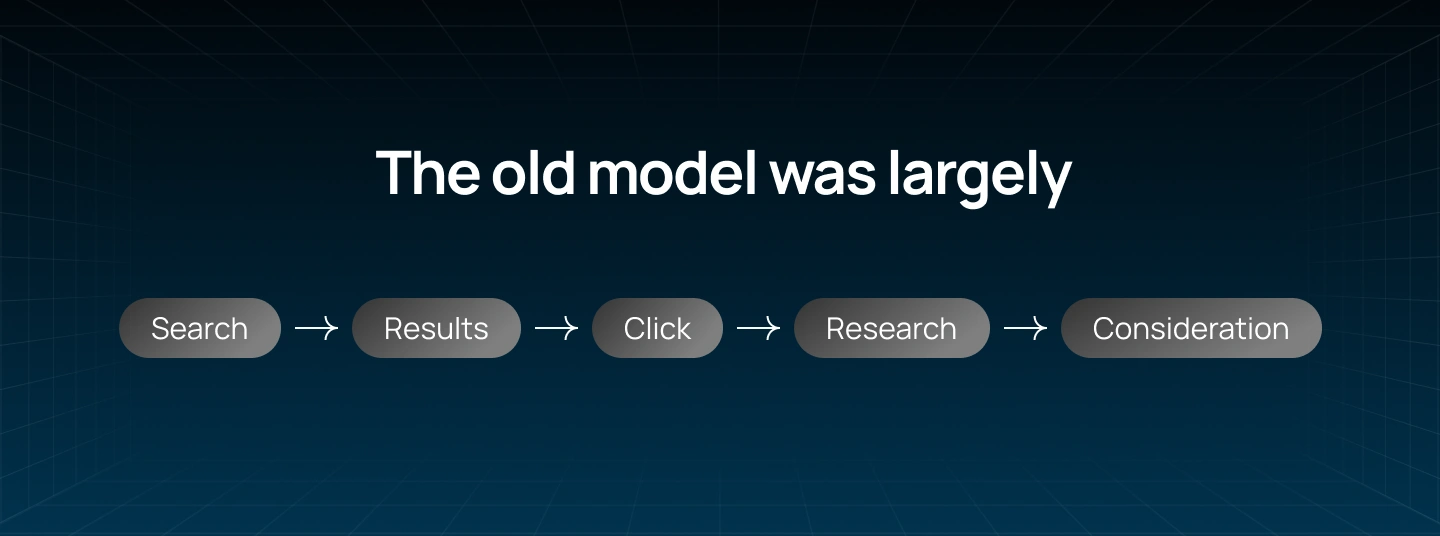
Traditional search largely works as a discovery layer. A user enters a query, the search engine retrieves relevant pages, and the user decides what to open, read, compare, and trust. The search engine helps organize information, but the buyer still carries much of the responsibility for turning that information into a decision.
AI-powered search experiences can compress part of that process. A user can ask a question in natural language, add context, describe a specific need, and receive a response that attempts to synthesize information across different sources. Instead of starting with a long list of possible answers, the buyer can start with an interpretation of the landscape.
That changes the role of search in the buyer journey.
The old model was largely:
The emerging model can look more like:
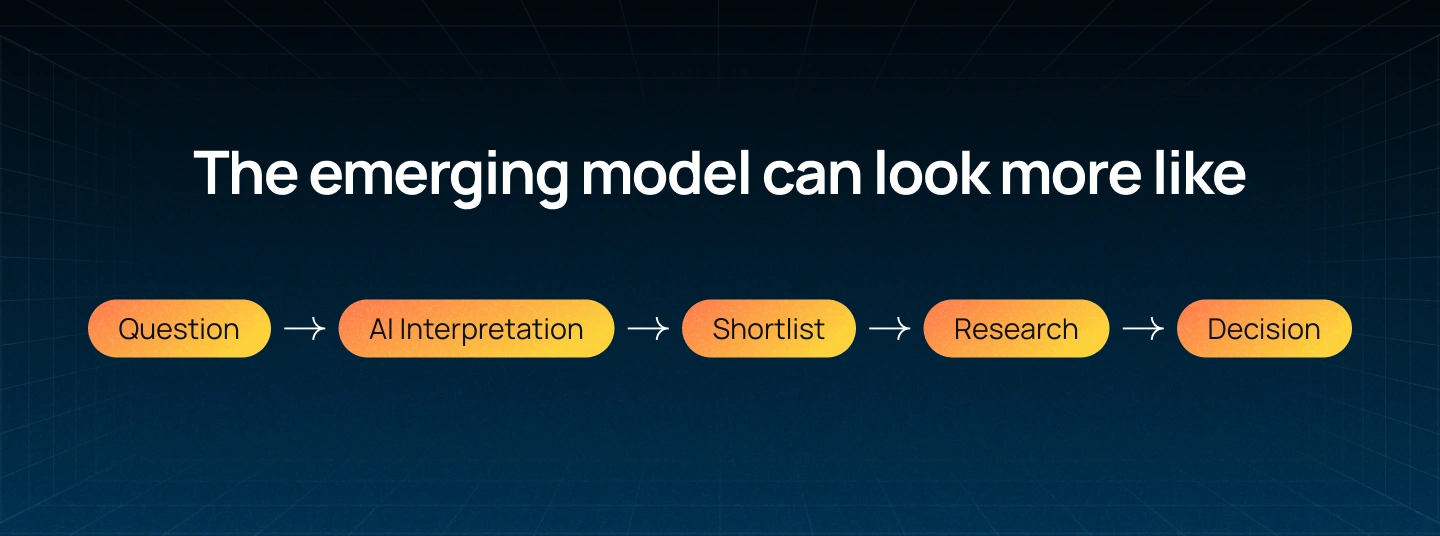
The difference happens in the middle.
AI is increasingly participating in the moment when a buyer decides which options are worth investigating. The buyer may still visit websites, read case studies, compare pricing, and speak with sales teams. But some of the businesses that make it into that research phase may already have been selected by the system before the buyer ever reaches those websites.
That means businesses are no longer competing only to rank a page for a keyword. They are competing to be understood as a relevant business within a specific context.
This is a much harder problem.
A page can be relevant to a keyword. A business needs to be relevant to a question.
Consider the difference between someone searching for “UX design agency” and someone asking, “Which UX design companies have experience designing complex digital products for global healthcare businesses?” The first query can be answered through keyword relevance and page-level signals. The second requires a much deeper understanding of the companies involved. The system needs to connect expertise, industry experience, capabilities, and evidence before it can determine who belongs in the answer.
This is why AI Search changes the unit of visibility.
Traditional SEO often asks: Can this page rank?
AI discoverability increasingly asks: Can this business be recognized as relevant?
The first is about the visibility of a page. The second is about the visibility of an entity within a decision.
And that is where many businesses begin to encounter a problem they did not know they had
ChatGPT, Perplexity, and Google’s AI-powered search experiences do not surface information in the same way. Each operates within a different search and discovery environment, presents sources differently, and plays a different role in how users move from a question to further research.
But from a business perspective, the more important similarity is what they increasingly ask brands to compete for: inclusion in the answer.
A buyer using ChatGPT may ask for recommendations, refine the question through follow-up prompts, and gradually narrow a broad market into a smaller set of options. On Perplexity, that same research process may be more explicitly connected to cited sources, allowing the buyer to move between a synthesized answer and the evidence behind it. Within Google’s AI-powered search experiences, AI-generated responses can appear alongside the broader search ecosystem, changing what users encounter before they decide which results deserve a click.
The experiences differ, but the underlying visibility challenge is remarkably similar.
Your business cannot rely on being present for its own name. It needs to be discoverable when buyers ask about the category you operate in, the problems you solve, the industries you understand, and the capabilities they are looking for. And being discoverable is only the first step. The information available about your business also needs to give these systems enough context to understand what you do and enough evidence to treat you as a credible option.
This is why AI visibility should not be approached as three separate optimization problems — one for ChatGPT, one for Perplexity, and one for Google. The interfaces, sources, and mechanisms may differ, but the underlying business objective remains the same: build a digital presence that makes your company easier to find, understand, trust, and ultimately consider.
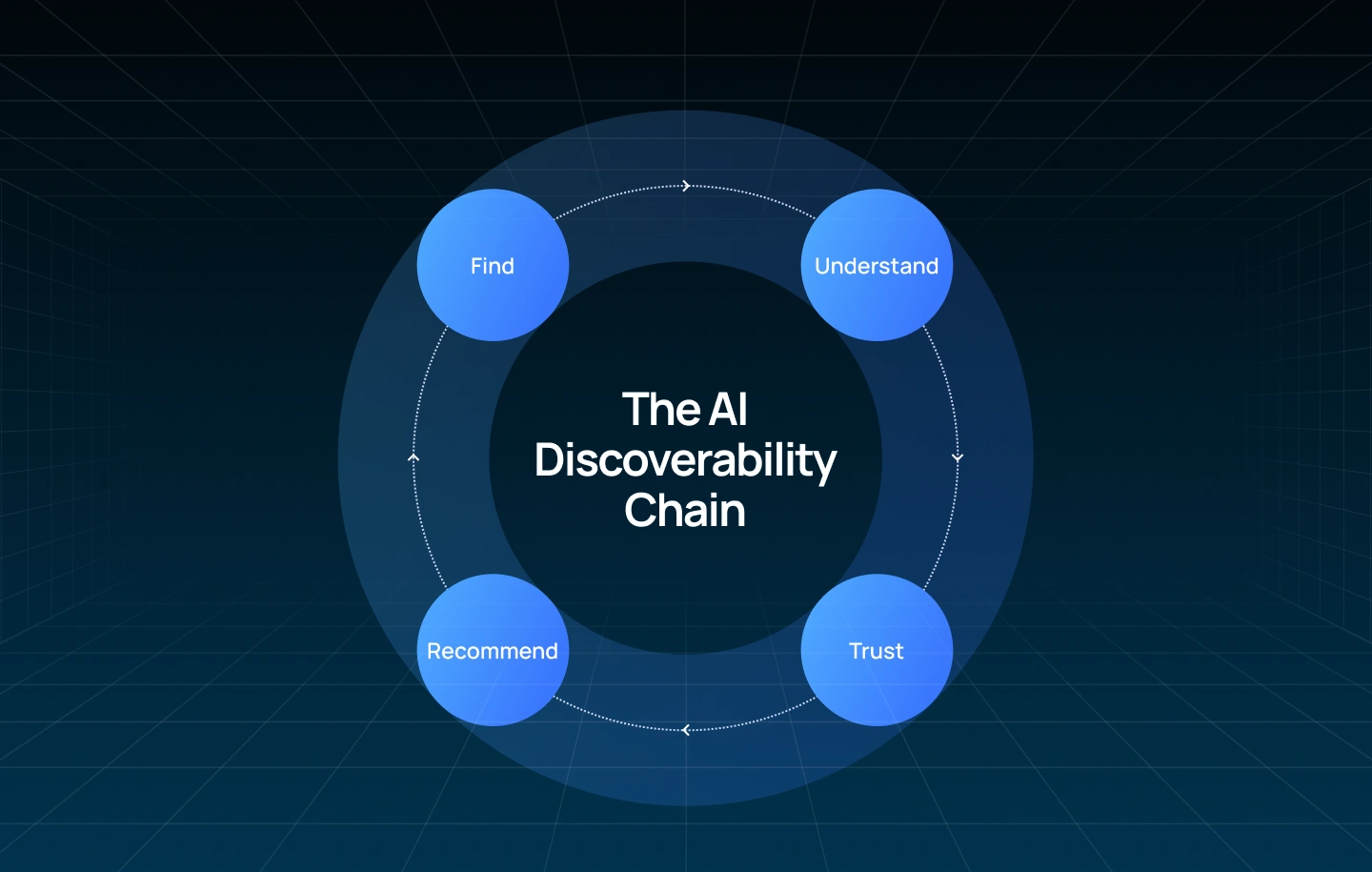
A business cannot become part of an AI-generated recommendation through visibility alone. Before AI can recommend a company, it needs to move through a chain of understanding.
First, it needs to find the business and access meaningful information about it. If important information is difficult to crawl, poorly structured, inaccessible, or scattered across disconnected pages, the business may never become visible enough to be considered.
But being found is only the beginning.
AI then needs to understand what the business actually does. It needs to connect the company with its services, expertise, industries, audiences, and use cases. A business that describes itself as a “digital transformation partner” may sound clear to a human reader, but that phrase alone does not tell AI when the company should be considered. The context matters. Does it specialize in enterprise software? Healthcare? Financial services? Product design? Technology consulting? Who does it serve, and what problems does it solve?
The clearer these relationships are, the easier it becomes for AI to associate the business with the right questions.
Then comes trust.
AI may understand that your company provides a particular service, but understanding does not automatically make the business recommendable. A company’s own website tells the world what it claims about itself. The wider digital ecosystem helps establish whether those claims are supported. Case studies demonstrate experience. Customer evidence reinforces outcomes. Industry publications provide external validation. Expert commentary demonstrates knowledge. Professional profiles and third-party sources add context beyond the company’s own marketing.
These signals help establish whether the business is not only relevant but credible.
Only then does the final stage become possible: recommendation.
Recommendation is the outcome businesses ultimately care about because it is closest to the moment of consideration. AI can find you without recommending you. It can understand you without prioritizing you. It can mention you without presenting you as a credible option.
This gives us a more useful way to think about AI discoverability:
Findability is the foundation. Understanding creates relevance. Trust creates confidence. Recommendation creates consideration.
The four stages are connected, but each represents a different business problem.
A company that cannot be found has a visibility problem. A company that is found but misunderstood has a clarity problem. A company that is understood but lacks supporting evidence has an authority problem. And a company that is consistently visible, understood, and credible yet still absent from recommendations may have a problem with relevance or competitive positioning.
This is why a single technical tactic cannot solve AI visibility.
Adding schema does not automatically make a business recommendable. Publishing more content does not automatically make it authoritative. Ranking higher does not automatically make it relevant to every question a buyer might ask.
The goal is to build a digital presence that moves through the entire chain: Find → Understand → Trust → Recommend.
The businesses that succeed in AI-driven discovery will be the ones that make this chain easy to complete.
There is an easy way to overestimate your AI visibility: search for your own brand.
Ask ChatGPT about your company. Search your name on an AI-powered platform. Check whether the system knows who you are. If the answer looks accurate, it is tempting to conclude that your business is visible.
But a branded search is often the least revealing test.
If a buyer already knows your name, your business has already won one of the hardest parts of discovery: being remembered. The more important question is what happens before that moment.
What if the buyer does not know you exist?
What if they ask, “Who are the best companies for this problem?” What if they ask which providers specialize in their industry? What if they ask for alternatives to the companies they already know? What if they describe their business challenge without using the language your marketing team uses to describe your service?
These are the questions that reveal whether your business is genuinely discoverable.
The most revealing AI visibility test is therefore not “What does AI say about my brand?” It is “Who would AI recommend if my brand name were not mentioned?”
That shift changes how businesses should evaluate their presence.
A branded query measures recognition. A non-branded query measures discoverability.
A branded query tells you whether AI knows you exist. A category or problem-based query tells you whether AI knows when you are relevant.
This is especially important for B2B businesses because the buyer journey often begins with a problem, not a provider. A company may need a new digital product, a technology partner, a transformation consultant, or a specialized service long before it knows which company to hire. The first question is usually not “Should I choose Company A?” It is “Who can solve this?”
That is the moment where AI visibility becomes commercially meaningful.
If your business consistently appears when buyers ask questions that describe the problems you solve, you have a chance to enter the consideration set before your competitors have been selected. If you disappear from those questions, strong brand awareness and traditional search rankings may not be enough to bring you into the conversation.
The goal, therefore, is not to make AI mention your brand more often.
It is to make your business relevant enough to appear when the buyer is still deciding whom to consider.
Traditional search has trained businesses to think in positions.
Rank first. Move from page two to page one. Defend your position against competitors. Measure the change.
AI visibility does not work in quite the same way.
There is no single AI “position one” that tells you whether your business is discoverable. The answer can change depending on the question, the context, the platform, the sources available, and the way the user frames their intent.
A company might appear when a buyer asks for the best providers in a broad category but disappear when the question becomes more specific. It might be recommended for one industry but not another. It might be visible in one AI Search environment and absent from another. It might be mentioned frequently but rarely recommended.
This is why AI visibility is better understood as a pattern, not a position.
The question is not whether your business appeared once.
The question is whether it appears consistently across the questions that matter.
That means measuring visibility across a set of buyer-relevant prompts. Start with broad category questions, then move into specific use cases, industries, problems, and comparison queries. Observe not only whether your business appears, but how it appears. Is it recommended? Is it merely mentioned? Is the description accurate? Which competitors appear alongside you? Which competitors appear instead when you are absent?
This creates a more realistic picture of how AI represents your business.
It also exposes a gap that traditional SEO dashboards cannot fully show. You may know exactly where you rank for “enterprise UX design,” but that tells you little about whether AI recommends you when someone asks, “Which design partners can help a global healthcare company redesign a complex digital product?”
The first is a ranking question.
The second is a consideration question.
The difference between them is where AI discoverability lives.
This does not make traditional SEO irrelevant. In fact, strong technical foundations, relevant content, and authority remain important inputs into the broader ecosystem of discovery. But they are no longer the complete definition of visibility.
SEO helps your pages become discoverable.
AI visibility asks whether your business becomes considerable.
And those are two different outcomes.
The assumption that strong Google rankings automatically translate into AI recommendations is understandable. If search engines already recognize your content as relevant, it seems logical that AI systems should recognize your business in the same way.
But this assumption confuses two different units of visibility.
Google often evaluates the relevance and authority of a page in relation to a search query. AI-generated answers can require a broader understanding of the business behind that page.
This is the difference between page visibility and entity visibility.
A page can rank because it contains useful information about a topic. A business needs to be recognized as a relevant entity within a particular context. The system needs to connect multiple pieces of information: what the company does, who it serves, what industries it understands, what problems it solves, and what evidence supports those associations.
That is why two businesses with similar SEO performance can have very different AI visibility.
Imagine two companies competing in the same category. Both have optimized websites. Both rank for important keywords. Both publish content regularly. But one has built a much clearer digital footprint around its expertise. Its case studies consistently reinforce its positioning. Its external presence validates the industries it serves. Its content demonstrates depth in the problems it solves. The other company has strong rankings but a more fragmented presence.
When AI is asked to recommend a provider for a specific need, the first company may be easier to understand and easier to validate.
It may therefore be easier to recommend.
The lesson is not that Google rankings no longer matter. They do. The lesson is that ranking a page and becoming visible as a business are increasingly different challenges.
A company can rank for “best digital transformation services” and still fail to appear when a buyer asks AI for a partner with specific experience in their industry. It can generate organic traffic while remaining absent from high-intent recommendations. It can dominate branded search while being invisible in the category conversations that happen before buyers know its name.
The real risk is not losing your Google ranking.
It is assuming that your Google ranking tells you everything about your discoverability.
It does not.
The shift toward AI-driven discovery does not mean businesses need to abandon SEO and start from scratch. It means the definition of discoverability needs to expand.
The first layer remains technical. AI cannot interpret information it cannot reliably access. Crawlability, indexability, site performance, information architecture, and structured data continue to matter because they create the foundation that allows information to be discovered and processed.
But technical accessibility is only the beginning of the journey.
The next layer is clarity. Your business needs to be understandable beyond a collection of keywords. AI should be able to connect your company with the services you provide, the audiences you serve, the industries you understand, and the problems you solve. Those relationships should be reinforced consistently across your most important content and digital touchpoints.
Then comes authority.
Your business needs evidence that exists beyond its own claims. The strongest signals are not necessarily the ones that say you are an expert. They are the ones that demonstrate why others should believe you are one. Case studies show what you have done. Original research shows what you know. Customer evidence demonstrates outcomes. Third-party sources provide independent context.
This creates a more complete definition of AI discoverability.
It is not about optimizing one page for one platform.
It is about building a digital presence that is accessible enough to be found, clear enough to be understood, credible enough to be trusted, and relevant enough to be recommended.
That is a larger system than traditional SEO, but it is not disconnected from it.
In fact, the strongest AI discoverability strategy may be the natural evolution of good digital marketing: technically sound websites, useful content, clear positioning, strong authority, and a consistent brand presence across the web.
The difference is that businesses now need to evaluate those foundations through a new lens.
Not just: Can people find us?
But: Can AI understand why we matter?
You can track your rankings. You can measure organic traffic. You can monitor impressions, clicks, and conversions. But there is one increasingly important part of the buyer journey that most traditional SEO dashboards still cannot fully show you: what happens when your potential customer asks AI who they should consider.
This is the new visibility gap.
A business may know exactly how it performs for “enterprise software company” but have no idea whether AI recommends it when a buyer asks for an enterprise software provider with experience in a highly regulated industry. It may know which competitors outrank it on Google while having no visibility into which competitors are being surfaced by AI instead.
The problem is not simply that businesses lack another metric.
They lack visibility into a new layer of consideration.
This is why AI Visibility should not be reduced to a simple count of brand mentions. A company appearing in ten AI answers does not necessarily have stronger visibility than one appearing in five. Context matters. Relevance matters. Accuracy matters. Recommendation matters.
A more useful AI Visibility assessment should ask six questions.
Together, these questions provide a more useful picture than a single mention count or isolated AI search.
They also reveal where the actual problem sits.
You may be visible but misunderstood. You may be understood but not trusted. You may be trusted but not relevant to the questions buyers are asking. Or you may be strong across all three but still lose consideration to competitors who have built a clearer presence in the specific contexts that matter.
This is why AI Visibility is not a vanity metric.
It is a diagnostic lens for understanding how your business is represented when AI becomes part of the buyer’s research process.
The right response to an AI visibility gap depends on where the chain breaks.
If AI cannot find your business, start with the foundations. Review technical accessibility, indexing, site performance, information architecture, and structured data. Important information should be accessible and organized in a way that makes the business easier to interpret.
If AI can find you but cannot understand you, the problem is likely deeper than technical SEO. Your positioning may be too broad. Your content may describe your services without establishing the contexts in which you are most relevant. Your website and external profiles may communicate different versions of the business. In this case, the priority is clarity.
The goal is to make the relationships obvious: what you do, who you serve, what problems you solve, and where your expertise is strongest.
If AI understands your business but does not trust it, look beyond your own website. What evidence exists outside your brand-controlled channels? Are customers validating your work? Are credible publications referencing your expertise? Are your case studies specific enough to demonstrate real experience? Is your brand associated with the topics and industries you want to be known for?
The solution is not to create more claims.
It is to create more evidence.
Finally, if AI can find, understand, and trust your business but still does not recommend it, the problem may be competitive relevance. Your competitors may have stronger associations with the exact questions buyers are asking. They may have clearer category ownership, stronger authority signals, or more evidence supporting a particular use case.
At this stage, the question becomes strategic: Why is AI choosing them instead? That is a much more useful question than simply asking why your ranking dropped. Because the answer may reveal something about your market positioning that your traditional SEO data never showed you.
The commercial value of AI visibility is not the number of times your brand appears on a screen. It is the possibility of entering the buyer’s consideration set earlier.
A potential customer may never click on your website if your business is not included in the options they are given to investigate. And if AI is increasingly helping buyers narrow the market, the businesses that consistently appear in those early answers may gain an advantage that is difficult to see through traditional traffic metrics.
This is especially relevant in B2B.
B2B buyers rarely make decisions after a single search. They research, compare, validate, and build internal consensus. The journey can involve multiple stakeholders and significant financial or operational risk. By the time a company reaches out to a provider, much of the market evaluation may already have happened.
If AI influences that evaluation, then visibility begins before the website visit.
The most valuable question becomes: Are we visible at the moment the buyer decides who is worth investigating? This changes how businesses should think about organic growth. Traffic still matters. Rankings still matter. Conversions still matter. But there is another layer between discovery and conversion that deserves attention: consideration.
AI Search is increasingly becoming part of that layer.
And the businesses that understand this early will not necessarily be the ones with the most content or the highest number of rankings. They will be the ones that make it easiest for AI to understand what they do, why they matter, and when they are the right answer.
The challenge with AI visibility is that much of what influences it sits across different parts of a business’s digital presence. Technical health lives in one place. Content lives somewhere else. Structured data may be incomplete. Brand authority is built across external sources. Performance and security create additional layers that are easy to overlook when the focus remains on rankings and traffic.
This makes the problem difficult to diagnose from a traditional SEO dashboard alone. Before you can improve your AI visibility, you need to understand where the gap actually is. This is where Lollypop Spot comes in.
Lollypop Spot helps businesses assess the foundations that influence AI Visibility across six areas: Content Presence, Structured Data, Brand Authority, Security Health, Web Performance, and Schema Coverage. Instead of looking only at whether a website ranks, it provides a broader view of the signals that can affect how clearly a business is discovered and interpreted in AI-driven search.
The value is not simply in receiving a score.
It is in understanding what the score is telling you.
A business may have strong content but weak structured information. It may have a technically healthy website but limited authority beyond its own channels. It may have a clear brand position but insufficient signals connecting that position to the questions its buyers are asking.
These are the blind spots that can sit between being visible online and becoming discoverable through AI.
Lollypop Spot is designed to help surface those gaps so businesses can understand where their AI Visibility foundations are strong, where they are weak, and what needs attention next. Because you cannot optimize what you cannot see. And before you ask AI to recommend your business, you first need to understand what AI can actually see.

The future of search visibility may not be defined by where your page ranks. It may be defined by whether your business makes it into the answer.
That does not make Google rankings irrelevant. It means rankings are becoming one part of a broader discoverability system. The businesses that remain visible in an AI-driven search environment will still need technically strong websites, useful content, and authority. But they will also need to make their expertise, relevance, and credibility easier for AI to interpret.
The shift is subtle but fundamental. SEO asks whether a page can be found. AI discoverability asks whether a business can be considered.
And the distance between those two questions is where the next generation of search visibility will be won.
The businesses that understand this shift will stop measuring visibility only by the traffic they receive and start asking what happens before the click. They will look beyond branded searches and test the questions their buyers ask when they do not yet know whom to choose. They will measure patterns, not isolated mentions. They will build evidence, not just claims.
Most importantly, they will recognize that the real competition is no longer just for the top of a results page.
It is for a place in the buyer’s shortlist.
Because when your next customer asks AI who they should consider, the most important question is no longer whether your business can rank.
It is whether your business can become the answer.
AI Search is not simply replacing traditional search. Instead, it is changing how people move from a question to an answer and, increasingly, from an answer to a decision. Traditional search remains an important part of discovery, while AI-powered experiences are becoming another layer in research and consideration. For businesses, the opportunity is not to choose between SEO and AI visibility, but to understand how both influence the buyer journey.
Yes. Traditional SEO remains an important foundation for discoverability. Technical accessibility, relevant content, strong information architecture, and authority can all contribute to how information is discovered and interpreted. However, ranking well on Google does not automatically mean a business will be recommended by AI. AI Visibility depends on a broader set of signals that help AI find, understand, trust, and associate a business with relevant buyer questions.
SEO primarily focuses on making web pages discoverable and relevant to search queries. AI Visibility looks more broadly at whether a business can be found, understood, trusted, and surfaced within AI-driven discovery and recommendation experiences. SEO focuses heavily on page visibility; AI Visibility increasingly considers the discoverability of the business or entity behind those pages.
Strong rankings do not necessarily mean AI has a complete understanding of your business. Your website may rank well for specific keywords while providing limited context about your expertise, industries, use cases, or authority. AI may also rely on information from multiple sources when generating an answer, so traditional search performance is only one part of the broader discoverability picture.
Start by identifying the questions your potential customers ask before they know your brand. Test category, problem, industry, use-case, and comparison queries across relevant AI Search environments. Then evaluate whether your business appears, how accurately it is described, whether it is recommended, which competitors appear instead, and what sources support the answers. Improvements may involve technical accessibility, structured data, clearer positioning, stronger content, better entity consistency, and greater external authority.
Do not rely only on brand mentions. Evaluate whether your business is present for relevant questions, whether it appears in the right contexts, how accurately AI represents it, whether it is recommended or simply mentioned, what sources support its presence, and how its visibility compares with competitors. The goal is to understand the quality and consistency of your discoverability, not just the number of times your brand appears.
Lollypop Spot is an AI Visibility platform that helps businesses assess the foundations influencing their discoverability in AI-driven search. It evaluates six areas — Content Presence, Structured Data, Brand Authority, Security Health, Web Performance, and Schema Coverage — to help identify potential gaps that may affect how clearly a business can be found and interpreted by AI.