For years, businesses focused on improving their visibility in search engines. Ranking on Google, publishing helpful content, and building authority online were often enough to attract potential customers during the research process.
That process is beginning to change as more people turn to AI platforms like ChatGPT, Perplexity, Google AI Overviews, and Microsoft Copilot to find answers, compare vendors, and evaluate solutions. Instead of reviewing multiple websites, users can now ask a single question and receive a curated response within seconds.
As a result, visibility is no longer just about appearing in search results. Businesses also need to ensure that AI systems can find, understand, and confidently reference their content when generating answers. The ability to be discovered and surfaced by these platforms is becoming an increasingly important part of digital visibility, a concept often referred to as AI discoverability.
In this article, we’ll explain what AI discoverability means, why it matters for modern businesses, and how to improve your chances of being recognized and cited across today’s leading AI platforms.
AI discoverability is the ability of a business to be found, understood, and recommended by AI-powered platforms such as ChatGPT, Perplexity, Google AI Overviews, and Microsoft Copilot. In practice, it determines whether AI systems can identify your expertise and surface your content when users ask questions related to your products, services, or industry.
As AI becomes an increasingly important part of how people research information and evaluate vendors, visibility is no longer limited to search engine results pages. Businesses also need to ensure that their content can be interpreted, trusted, and cited by AI systems when generating answers. The easier it is for AI to understand and reference your business, the stronger your AI discoverability becomes.
This shift is becoming increasingly visible. According to an Ahrefs analysis of 863,000 keyword SERPs and 4 million AI Overview URLs, only 38% of pages cited in Google AI Overviews also ranked in Google’s top 10 results for the same query.
In other words, strong SEO remains important, but ranking on page one is no longer a guarantee that your business will be visible inside AI-generated answers.
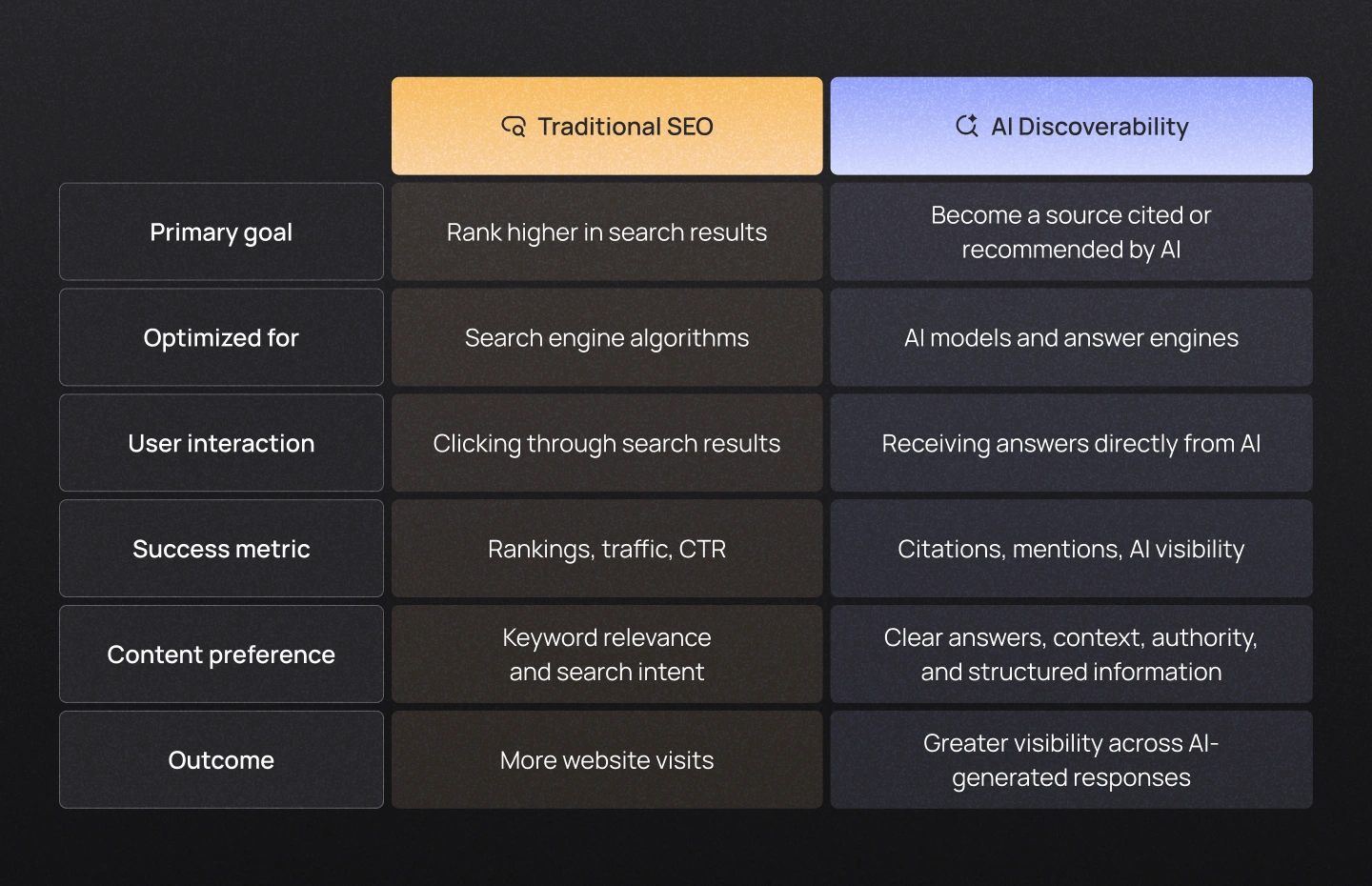
AI discoverability is built on many of the same foundations as SEO, including high-quality content, technical website health, and topical authority. However, the ultimate goal is different.
Traditional SEO focuses on helping users find your website through search results. AI discoverability focuses on helping AI systems understand, trust, and reference your content when generating answers.
Many businesses assume that if their website is visible on Google, it will also be visible across ChatGPT, Perplexity, Google AI Overviews, and Microsoft Copilot. In reality, these platforms do not work the same way, and they often rely on different sources when generating answers.
This is one of the reasons AI discoverability can be difficult to measure. ChatGPT may rarely cite a company that appears frequently in Perplexity responses. Likewise, a website that performs well in Google AI Overviews may not receive the same visibility in other AI platforms.
Some platforms rely heavily on information found directly on company websites, while others place greater emphasis on third-party mentions, review platforms, community discussions, or previously cited content. As a result, 2 AI tools responding to the same question may recommend different companies, reference different articles, and cite entirely different sources.
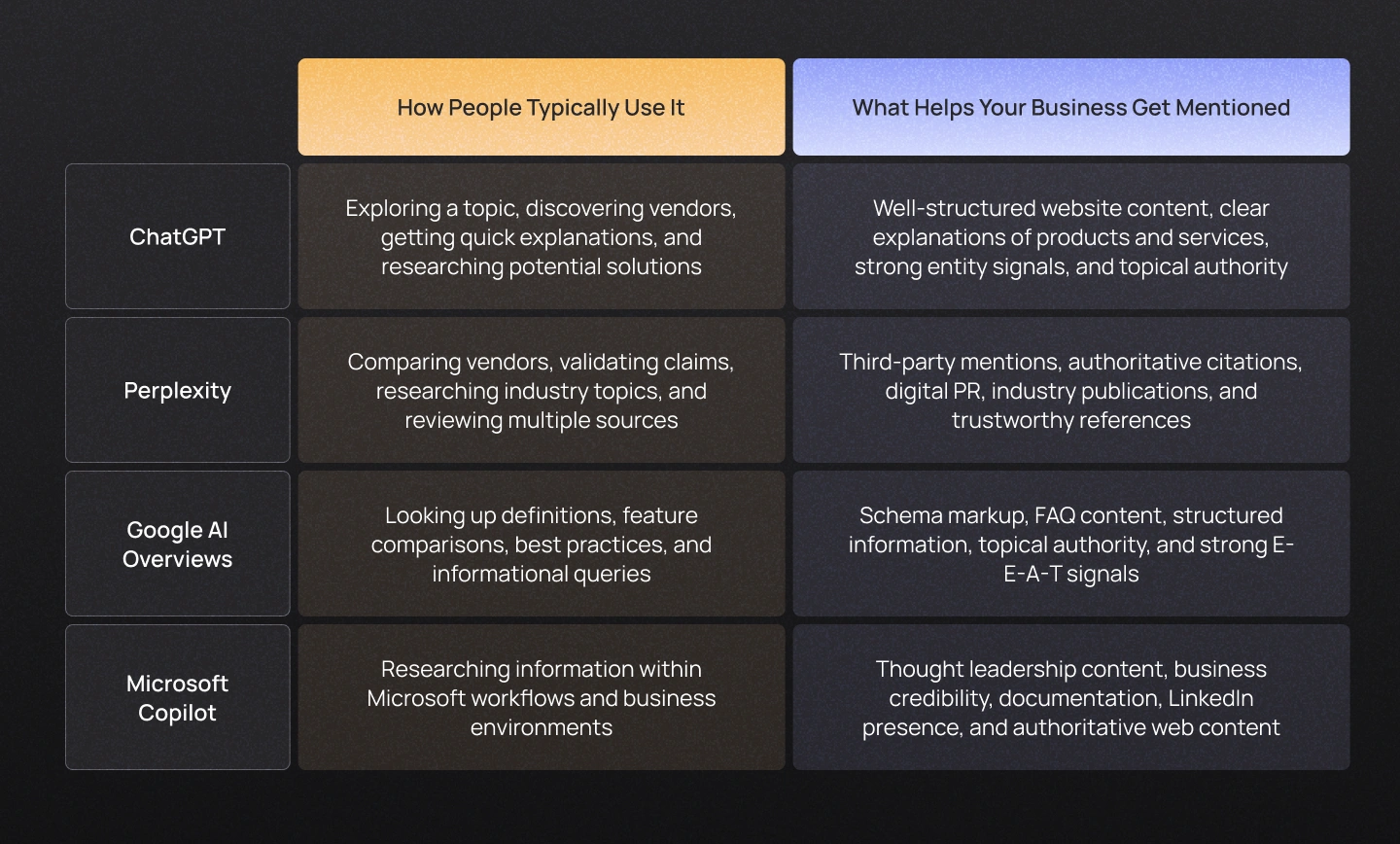
While dozens of AI-powered search and assistant platforms are available today, tools such as ChatGPT, Perplexity, Google AI Overviews, and Microsoft Copilot have emerged as some of the most widely used examples. Although they share similar goals, each platform has developed its own strengths, user behaviors, and approaches to sourcing information. Understanding how people use these tools can help businesses identify the visibility signals that matter most across today’s AI ecosystem.
As AI-powered search becomes more common, businesses need to think beyond rankings and traffic alone. The goal is no longer just to appear in search results. The goal is to become a source that AI systems can confidently understand, trust, and recommend.
This requires a broader approach to digital visibility, including:
Companies that adapt to this shift will be better positioned as more buyers rely on AI platforms to discover, evaluate, and shortlist vendors before ever visiting a website.
Many businesses are investing in AI visibility without fully understanding what makes a website visible to AI in the first place. It’s easy to assume that if a page is published online, AI platforms can automatically read it, understand it, and recommend it to users.
In reality, that’s not how modern AI systems work.
When platforms like ChatGPT, Perplexity, Google AI Overviews, or Microsoft Copilot generate answers, they don’t simply scan a website the same way a human visitor would. Instead, they rely on a combination of technical signals, structured data, content quality, and trust indicators to determine whether a source is worth using.
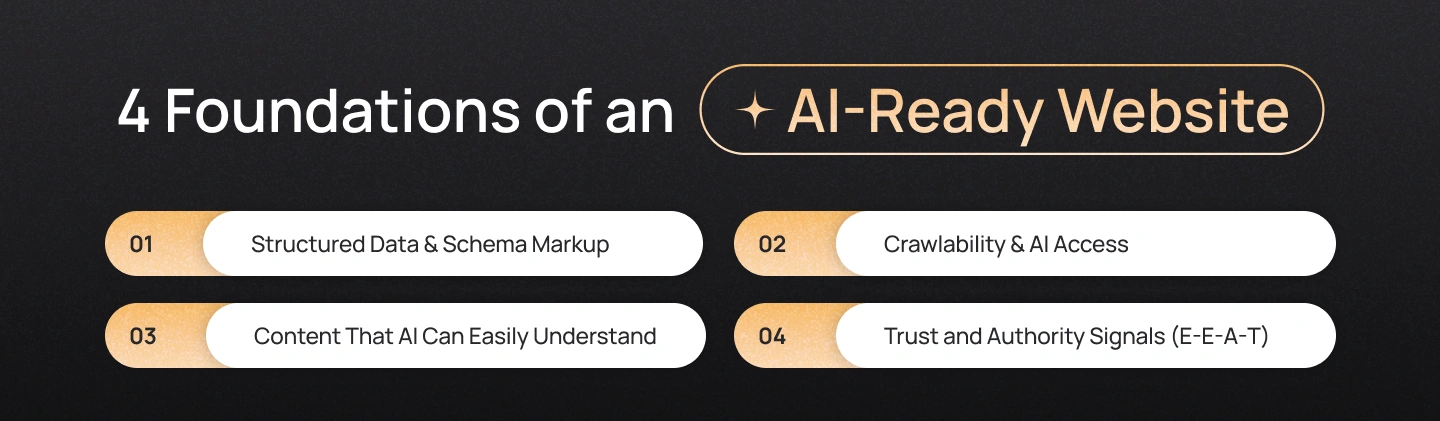
This means 2 websites with similar products or services can have very different levels of AI visibility. One may be frequently cited in AI-generated answers, while the other is rarely mentioned despite ranking well in traditional search. To become AI-ready, businesses need to ensure their websites are easy for AI systems to access, understand, evaluate, and trust.
The 4 areas below form the foundation of AI discoverability:
Imagine visiting a website in a language you partially understand. You might be able to figure out what the company does, but some details would remain unclear. AI systems face a similar challenge when trying to interpret website content.
While AI models have become increasingly capable of understanding natural language, they still benefit from explicit signals that explain what a page is about and how different pieces of information relate to one another. This is where structured data and schema markup become valuable.
Schema markup provides machine-readable context that helps search engines and AI systems understand the purpose of a page. Instead of guessing whether a block of content describes a product, a company, a frequently asked question, or a step-by-step guide, AI can identify that information directly through structured markup.
Common schema types include:
Even the most authoritative content cannot influence AI-generated answers if AI systems are unable to access it. Many organizations focus heavily on publishing content but overlook a more fundamental requirement: discoverability. Before an AI platform can evaluate a page, that page must first be crawled, indexed, and made available for retrieval.
This becomes increasingly important as AI platforms introduce their own web crawlers. Unlike traditional search engines, which primarily rely on Googlebot or Bingbot, today’s AI ecosystem includes crawlers such as GPTBot, PerplexityBot, ClaudeBot, and Google-Extended. Each plays a role in helping AI systems discover and learn about content across the web.
A surprisingly common issue is that websites accidentally block these crawlers through robots.txt rules, security configurations, or overly restrictive hosting settings. When this happens, businesses may unknowingly limit their visibility within AI platforms even though their content remains accessible to human visitors.
Businesses should therefore regularly review:
Another emerging practice is the implementation of llms.txt, a proposed standard that helps AI agents understand which parts of a website are most important and how content should be prioritized.
Although still in its early stages, llms.txt reflects a broader shift: websites are no longer being optimized solely for search engines. Increasingly, they also need to communicate clearly with AI systems.
Having technically accessible content is only part of the equation. Once an AI platform reaches your website, it still needs to determine whether your content contains useful information that can help answer a user’s question. This is where many business websites struggle.
Over the years, corporate content has often been written primarily for marketing purposes. Pages are filled with company-centric messaging, broad claims, and lengthy descriptions of services, but they rarely answer the questions that potential customers are actually asking. While this may work for brand storytelling, it creates challenges for AI systems that are trying to identify clear, factual answers.
Consider the difference between these two approaches:
Example 1: We are a leading digital transformation partner helping organizations accelerate innovation through cutting-edge technology solutions.
Example 2: Digital transformation consulting helps organizations modernize processes, improve operational efficiency, and adopt new technologies to achieve business goals.
The second example gives AI a much clearer understanding of the topic because it provides a direct explanation rather than a marketing statement.
This is why AI-friendly content tends to share several characteristics:
Even if AI systems can access your website and understand your content, there is still one critical question left to answer: Can your business be trusted as a source?
When an AI platform generates a recommendation, it is effectively making a judgment about which information is credible enough to include. To do this, many AI systems rely on signals that help evaluate expertise, authority, and trustworthiness.
This concept closely aligns with Google’s E-E-A-T framework:
For example:
Imagine 2 companies offering the same service. One has detailed case studies, expert-written articles, industry recognition, and references from credible sources. The other provides only marketing copy with little supporting evidence.
Both companies may claim to be experts, but AI systems are far more likely to trust and recommend the first one because there are stronger signals validating its expertise.
This becomes especially important for B2B organizations operating in areas such as cybersecurity, healthcare, finance, legal services, and technology, where credibility often plays a major role in purchasing decisions.
As AI platforms continue to evolve, trust signals are becoming just as important as technical optimization. In many cases, the brands that are cited most frequently are not necessarily the loudest voices online, but the ones that consistently demonstrate expertise and authority.
Many organizations approach AI readiness as a series of isolated tasks: add schema markup, publish more content, update robots.txt, and move on. While each of these activities can help, they rarely produce meaningful results when treated independently.
AI discoverability is ultimately the result of multiple factors working together. A website might have excellent content but poor crawlability. Another may be technically sound but lack the authority signals needed to earn trust. Some businesses publish valuable insights yet make them difficult for AI systems to interpret because of weak structure or unclear messaging.
This is why AI readiness should be viewed as a business capability rather than a technical project.
To improve visibility across AI platforms, organizations need to evaluate how well their website performs across four critical dimensions:
Answering these questions manually often requires reviewing hundreds of pages, technical configurations, content structures, and authority signals. For many businesses, that process can take weeks.
That’s where SPOT by Lollypop helps.
SPOT evaluates your website across key AI-readiness dimensions and identifies the factors most likely to impact your discoverability. Instead of guessing where the gaps are, businesses receive a prioritized roadmap that highlights what needs attention and where improvements can have the greatest impact.
Want to know how AI platforms see your website? Get an AI Readiness Audit from SPOT and uncover the opportunities that could be limiting your visibility across today’s AI ecosystem.

Google’s AI-powered search experience is changing how businesses are discovered online. With the introduction of AI Overviews and Gemini-powered features across Search, Maps, and other Google products, users can increasingly receive answers directly from Google without visiting multiple websites.
This shift means that visibility is no longer determined solely by search rankings. Businesses also need to ensure that Google’s AI systems can accurately understand their products, services, expertise, and brand positioning. If information is unclear, outdated, or difficult to interpret, AI-generated responses may overlook important details or fail to surface the business altogether.
Google’s AI models rely on signals from multiple sources, including your website, Google Business Profile, reviews, and other publicly available content. Together, these sources help Gemini build an understanding of what your company does and when it should be recommended to users.
For businesses, the implication is straightforward: a website can no longer function solely as a marketing asset. It must also serve as a reliable source of information that AI systems can access, understand, and trust.
To improve visibility across Google’s AI ecosystem, businesses should focus on:
The conversation around AI visibility is still in its early stages. While terms such as Generative Engine Optimization (GEO), Answer Engine Optimization (AEO), and Large Language Model Optimization (LLMO) continue to evolve, they all point toward the same reality: businesses need to make their content easier for AI systems to find, understand, and trust.
This shift mirrors the early days of SEO. Companies that invested in search visibility before it became mainstream were able to build authority, earn backlinks, and establish strong organic positions that became increasingly difficult for competitors to replicate later. AI discoverability is beginning to follow a similar pattern.
When an AI platform repeatedly cites a company as a source, that visibility can compound over time. More citations lead to greater exposure, stronger authority signals, and additional opportunities to be surfaced in future responses. As more businesses compete for visibility across AI platforms, earning those trusted positions is likely to become more challenging.
Industry analysts are already recognizing this shift. In its 2026 research, Forrester noted that organizations need to move beyond simply driving traffic through search engine optimization and focus on increasing visibility through answer engines and AI-powered experiences.
The good news is that the fundamentals remain familiar. Businesses do not need to reinvent their digital strategy from scratch. The same qualities that help users trust a website also help AI systems understand and recommend it:
The difference is that these signals are no longer being evaluated only by search engines. Increasingly, they are being evaluated by AI systems that influence how people discover information, compare vendors, and make purchasing decisions.
For businesses that start preparing now, AI discoverability is more than a technical initiative. It is an opportunity to build visibility in a channel that is still developing, before competition becomes significantly more intense.
AI is changing how people discover businesses online. Instead of browsing through pages of search results, buyers can now ask a question and receive a curated answer from platforms like ChatGPT, Perplexity, Google AI Overviews, and Microsoft Copilot.
This shift is creating a new layer of digital visibility. It’s no longer enough for your website to rank well in search engines. Businesses also need to ensure that AI systems can find, understand, and confidently reference their content when generating answers.
The good news is that AI discoverability isn’t about gaming algorithms. The same fundamentals that help people trust your business also help AI understand it: clear content, strong expertise, structured information, and a credible online presence.
At SPOT by Lollypop, we help businesses understand how visible they are across today’s AI ecosystem. Through AI readiness assessments, citation analysis, and actionable recommendations, SPOT helps organizations identify the gaps that may be limiting their visibility in AI-powered search and answer engines.
As AI becomes a larger part of how buyers research, compare, and select vendors, businesses that invest in AI discoverability today will be better positioned to stay visible tomorrow.
AI discoverability is the ability of a business to be found, understood, cited, and recommended by AI-powered platforms such as ChatGPT, Perplexity, Google AI Overviews, and Microsoft Copilot.
While SEO focuses on improving rankings in search engine results pages, AI discoverability focuses on increasing the likelihood that AI systems will reference your content when generating answers. The two disciplines overlap, but strong search rankings alone do not guarantee visibility in AI-generated responses.
Improving AI discoverability starts with making your website easier for AI systems to access, understand, and trust.
Some of the most important steps include:
An AI readiness assessment can help identify which areas require the most attention and where improvements are likely to have the greatest impact.
The most commonly used AI platforms today include ChatGPT, Perplexity, Google AI Overviews, and Microsoft Copilot. Each platform serves a slightly different purpose within the research process.
For example:
Because these platforms do not always surface the same sources, businesses should focus on building visibility across the broader AI ecosystem rather than optimizing for a single platform.
Yes. Google’s AI-powered search experience is changing how users interact with search results.
Features such as AI Overviews can provide answers directly within Google, which means users may gather information before visiting a website. At the same time, Google’s AI systems increasingly rely on information from websites, Google Business Profiles, reviews, and other public sources to understand and represent businesses.
This makes it more important than ever to maintain accurate information, publish clear content, and structure your website in ways that AI systems can easily interpret.
No. AI discoverability matters for businesses of all sizes.
Whether you’re a startup, SaaS company, consulting firm, agency, or enterprise organization, AI platforms can influence how potential customers discover and evaluate your business. Companies that establish strong AI visibility early may gain an advantage as more research and buying journeys begin through AI-powered experiences rather than traditional search alone.