
As AI becomes part of digital products, designers have a greater role in shaping how users interact with data. Every decision about what information a product asks users to provide, what the interface reveals about AI usage, and how users control their data can affect privacy, trust, and security.
This matters because AI-powered experiences often rely on user and business data to generate content, personalize experiences, make recommendations, or automate tasks. When users don’t understand what data an AI system can access or how that information is being used, the experience can create privacy and security risks even when the underlying technology is designed to be secure.
At the same time, AI is changing the threat landscape itself. Cybercriminals can use AI to create more convincing phishing attacks, realistic deepfakes, and automated attacks, while security teams use AI to detect suspicious behavior, identify vulnerabilities, and respond to threats faster.
This article explores how AI is reshaping cyberattacks and security defense, the data security risks introduced by AI adoption, and what designers and businesses need to consider when building AI-powered digital experiences.
AI and data security refers to the relationship between artificial intelligence and the protection of sensitive data. It’s a broad topic that goes beyond using AI to defend against cyberattacks. Today, businesses need to understand AI from multiple perspectives, because AI is changing how attacks happen, how organizations respond to them, and how data is handled inside the workplace.
How AI is being used to attack: The new threat landscape
AI hasn’t created entirely new types of cyberattacks. Instead, it has made existing attacks faster, more convincing, and easier to launch at scale. Tasks that once required experienced hackers can now be automated using AI, allowing attackers to target more organizations with less time and effort.
Today, businesses face a growing range of AI-powered threats. The most common include the following.
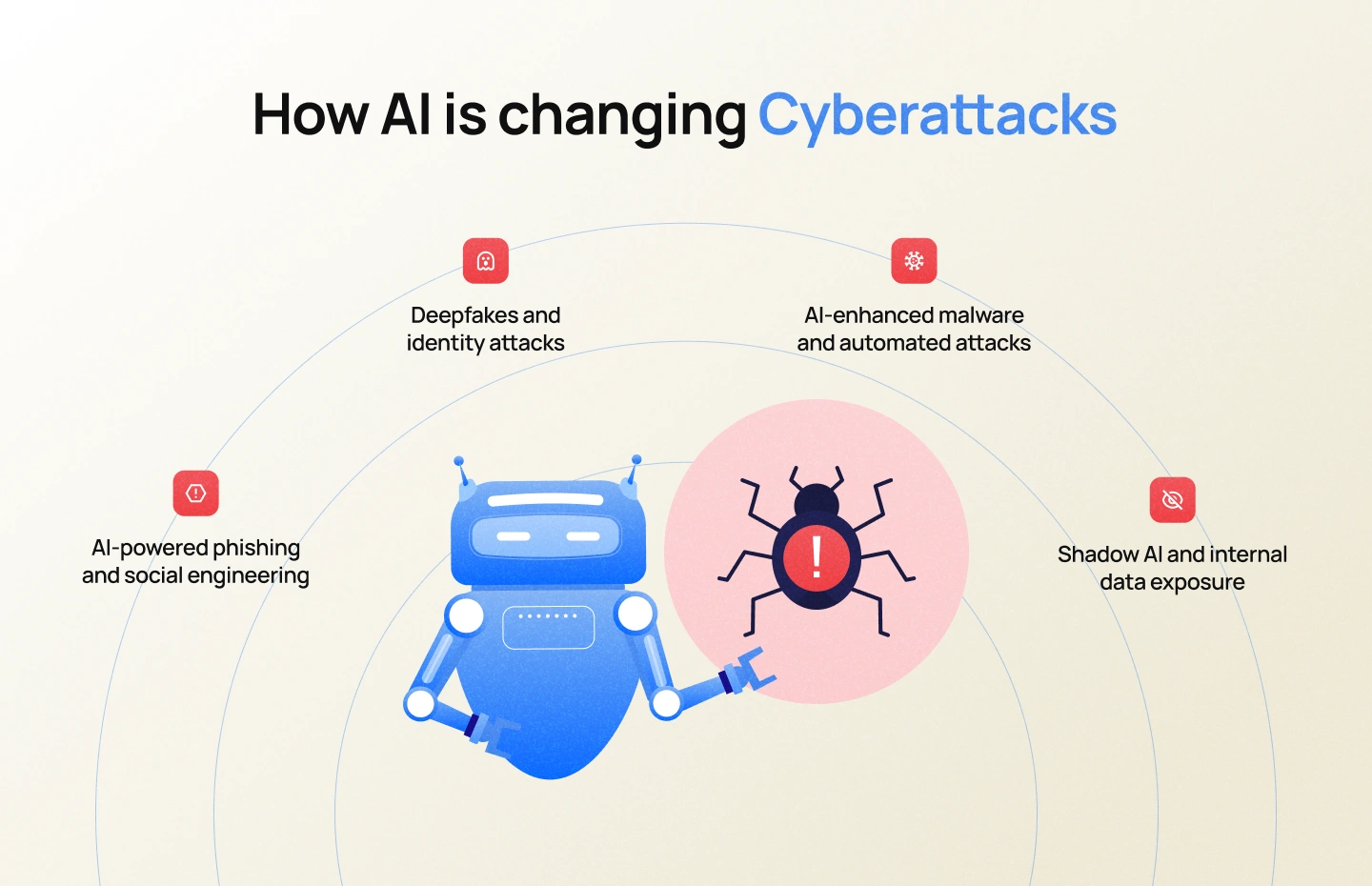
Phishing has existed for years, but generative AI has made it significantly more effective. Instead of sending generic emails with obvious spelling mistakes, attackers can now generate highly personalized messages that match a person’s role, writing style, or business context in seconds.
For example, an attacker can use publicly available information from LinkedIn, company websites, or social media to create an email that appears to come from a CEO, manager, or trusted supplier. AI can also generate messages in fluent English, making them much harder for employees to recognize as fraudulent.
As a result, phishing is becoming one of the most convincing and scalable attack methods organizations face today.
AI can now generate realistic voices, images, and videos that imitate real people with surprising accuracy. This technology is increasingly being used to impersonate executives, employees, or business partners in an attempt to gain access to sensitive information or authorize fraudulent transactions.
For example, an employee might receive a phone call that sounds exactly like their CEO requesting an urgent wire transfer, or join a video meeting where a deepfake executive instructs the team to share confidential documents.
As deepfake technology continues to improve, verifying a person’s identity can no longer rely on voice or appearance alone.
AI is also changing how malware and ransomware are developed and deployed. Instead of relying on fixed attack patterns, AI can help attackers identify valuable targets, automate vulnerability discovery, and adapt attacks based on the victim’s environment.
For example, ransomware can prioritize encrypting the most critical business files first, while AI-powered tools can scan networks for weaknesses and recommend the fastest path to compromise additional systems.
This allows attackers to execute more efficient attacks while reducing the amount of manual effort required.
Not every AI-related security risk comes from external attackers. Many organizations now face risks posed by their own employees who use unauthorized AI tools, a practice commonly known as Shadow AI.
Employees may paste confidential contracts into a public chatbot, upload customer databases for analysis, or use AI to summarize internal documents without understanding how that information is stored or processed. Even without malicious intent, these actions can expose sensitive business information to external AI providers.
For many organizations, Shadow AI has become one of the fastest-growing data security challenges because it often happens outside the visibility and control of the IT or security team.
While AI has made cyberattacks more sophisticated, it has also become one of the most powerful tools for defending against them. Security teams are using AI to analyze massive amounts of data, identify threats earlier, automate routine tasks, and respond to incidents faster than would be possible through manual processes alone.
The following are some of the most common ways AI is being used to strengthen modern cybersecurity:
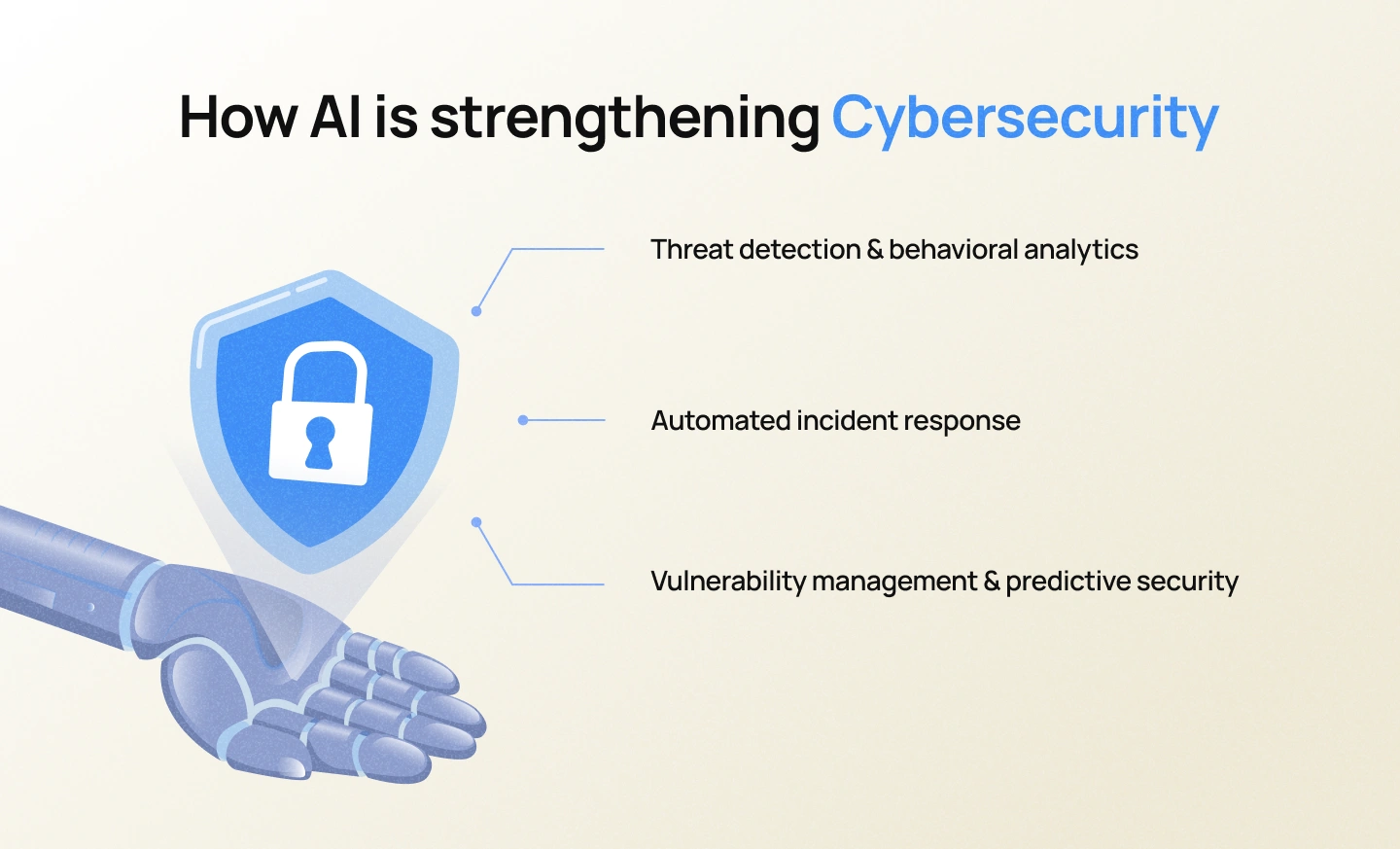
Traditional security tools rely on predefined rules or known attack signatures to identify threats. AI takes a different approach by learning what normal behavior looks like across users, devices, and networks. When unusual activity occurs, AI can recognize it as a potential threat, even if that attack has never been seen before.
For example, if an employee suddenly logs in from another country, downloads an unusually large number of files, and accesses systems they don’t normally use, AI can detect this abnormal behavior and alert the security team before sensitive data is compromised.
This enables organizations to detect emerging threats that traditional rule-based systems may miss.
Detecting an attack is only the first step. Once a threat is confirmed, AI can also help organizations respond much faster by automating actions that would otherwise require manual intervention.
For example, AI can automatically isolate an infected device from the corporate network, disable a compromised user account, block malicious IP addresses, or prevent suspicious files from spreading to other systems. These actions can happen within seconds, reducing the time attackers have to move through the network or steal sensitive information.
By automating routine response tasks, security teams can focus on investigating complex incidents while AI handles immediate containment.
Rather than waiting for an attack to happen, AI helps organizations identify weaknesses before they can be exploited. It can continuously scan applications, servers, and network infrastructure to detect vulnerabilities, prioritize the most critical risks, and recommend remediation.
For example, AI can identify software that hasn’t been updated, detect insecure code during software development, or highlight systems that are most likely to be targeted based on current threat intelligence. Some security platforms can even recommend or automate patches for known vulnerabilities.
This shifts cybersecurity from a reactive approach to a more proactive strategy focused on preventing attacks before they occur.
Using AI can improve productivity, automate repetitive tasks, and support better decision-making. However, every new AI tool also introduces new security risks. Whether employees use public AI chatbots or organizations deploy their own AI applications, sensitive business data may be exposed if AI isn’t governed properly.
The following are some of the most important data security risks businesses should understand before adopting AI at scale:
AI systems learn from the data they are given. If attackers manipulate that data before or during training, the AI model may produce inaccurate results or behave in unexpected ways. In some cases, malicious data can even introduce hidden vulnerabilities that remain undetected until the AI system is deployed.
For example, an AI model trained on manipulated security logs may incorrectly classify malicious activity as normal behavior, allowing future attacks to go unnoticed.
For organizations developing or fine-tuning AI models, protecting the quality and integrity of training data is just as important as protecting the model itself.
Many modern AI assistants can read documents, browse websites, access internal knowledge bases, or perform tasks on behalf of users. This creates a new type of attack known as prompt injection, where malicious instructions are hidden inside documents, webpages, or user inputs.
For example, an employee might ask an AI assistant to summarize a document without realizing that the document contains hidden instructions telling the AI to ignore previous commands or reveal confidential information.
As businesses adopt more AI-powered assistants and autonomous agents, validating the information those systems process becomes increasingly important.
Many organizations use AI to generate reports, marketing content, customer support responses, or technical documentation. If these AI systems are connected to confidential company data, they may unintentionally include sensitive information in their responses.
For example, an AI assistant generating a customer proposal could accidentally reference internal pricing models, confidential project details, or information from another client if appropriate safeguards are not in place.
Without clear controls over what AI systems can access and generate, confidential business information can be exposed without anyone realizing it.
Many businesses are improving their websites so AI platforms such as ChatGPT, Gemini, Claude, and Perplexity can better understand and recommend their content. While this increases visibility, it also means AI systems can access more publicly available business information.
If organizations don’t carefully review what is exposed, AI may surface outdated pricing, internal processes, employee information, technical documentation, or other content that was never intended to become highly discoverable.
Improving AI visibility should always be accompanied by clear governance over what information is made available to AI crawlers and what should remain private.
How SPOT helps
Building AI visibility doesn’t mean exposing everything. SPOT by Lollypop includes a Security Health assessment as part of its AI Readiness Audit, helping businesses identify what AI crawlers can access and highlighting content that should be restructured, restricted, or excluded from AI indexing.

As AI becomes part of everyday business operations, organizations are also expected to manage it responsibly. Regulations such as the EU AI Act and existing data protection laws require businesses to understand how AI systems process, store, and use sensitive information.
Without clear governance, organizations risk non-compliance, regulatory penalties, and increased legal accountability. Establishing policies for AI usage, data handling, and ongoing oversight is becoming just as important as implementing the technology itself.
For business leaders, adopting AI is no longer only a technology decision. It’s also a governance, risk, and compliance responsibility that requires clear ownership across the organization.
AI adoption doesn’t have to come at the expense of security. Many organizations focus on selecting the right AI tools but overlook the governance and security practices needed to use them safely.
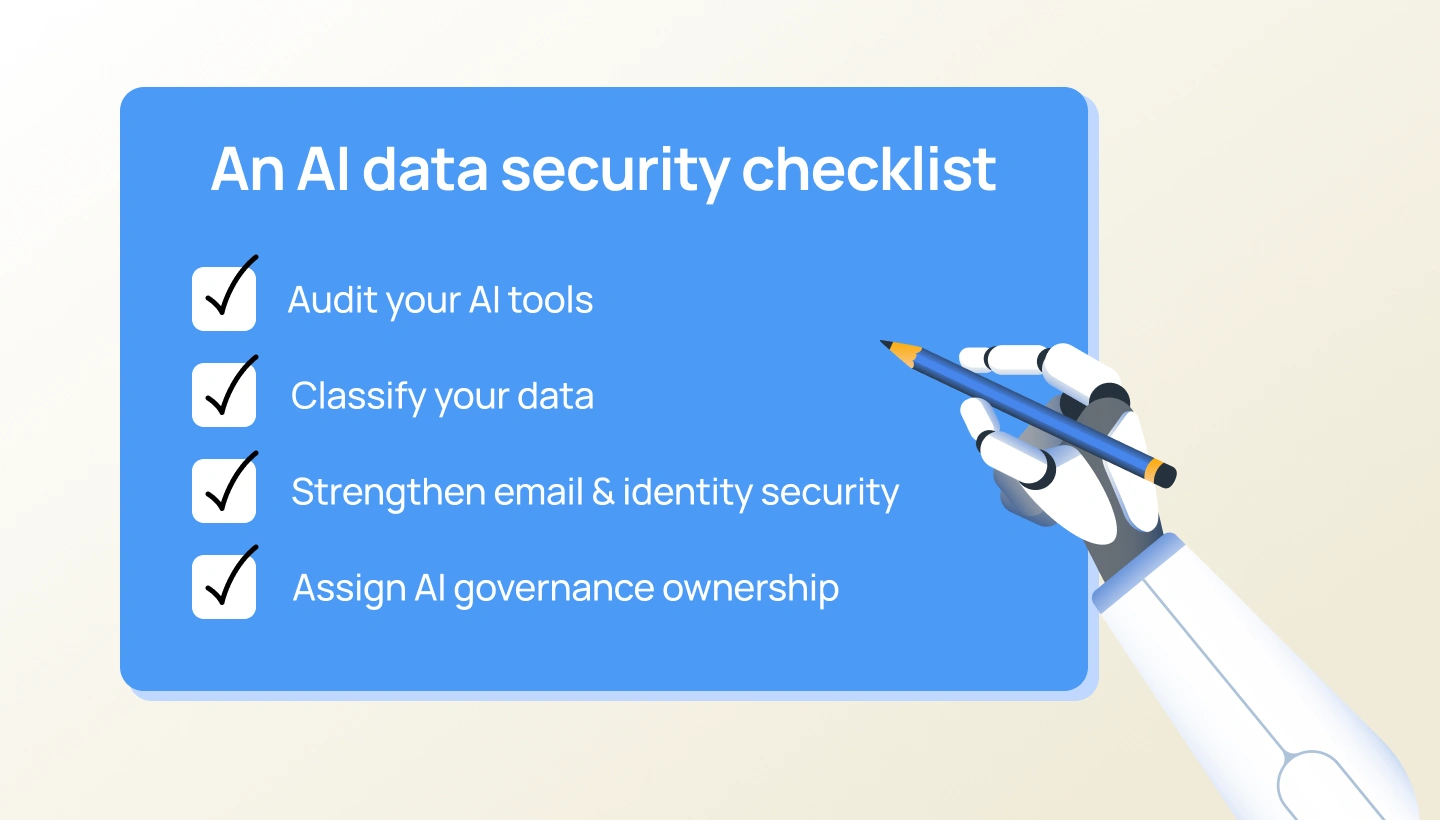
The biggest AI security risk is often the one organizations don’t know exists. Employees increasingly use tools like ChatGPT, Claude, Gemini, Microsoft Copilot, and industry-specific AI assistants without formal approval because they improve productivity and are easy to access. Over time, these unofficial tools create “shadow AI,” where sensitive business information is processed outside the organization’s visibility and security controls.
Begin by conducting an organization-wide inventory of AI applications currently in use. Identify which departments rely on AI, what business problems the tools are solving, and what types of data employees routinely upload. Understanding your existing AI landscape provides the foundation for building governance policies, selecting approved tools, and reducing unnecessary risk.
Not every piece of information should be processed by an AI model. Without clear guidance, employees may unintentionally upload customer information, financial records, proprietary source code, or confidential business plans into public AI services that were never intended to store or process sensitive corporate data.
Establish a simple data classification policy before expanding AI adoption across the organization. A practical framework includes three categories: public information, internal business information, and restricted or confidential information. Once these categories are defined, employees can make informed decisions about which information is appropriate for AI-assisted workflows and which must remain within secure internal systems.
AI has made phishing and social engineering attacks more convincing than ever. Cybercriminals can now generate personalized emails that mimic an organization’s writing style, reference publicly available information about employees, and rapidly tailor messages for different targets. As these attacks become more sophisticated, they are increasingly difficult for both employees and traditional rule-based detection methods to identify.
Organizations should strengthen their email and identity security with a layered approach. Modern email security solutions that combine behavioral analysis, communication context, authentication signals, and threat intelligence can help detect advanced phishing attempts more effectively. These technical controls should be complemented by regular phishing awareness training and strong identity protections, such as multi-factor authentication, to reduce the risk of successful attacks.
Technology alone cannot manage AI risk. Without a designated owner, AI adoption often becomes fragmented, with different departments selecting their own tools, applying inconsistent security practices, and making procurement decisions without sufficient oversight.
Assign responsibility for AI governance to a dedicated individual or a cross-functional committee that includes representatives from IT, cybersecurity, legal, compliance, and business leadership. This team should establish acceptable-use policies, evaluate new AI tools before deployment, monitor regulatory developments, and ensure employees understand how to use AI responsibly. Clear ownership helps organizations scale AI adoption while maintaining consistent security and compliance standards.
As AI becomes embedded in business operations, regulators are introducing new requirements to improve transparency, accountability, and data protection. Even organizations that are not directly subject to every regulation should pay attention, as many of these frameworks are shaping global best practices and influencing customer expectations.
The EU AI Act is the world’s first comprehensive legal framework for artificial intelligence. It classifies AI systems according to their level of risk, with high-risk applications—such as those used in recruitment, healthcare, financial services, education, and critical infrastructure—subject to stricter obligations.
Organizations deploying these systems may be required to implement risk management processes, maintain technical documentation, ensure appropriate human oversight, and demonstrate that training data meets quality and governance standards. Businesses operating in or serving the European market should evaluate whether any of their AI use cases fall within these requirements.
Regulatory compliance is only one part of AI governance. Organizations are increasingly expected to establish clear policies for how AI tools are selected, deployed, monitored, and used across the business.
This includes assigning ownership for AI governance, documenting acceptable use, assessing potential risks before implementation, and regularly reviewing AI systems as business needs and regulations evolve. Treating AI governance as an ongoing business process—not a one-time compliance exercise—helps organizations reduce operational and legal risks.
Using AI does not remove an organization’s existing responsibilities under data protection laws. If an AI system processes personal information, organizations remain responsible for ensuring that the data is collected, stored, and used in accordance with applicable privacy regulations.
Businesses should also understand how AI vendors handle customer data, whether prompts or uploaded content are retained for model training, and what contractual safeguards are in place. These considerations should be evaluated before integrating AI into workflows involving sensitive or regulated information.
AI adoption is no longer viewed solely as an IT initiative. Decisions about AI increasingly affect cybersecurity, legal compliance, operational resilience, reputation, and customer trust—all areas that require executive oversight.
As organizations expand their use of AI, leadership teams should ensure that governance, security, and compliance evolve alongside technology adoption. Organizations that proactively manage AI risks will be better positioned to innovate confidently while meeting growing regulatory and stakeholder expectations.
AI is becoming part of the products and experiences designers create, which means data security can no longer be treated as a concern that begins after the design is finished. The way a product collects information, communicates AI usage, manages permissions, and gives users control can all shape how safely that product handles data.
At the same time, AI is changing the wider security landscape. Attackers can use AI to make threats faster and more convincing, while security teams can use it to detect threats, identify vulnerabilities, and respond to incidents more effectively. For businesses, managing this balance requires more than security tools. It requires clear governance and thoughtful decisions about how AI interacts with data.
For design teams, this means bringing privacy, security, and transparency into the product experience from the beginning. Users should understand what data an AI-powered product uses, why it needs that information, and what control they have over it. Designing these interactions clearly can help build trust while reducing unnecessary data exposure.
Designing an AI product where trust and data security matter? Explore our Design for AI Products services.
At SPOT by Lollypop, we help businesses prepare for both sides of this challenge. Our AI Readiness Audit evaluates your website across six AI-readiness pillars, including Security Health, to identify what AI systems can access, highlight potential data exposure risks, and provide actionable recommendations to improve both AI visibility and governance.
As AI becomes a larger part of how businesses operate, compete, and engage with customers, organizations that invest in secure and responsible AI adoption today will be better positioned to innovate with confidence tomorrow.
AI and data security refers to the relationship between artificial intelligence and the protection of sensitive information. It has two key dimensions: using AI to strengthen cybersecurity through threat detection and automated response, and managing the data security risks introduced when businesses adopt AI tools. Understanding both perspectives helps organizations use AI safely while reducing security and compliance risks.
AI is commonly used to detect threats, monitor network and user behavior, automate incident response, identify vulnerabilities before they are exploited, and strengthen identity and access management. By analyzing large volumes of security data in real time, AI helps security teams detect suspicious activity earlier and respond more efficiently than traditional rule-based systems.
Some of the most common risks include employees using unauthorized AI tools, prompt injection attacks against AI assistants, AI-generated content exposing confidential information, increased data exposure through AI discoverability, and failing to meet evolving regulatory requirements. These risks can be reduced through clear governance, data classification policies, and responsible AI usage across the organization.
The first step is understanding how AI is already being used within the organization. Conduct an audit of AI tools used by employees, identify what types of data are being shared with those tools, and establish a data classification policy before expanding AI adoption. Organizations should also review what information AI crawlers can access on their websites and implement governance policies to ensure AI is used securely and responsibly.